What you'll get
International Payment Platforms for Digital Product Creators
Compare international payment platforms for digital products, fees, payouts, eligibility, and tax roles for a US LLC owner living abroad.

Founder & Editor

A US LLC does not by itself answer whether a payment provider will accept an owner who lives abroad. For creators selling courses, memberships, or downloads worldwide, Whop is built around digital products, Stripe offers flexible payment and subscription tools, Airwallex combines payments with multi-currency financial features, PayPal can serve as a checkout option, and Adyen is positioned for larger operations. Start by checking your actual residence and payout route. Our payment processor options research compares platforms by use case and effective cost.
International fees are only part of the decision. Payout timing, currency conversion, local payment methods, account eligibility, and who is responsible for applicable taxes can affect what you keep and how you operate. The Financial Stability Board’s 2024 cross-border report treats cost, speed, transparency, and access as separate challenges. For a creator abroad, that means checking the specific customer and payout corridors you use, rather than relying on a broad claim of global coverage.
Key takeaways for creators selling across borders
- Check whether the provider accepts both your LLC and the owner’s actual country of residence before building a checkout around it.
- Whop focuses on digital products and communities, while Stripe offers payment and subscription tools for businesses that need more control over checkout.
- Airwallex combines online payment acceptance with multi-currency business features, so assess both the payment fee and the cost of moving or converting funds.
- PayPal can be considered as a familiar checkout option, but include its international transaction and currency conversion charges in your cost estimate.
- Adyen is positioned for businesses with more complex payment needs, so assess whether its implementation and commercial terms suit a creator-led operation.
How do the platforms compare at a glance?
- Compare like with like: A card rate, a wallet checkout rate, and a negotiated acquiring agreement are not interchangeable fee measures.
| Platform | Digital product fit | Published fee signal | What to verify first |
|---|---|---|---|
| Airwallex | Online payments alongside multi-currency accounts and other financial operations. | Airwallex’s US pricing page lists 2.80% + $0.30 for domestic cards and 4.30% + $0.30 for international cards. | Check which payment methods and settlement currencies apply to your business and customer corridors. |
| Whop | Designed around digital products, courses, memberships, and communities. | Whop’s published payment documentation lists a base card rate of 2.7% + $0.30 per transaction. The effective percentage depends on the sale amount and any additional applicable charges. | Confirm owner residence eligibility, payout options, and any cross-border or conversion charges. |
| Stripe | Payment acceptance and subscription tools for businesses that want configurable checkout. | Stripe’s US pricing page lists 2.9% + $0.30 for domestic card payments, with additional charges for international cards and currency conversion when applicable. | Check account eligibility, the full international fee stack, and payout availability for your setup. |
| PayPal | A payment option for digital sales where buyers prefer PayPal checkout. | PayPal’s US merchant fee schedule, updated October 1, 2026, lists 3.49% + $0.49 for PayPal Checkout domestic transactions, with an additional 1.50% for international commercial transactions. | Check currency conversion, withdrawal options, and the fee for the specific PayPal product you plan to use. |
| Adyen | Online payments for businesses with more complex or larger-scale requirements. | Non defini pour le moment. Request a written offer for your payment methods and markets. | Confirm onboarding requirements, implementation scope, and whether the commercial terms fit your volume. |
These fee examples describe different products and transaction types, so they are not a universal ranking of cheapest to most expensive. For a fair estimate, compare the same payment method, customer location, sale currency, payout currency, and refund assumptions. Include any subscription, payout, or conversion charges that apply to your account.
Airwallex
- Best for: Digital businesses that want to consider payment acceptance together with currency management and business finance operations.
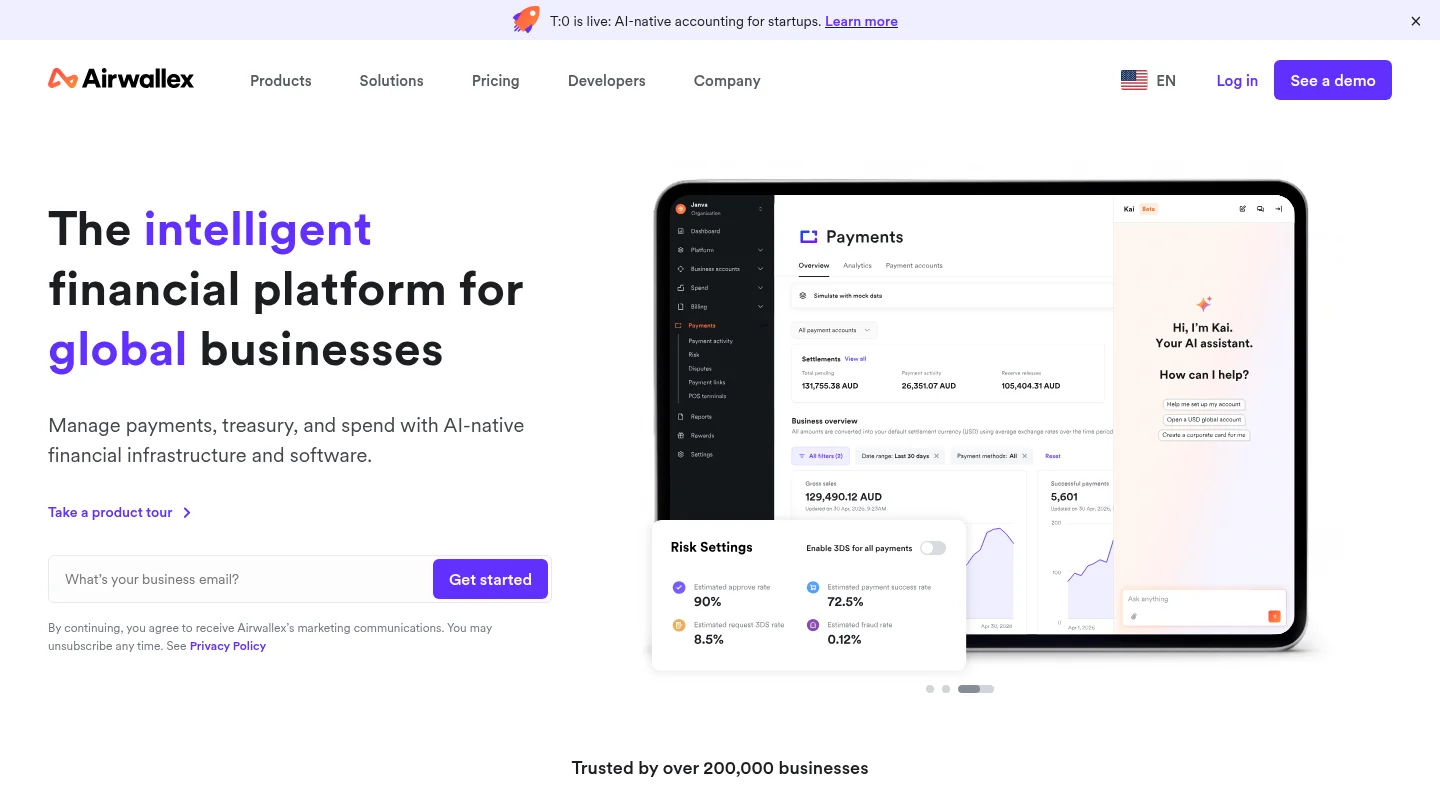
Airwallex is worth evaluating when the LLC needs more than customer checkout, especially if the business also manages balances or transfers across currencies. Its US pricing page lists card processing at 2.80% + $0.30 for domestic cards and 4.30% + $0.30 for international cards. The same pricing page describes local payment methods and recurring subscription support, while other charges can depend on the selected method or service. Compare the actual methods your customers use and the route by which you plan to receive proceeds.
Its broader financial toolkit can be useful if it consolidates tasks the business already handles elsewhere. That breadth is not automatically an advantage for a creator who only needs a checkout page and recurring billing. Verify eligibility for the owner’s country of residence, available payout routes, and the conversion treatment for each currency you expect to collect or withdraw.
Pros:
- It combines payment acceptance with multi-currency financial features that may be relevant to a business operating across countries.
- Its public US pricing separates domestic and international card rates.
Cons:
- The international card rate is higher than its domestic card rate, before any other applicable costs.
- A creator who needs only digital product checkout may not need the wider financial operations toolkit.
Whop
- Best for: Creators selling digital products, memberships, or community access who want product and payment functions in one place.
Whop is the most directly aligned option here for a creator whose offer is a course, membership, downloadable resource, or paid community. Its product model is built around digital sales, and its payment documentation lists a base card fee of 2.7% + $0.30 per transaction. That rate is roughly 3% on larger tickets, but the fixed charge makes the effective percentage higher on smaller sales. Check the full fee breakdown for the payment method and currency you expect customers to use.
Pros:
- Its digital-product and community orientation is a closer fit for creator offers than a general-purpose business payment account.
- One platform can bring product access and payment operations together, reducing the need to assemble separate tools for every customer interaction.
Cons:
- Confirm the precise payout and account eligibility rules for an owner living abroad before making it your only payment route.
- Its base card rate does not establish the total cost for every international payment or currency conversion.
Stripe
- Best for: Creators who need configurable checkout, recurring billing, or a payment setup that can connect to other systems.
Stripe suits businesses that want to shape the checkout experience and manage subscriptions through payment infrastructure. Its US pricing page lists a domestic card rate of 2.9% + $0.30, with an additional 1.5% for international cards and 1% when currency conversion is required. Those additions matter when customers pay in currencies different from the LLC’s settlement currency. Model the combined cost using your likely customer mix rather than treating the domestic headline rate as the total.
For an owner abroad, verify eligibility using the actual LLC, beneficial owner, residence, and payout details. Do not assume that forming a US company resolves every account-country or verification question. Stripe’s flexibility is useful when it matches the business’s technical and subscription needs, but it is less of an all-in-one digital product and community destination than a creator-focused platform.
Pros:
- It provides payment and recurring billing capabilities for businesses that need more control over how checkout works.
- Its public pricing identifies separate charges for international card acceptance and required currency conversion.
Cons:
- The total cost rises when international-card and currency-conversion charges apply.
- Confirm account eligibility and payout arrangements for the owner’s residence before relying on it as the sole processor.
PayPal
- Best for: Creators who want to offer PayPal as an additional checkout choice to customers who prefer that wallet.
PayPal can work as a payment option alongside a primary processor, particularly when buyers recognize and prefer its checkout. For US PayPal Checkout accounts, the merchant fee schedule lists a domestic commercial rate of 3.49% + $0.49 and adds 1.50% for an international commercial transaction. Currency conversion can add another cost, so do not treat the international surcharge as the whole cross-border expense. PayPal also has different fees for different payment products, which makes it important to compare the specific method you intend to activate.
PayPal is best assessed as one part of the checkout mix, not automatically as the platform that manages the whole creator business. Confirm what happens when funds are withdrawn or converted into the currency you actually use. If you compare it with card processing elsewhere, compare the same transaction type and include the fixed fee.
Pros:
- It gives buyers who prefer PayPal a familiar way to pay for eligible digital offers.
- Its US merchant fee schedule distinguishes domestic and international commercial transactions.
Cons:
- International transaction and currency conversion charges can increase the cost beyond the domestic checkout rate.
- It does not replace the need to select a product delivery, membership, or course-access system.
Adyen
- Best for: Larger digital businesses with complex payment operations and the capacity to assess a more involved provider relationship.
Adyen offers online payment infrastructure and positions its platform for businesses operating at global scale. That makes it a possible fit for a creator business that has grown into a more complex operation, but its scope may exceed what a solo seller needs. The available information here does not establish a single standard fee for this setup. Request a written proposal that explains processing, payment-method, currency, payout, and any recurring costs for the LLC’s exact use case.
Do not select Adyen based on broad international coverage alone. A larger footprint is valuable only if the provider supports your target markets, the specific digital products you sell, your residence and entity details, and your integration needs. For a small creator, compare the effort and terms of onboarding against a simpler option before proceeding.
Pros:
- Its global payment infrastructure is relevant to businesses with more complex payment requirements.
- It can be considered when payment acceptance needs to scale beyond a straightforward creator checkout.
Cons:
- Its fit for a solo creator is less direct than platforms built around digital products and memberships.
- Obtain account-specific commercial terms before estimating costs or comparing it with public flat-rate pricing.
What changes when the LLC owner lives abroad?
- Check both sides of the account: The company’s US formation and the owner’s actual residence are separate details to verify.
Before applying, confirm the provider’s current onboarding rules for the business entity, its owners, the owner’s residence, and the bank account that will receive payouts. Keep the LLC name, tax details, ownership information, product description, and payout account records consistent. If an application requests evidence of the business, describe the real digital products and customer journey clearly. A US registration is not a substitute for satisfying an individual provider’s verification process.
There is also a distinction between payment processing and the seller’s legal and tax role. A payment service provider generally processes payments while the business remains the seller; a Merchant of Record arrangement can take on the legal seller role and specified tax responsibilities. Read the relevant contract rather than assuming that a platform handles VAT, sales tax, GST, refunds, or chargebacks just because it supplies checkout. For a single-member LLC, the IRS LLC classification guidance explains that federal tax classification can differ from the LLC’s state-law form. Ask a qualified tax professional about obligations that apply to your ownership and residence situation.
How should you choose a processor for digital products?
- Start with the offer and corridor: Match the product type, customer locations, payment method, and payout currency before comparing headline rates.
Make a short list of your actual payment needs. Separate one-time downloads from subscriptions, courses from paid communities, and card payments from local methods. Then identify where customers live, which currencies they use, and where proceeds need to land. Our list of payment processors can help broaden an initial shortlist, but only providers that accept your exact business and owner setup belong in the final comparison.
Next, calculate the effective transaction cost, not just the advertised card rate. Add fixed charges, international card surcharges, currency conversion, subscription fees, payout charges, and any payment-method fees that apply. For example, if the processor collects in euros but the LLC needs dollars, check whether conversion happens automatically, whether funds can be held in euros, and what rate and fee are used. The Financial Stability Board’s framing is useful here: cost, speed, transparency, and access are distinct dimensions, so record each separately for every important corridor.
Then decide whether you need a processor or a Merchant of Record. If you want the business to remain the direct seller, verify how the provider processes payments and what obligations stay with the LLC. If you expect a third party to take the seller role and specified tax responsibilities, confirm those terms in writing. Our overview of third-party payment processors explains the distinction. Also check whether the platform handles access to a course or community, or whether you need a separate service to deliver the product after payment.
Finally, consider the local checkout methods customers actually use. Cards and wallets are not equally available or preferred in every country, and adding methods can change both cost and reconciliation. For digital sellers comparing regional checkout approaches, our guide to payment options for international ecommerce offers another comparison point. Keep the scope focused on your digital offer, then test checkout, refunds, subscription renewal, and payout reporting before routing all sales through a new provider.
What should you check before sending live traffic?
- Test the whole payment path: A successful checkout is only one step in getting paid reliably.
Run a small, controlled test using the payment methods and currencies that matter to your business. Confirm what the customer sees at checkout, which currency appears on the receipt, how a refund is initiated, and how the payout is recorded. Review the account’s terms for reserves, reviews, holds, and dispute handling. Keep a second viable payment route where it makes business sense, but do not split transactions across providers without knowing how that affects reporting and customer support.
Protect customer card data by using the provider’s supported checkout tools and understanding your own responsibilities. The PCI Security Standards Council’s merchant guidance for card data explains that e-commerce channels handling card details need appropriate protection and assessment. A processor can reduce the systems you operate directly, but it does not automatically remove every security obligation from the merchant.
Verdict: match the platform to your real setup
For a US LLC owner living abroad who sells courses, memberships, or downloads, Whop is the most direct starting point when its product and access model fits the offer and its eligibility rules fit the owner. Stripe suits a creator who prioritizes checkout control and subscription tools. Airwallex is worth considering when multi-currency financial operations matter alongside payment acceptance. PayPal can serve as an additional checkout option, while Adyen is more appropriate to assess when payment operations become complex. Before choosing, verify residence eligibility, total fees by corridor, payout terms, and the contract’s treatment of seller and tax responsibilities. The strongest international payment platforms choice is the one that fits both the digital product and the person who owns the account.
Compare the costs behind cross-border payouts
For creators abroad, a checkout rate is only part of the decision. Currency conversion, payout availability, account reviews, and the seller’s tax responsibilities can change whether a platform works in practice. Check the provider’s terms against the country where you live, the LLC’s details, and the currencies you need to receive.

Our editorial comparisons use test accounts, official documentation, fee analysis across relevant cost categories, and use-case-specific criteria. We disclose affiliate relationships, do not use vendor-paid placement, and revisit articles quarterly. If Whop is on your shortlist, read our guide to Whop’s multi-currency payouts before settling on a payout route.
Frequently Asked Questions
Does having a US LLC guarantee approval from an international payment platform?
No. The provider may assess the business, its owners, the owner’s residence, the product, and the payout account under its own onboarding rules. Confirm eligibility using your actual details before relying on a platform.
Is a payment processor the same as a Merchant of Record?
No. A processor handles payment transactions, while a Merchant of Record takes the legal seller role and specified tax responsibilities under its agreement. Read the contract to see which responsibilities remain with your LLC.
Should I use one platform or more than one?
One platform can simplify checkout and reconciliation if it fits your products, customers, and payouts. A second option can provide a fallback or another preferred payment method, but adds operational work and requires clear reporting.
Are the fees the same for every customer country?
No. International card charges, payment-method pricing, and currency conversion can affect the total. Compare fees for the specific customer countries, currencies, and payout route you expect to use.
Can PayPal replace a digital product platform?
PayPal can provide a way to collect payment, but a creator may still need a separate tool to deliver courses, downloads, or community access. Check the full customer journey, from checkout through product delivery and refunds.
Keep reading
Browse all guidesBlog
FastSpring vs Paddle for Software Distribution: 2026 Guide
Blog
Best Payment Processor for Online Courses in 2026 for Creators
Guide
Sales Tax on Digital Products: State-by-State Guide 2026
Guide
EU VAT for Non-EU Creators Selling Digital Products (2026)
Guide
DAC7 Reporting Explained: What EU Creators Actually Owe
Guide