What you'll get
Best Payment Processor for Online Courses in 2026 for Creators
Find the best payment processor for online courses, with practical criteria for global creators, fees, payouts, tax and checkout risk.

Founder & Editor

A payment failure during a course launch can affect more than one sale. It can interrupt access, create refund requests and trigger a review when your business already has a complicated profile. That is why the best payment processor for online courses is not automatically the provider with the lowest advertised rate. You need to compare checkout, payouts, risk controls and international fit. Our best payment processors index provides a broader starting point when you need to compare several options.
The course market also contains many different operating models. A self-paced course, a cohort program, a high-ticket mastermind and a paid community may all require different payment workflows. A 2026 report from Ruzuku’s course data analyzed more than 32,000 published courses, 929,000 students and $81 million in platform revenue. That scale shows why payment infrastructure should be evaluated as part of the business model, not added as an afterthought.
What should your payment stack handle?
- Your payment stack should support one-time purchases, payment plans and recurring subscriptions where your offer requires them.
- It should clearly separate payment processing, course delivery, tax handling and community access responsibilities.
- It should provide predictable payouts without making your international structure impossible to explain during account reviews.
- It should give buyers familiar payment methods without forcing you to build every checkout function yourself.
A course creator living outside the United States may operate through a US LLC, hold a foreign residence and sell to customers in several countries. That combination can create additional review questions for payment providers. You should therefore prepare documentation that explains your entity, residence, product, customer base and fulfilment process.
Payment processors and payment platforms are not always the same thing. A processor mainly handles authorization and settlement. A broader platform may also provide checkout pages, digital delivery, subscriptions, affiliate tracking, community access and payout tools. This distinction matters because a platform can reduce the number of integrations you operate, but it may also impose its own rules, fees and review procedures.
Tax responsibility requires separate attention. A payment processor does not automatically become the legal seller of your course. Ask whether the provider acts as a Merchant of Record, whether it calculates or collects indirect taxes and who handles refunds, chargebacks and customer invoices. If those answers are unclear, a lower transaction rate may not compensate for the administrative risk.
Why can the lowest fee still lose money?
- A low headline rate can be offset by international card charges, currency conversion, payout costs or monthly minimums.
- A cheaper provider may require separate tools for checkout, access control, subscriptions and customer support.
- A payment hold during a launch can cost more than a modest difference in processing fees.
- A familiar payment method can reduce friction, but the total cost should include disputes, refunds and failed renewals.
Course revenue is often uneven. You may spend weeks preparing a launch, then receive a concentrated volume of transactions during a webinar, promotion or cohort opening. That pattern can attract additional monitoring, especially when the provider sees a sharp change from your previous volume.
Compare the effective all-in fee, not only the rate displayed on a pricing page. Your calculation should include domestic and international transaction costs, foreign exchange, payment method surcharges, refunds, chargebacks, payout fees and any monthly platform charge. If a provider does not publish a reliable figure for your situation, write “Non defini pour le moment” in your internal comparison rather than guessing.
Payment plans create another layer of complexity. A $2,000 course paid over six months produces several authorization events, possible failed renewals and additional customer support work. Your provider should offer clear retry logic, payment update tools and reporting that distinguishes a failed renewal from a customer cancellation.
For higher-priced programs, the commercial terms deserve their own review. Our guide to our payment processing for high-ticket courses focuses on payment plans, disputes, risk exposure and the operational questions that matter when one failed transaction represents substantial revenue.
How do international buyers change the decision?

- International sales require you to review supported currencies, local payment methods, settlement options and conversion rules together.
- You should confirm whether the provider lets you hold or receive funds in the currencies your business actually uses.
- You should test payout timing to your bank before a major launch, especially when your residence and company country differ.
- You should explain your customer geography accurately during onboarding and future account reviews.
International buyers often expect a checkout experience that feels local. That may involve local currency display, digital wallets, bank payments or installment options. The right mix depends on where your customers live and what they use for higher-value purchases.
A 2026 ACI Worldwide and YouGov report studied higher-education payments rather than creator courses. It found that 68% of respondents preferred digital payment options, while 48% used a personal checking account for tuition or fees. The ACI payment report is not a direct benchmark for online courses, but it reinforces a useful principle: buyers value digital convenience while still expecting payment choice.
You should also examine how the provider handles currency conversion. A processor may accept a foreign card but settle the proceeds in US dollars, applying a conversion margin before the funds reach your account. Another platform may support multi-currency balances or local payout rails. Those differences can materially affect a creator with recurring international revenue.
Geographic fit also includes account support. A payment provider may accept customers in many countries while limiting merchant onboarding to selected jurisdictions. Verify both sides of the relationship, including where you can operate from and where your customers can pay from. Do not infer merchant eligibility from customer coverage alone.
Which platforms deserve a serious comparison?
- A platform should match your product format, from self-paced courses to cohorts, memberships and high-ticket programs.
- You should compare hosted course platforms with broader digital-product platforms, because their responsibilities may differ.
- You should treat payment coverage, tax handling and payout reliability as separate evaluation categories.
- You should use independent reviews to identify limitations that are not obvious from a provider’s feature list.
The table below separates WhatPayment’s editorial role from the platforms you may evaluate. We are not a payment processor, Merchant of Record or course platform. Our role is to help you compare effective fees, payout behaviour, tax responsibility, account risk and use-case fit.
| Option | Relevant fit | Role in your stack | International questions | Fee figure used here |
|---|---|---|---|---|
| WhatPayment research | Independent comparison for creators and online sellers | Editorial research, reviews, fee analysis and decision guidance | Compares currencies, payouts, holds and Merchant of Record considerations | Non defini pour le moment |
| Whop | Digital products, courses, communities and online operations | Platform powered by multiple payment providers | Review the current country, currency, payout and tax coverage for your profile | 2.7% plus $0.30, roughly 3% effective |
| Stripe | Creators requiring custom checkout or developer control | Processor, billing tools and programmable payment infrastructure | Confirm merchant eligibility, local methods, conversion costs and payout timing | Non defini pour le moment |
| PayPal | Creators whose buyers prefer a familiar wallet | Wallet and payment acceptance layer | Review international fees, conversion rules, holds and dispute procedures | Non defini pour le moment |
| Teachable | Creators who want hosted course delivery | Course platform with payment and student access features | Confirm available payment methods, payout rules and tax responsibilities | Non defini pour le moment |
| Thinkific | Creators who want structured course delivery and integrations | Learning platform connected to payment options | Confirm processor availability, currencies and regional restrictions | Non defini pour le moment |
Whop deserves attention when you want payment access and operating tools in one environment, but it is not a traditional standalone payment processor. The supplied 2026 review data lists a 2.7% plus $0.30 fee, which is roughly 3% effective. Any figure suggesting an effective cost of around 6% is obsolete and should not be used for current comparison work.
Hosted course platforms can reduce technical work, but they may limit your control over checkout, payment routing or customer data. Before choosing one, review our Teachable payment platform review and our Thinkific payment platform review as separate use-case references. A platform that suits a domestic self-paced course may not suit a cross-border cohort with payment plans.
Why should offer validation come before processor choice?
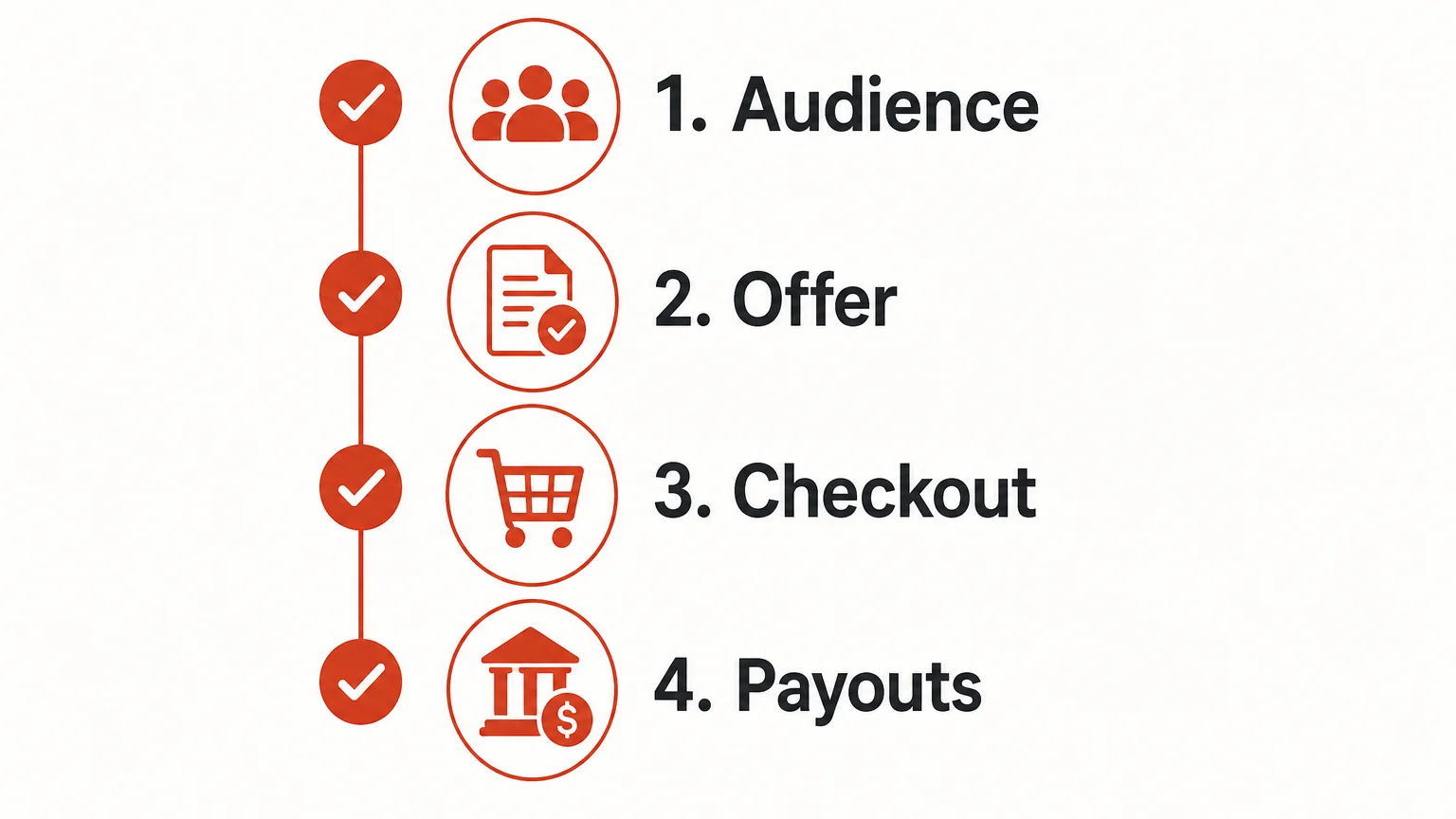
- Use ad-intelligence tools to examine recurring creative angles, landing-page promises and audience language before investing in a large launch.
- Validate the offer with a small audience before optimizing payment infrastructure for volume.
- Test checkout, refunds, failed renewals and access delivery in a controlled environment.
- Measure the complete path from advertisement to payout, not only the payment authorization rate.
Payment infrastructure cannot repair an offer that does not convert. Before selecting a processor, use ad spy and offer-validation tools to understand how similar products position outcomes, price points, guarantees and payment plans. Tools such as Minea or Pipiads may help you inspect creative patterns, but you still need to verify that the audience and promise fit your own expertise.
This process is especially important for the displaced creator. Your customer acquisition may span several countries, while your company, residence and payout bank sit elsewhere. The offer should therefore be tested with clear disclosures, accurate fulfilment expectations and a checkout flow that does not create avoidable disputes.
Run a complete payment test before a launch spike. Check successful card payments, declined cards, refunds, partial refunds, payment-plan renewals, customer access and payout reconciliation. A March 2026 education-payments report from Digital Transactions reported that 37% of respondents experienced increased administrative workload. For course creators, that is a reminder to test reconciliation and support workflows before transaction volume increases.
Also document your operating model. Keep your business registration, tax information, course outline, refund policy, customer-support process and fulfilment evidence ready. Clear documentation does not guarantee approval, but it can make future reviews easier to answer accurately.
Verdict: choose for resilience, not only rate
The best payment processor for online courses depends on your offer, customer geography, launch pattern and operational tolerance. For a displaced creator with a US LLC, the practical priority is a payment setup that combines reliable checkout, transparent currency treatment, predictable payouts and clear tax responsibility. Review each provider as a complete operating system, then test it with real scenarios before directing significant advertising spend to the offer. Bold claims about low fees are less useful than verified answers about holds, disputes, failed renewals and international settlement.
Take action with WhatPayment
Choosing payment infrastructure is difficult when your company, residence and customers are spread across different jurisdictions. You need practical comparisons that separate headline rates from effective costs, payment coverage, payout behaviour, tax responsibility and account risk.
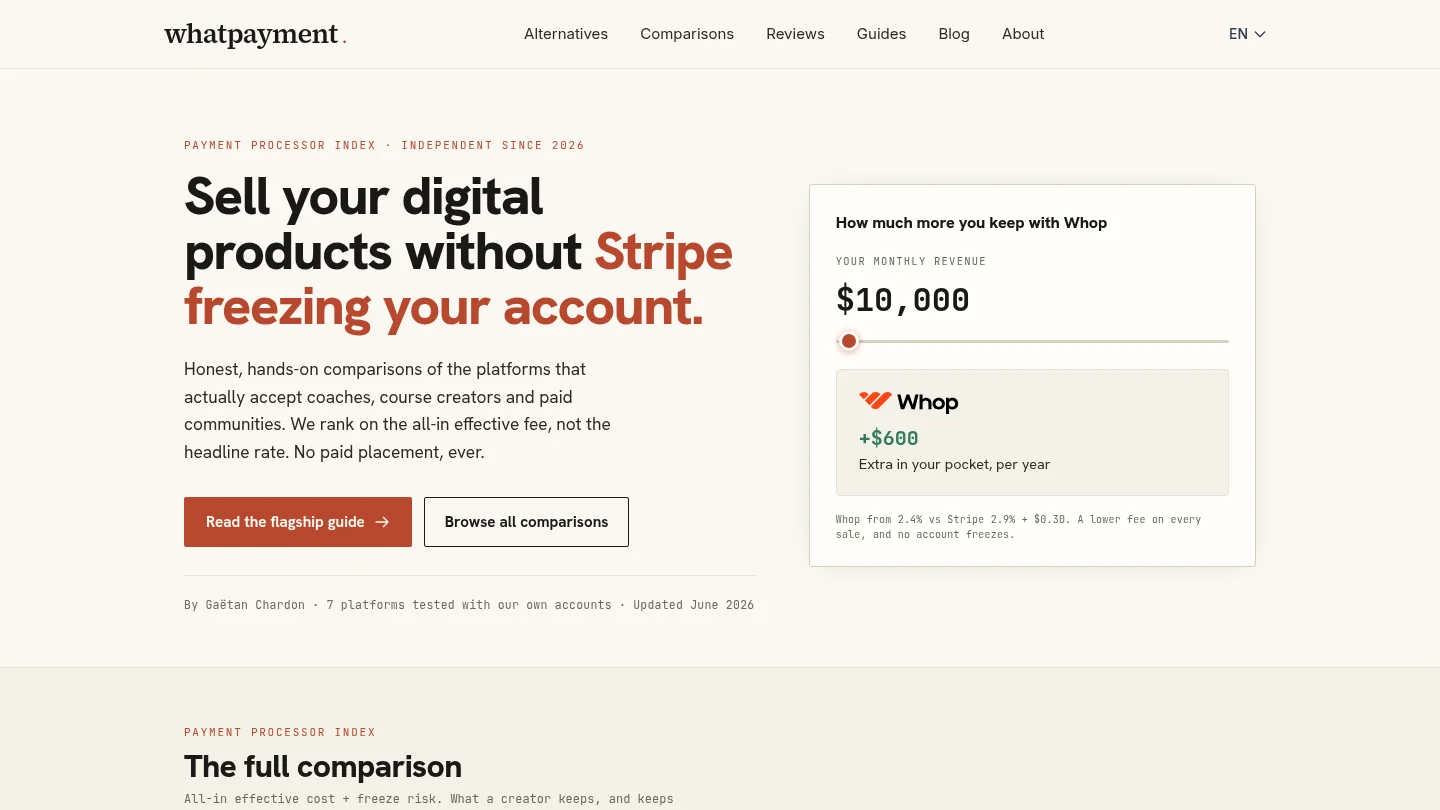
Our editorial research is built for creators, course sellers, coaches and online businesses comparing payment platforms for digital products. To examine one operating layer for selling courses, payments and related online products, read our review of Whop for selling online courses and compare its fit against your own requirements.
Frequently Asked Questions
What is the best payment processor for online courses?
There is no universal choice because the correct option depends on your product, customer countries, payment model and tax responsibilities. A broader platform may suit creators who want checkout, delivery and operations together, while a traditional processor may suit businesses requiring custom control.
Should course creators use a Merchant of Record?
A Merchant of Record may simplify certain tax and payment responsibilities, but you should verify exactly what it handles in your countries of sale. It can also impose product restrictions, payout rules and additional commercial terms.
What should international course creators check first?
Check merchant eligibility, supported customer countries, currencies, conversion rules, payout destinations, review procedures and dispute handling. Your US LLC does not by itself confirm that a provider will approve your residence and operating profile.
Are hosted course platforms safer than standalone processors?
Hosted platforms can reduce integration work and connect payment with course access. They may also limit checkout control, payment routing or portability, so compare convenience with your need for flexibility.
How can WhatPayment help with the decision?
We compare payment platforms using effective fees, Merchant of Record status, payout behaviour, account risk, tax handling and use-case fit. Our reviews can help you narrow the shortlist before you test a provider with your own business documentation and customer journey.