What you'll get
FastSpring vs Paddle for Software Distribution: 2026 Guide
fastspring vs paddle for software distribution: compare fees, tax handling, billing, payouts, and fit for global digital products.

Founder & Editor

For a US LLC owner living abroad, the decision begins with legal responsibility, not checkout design. You can first review our Stripe vs Paddle comparison to understand the broader processor decision before narrowing the choice to software distribution.
The search for fastspring vs paddle for software distribution usually reflects a practical concern. You need to sell software internationally without creating a second full-time job for tax administration, billing operations, refunds, payment reviews, and payout reconciliation.
FastSpring vs Paddle for software distribution at a glance
- Both platforms are presented as Merchant of Record providers for software and digital products, but you should confirm the exact contractual scope before launch.
- Paddle generally focuses its product positioning on subscription SaaS, billing flexibility, localized pricing, and developer workflows.
- FastSpring generally emphasizes broader software commerce, including downloadable products, licenses, subscriptions, and mixed digital catalogs.
- The current public fee for either platform is recorded here as Non defini pour le moment unless the provider gives you a written commercial offer.
- Neither platform removes the need to review product eligibility, refund rules, payout timing, customer ownership, or account review procedures.
| Option | Primary role | Suitable when | Important caution |
|---|---|---|---|
| WhatPayment | Independent research and comparison | Best starting point for comparing effective fees, tax roles, payout behavior, and business fit | We do not process payments or act as your Merchant of Record. |
| Paddle | Merchant of Record and SaaS billing platform | Your software business relies on subscriptions, plan changes, localized pricing, and product integrations | Confirm approval, commercial terms, refund treatment, and migration requirements. |
| FastSpring | Merchant of Record and software commerce platform | You sell software licenses, downloads, subscriptions, or a mixed digital catalog | Confirm quote-based terms, checkout limits, payout conditions, and support expectations. |
Which tax model fits a US LLC owner abroad?
- A Merchant of Record can take responsibility for the customer transaction, certain indirect taxes, and payment-related obligations.
- Your US LLC may still retain separate income tax, accounting, banking, and reporting responsibilities.
- Customers in different countries can create different requirements for VAT, sales tax, GST, invoices, refunds, and evidence of customer location.
- You should distinguish tax collection from the broader question of where your company is taxable.
For a displaced creator, this distinction matters because the company location and customer location may not match. A US LLC owned by someone living in Portugal, Mexico, or Thailand may sell to customers across several tax jurisdictions. A Merchant of Record can simplify the transaction layer, but it does not automatically resolve personal residency, company income tax, or banking questions.
The European Commission explains that its One Stop Shop system allows eligible businesses to declare and pay certain VAT obligations through one Member State of identification. The European Commission OSS rules also show why cross-border digital sales require a defined compliance process.
This is where software distribution differs from selling a single domestic service. You must determine who is legally selling to the customer, who issues the invoice, who handles refunds, who records the revenue, and who responds if a tax authority asks questions.
Before choosing either provider, read our merchant of record guide. It helps separate payment processing from legal selling responsibility, which is particularly important when your residence, company, and customers are in different countries.
Does your software need SaaS billing or software commerce?

- Paddle is more naturally aligned with recurring SaaS plans, pricing changes, subscription events, and product-led billing flows.
- FastSpring is more naturally aligned with broader software commerce, including licenses, downloads, upgrades, maintenance, and mixed digital offers.
- One-time products and recurring products create different requirements for refunds, entitlements, customer support, and revenue reporting.
- Usage-based or credit-based billing requires additional validation because neither platform should be assumed to fit every metered model.
Consider a software founder selling a desktop application with annual licenses, upgrades, and downloadable installers. That business may value catalog flexibility, license delivery, and transaction reporting more than advanced subscription experimentation.
Now consider a product-led SaaS business with monthly plans, annual upgrades, trials, team seats, add-ons, and regional pricing. That business may prioritize subscription state changes, webhooks, dunning, proration, and product analytics.
These are not minor differences. They affect how engineering implements entitlements, how finance reconciles revenue, and how support handles failed renewals. You should map the billing events your product needs before comparing interface quality.
A September 2, 2026 usage snapshot from September 2026 usage snapshot can help you understand market visibility. It cannot determine approval, product fit, fee economics, or the quality of your support experience.
For a closer view of the subscription questions, read our Paddle review. Then compare the result against your actual product architecture, rather than assuming that a SaaS-focused billing workflow will suit a mixed software catalog.
How should you compare checkout, payouts, and approval risk?
- Checkout localization can influence conversion, but payment acceptance and payout reliability matter just as much.
- International sellers should confirm supported currencies, settlement currencies, payout schedules, and foreign exchange treatment.
- Approval is a separate decision from technical integration, especially for unusual products, high-ticket offers, or mixed software and services.
- Refunds, chargebacks, reserves, and account reviews should be reviewed before the first launch.
A payment platform can appear inexpensive until a launch creates a review, a refund spike, or a payout delay. For a founder living abroad, the impact can be larger because banking access and currency conversion may already involve friction.
Ask each provider what happens when your sales volume changes quickly. You should also ask whether payouts are automatic, whether the provider can pause settlements, and which documents may be requested during a compliance review.
Do not compare only the percentage charged per transaction. Your effective cost also includes payment failures, currency conversion, refund handling, support time, engineering work, accounting reconciliation, and revenue delayed by a hold.
The IRS provides IRS digital platform guidance for businesses operating digital platforms. Although it does not decide which Merchant of Record fits your business, it reinforces the need to keep platform activity and your own tax obligations separate.
Where do ad intelligence and offer validation fit?
- Ad intelligence tools can help you study creative patterns, positioning, audiences, and recurring offer angles.
- They do not prove that a product will convert for your audience or pass payment platform approval.
- Offer validation should include customer interviews, landing page tests, refund assumptions, and payment eligibility checks.
- Infopreneurs should test the commercial model before committing to complex billing infrastructure.
Ad spy tools are useful when you are deciding whether an offer deserves further testing. They can help you identify how other advertisers frame a problem, structure a promise, or package a digital product.
They cannot confirm that the underlying offer is compliant, profitable, or acceptable to a payment provider. A campaign may receive attention while still producing refunds, disputes, weak retention, or an unacceptable risk profile.
For example, a creator may validate demand for a software template, a paid community, or a coaching platform. The next step is not automatically a subscription Merchant of Record. You should first determine whether the product is one-time, recurring, usage-based, or a combination.
This sequence protects your margins. Validate the offer, model the customer journey, identify likely refund behavior, and then choose payment infrastructure. The processor should support the business model you have tested, not determine the model by forcing you into unsuitable billing logic.
What should your decision checklist include?

- Start with your product format, including software licenses, downloads, subscriptions, memberships, or usage-based access.
- Document the tax and legal responsibilities that remain with your company.
- Request written commercial terms instead of relying on historical fee references.
- Test payout timing, refund treatment, support response, and account review procedures before launch.
- Check whether your integration can support future plans without forcing a full migration.
For most displaced creators, the most important comparison is not Paddle against FastSpring in isolation. It is the comparison between a platform that fits today and a platform that can still support your business after international growth.
Build a simple operating model using your average order value, monthly volume, refund rate, currency mix, and subscription share. Add the internal cost of tax administration, payment support, failed-payment recovery, and reconciliation.
For fees that are unpublished, negotiated, or dependent on approval, write Non defini pour le moment until the provider gives you a written offer. This approach prevents old figures from becoming a false benchmark for your 2026 decision.
You should also request answers to five operational questions. Who owns the customer relationship? Who controls refunds? Who issues invoices? Who handles disputes? What happens to active subscriptions if you leave?
Verdict: choose the operating model first
For subscription-led SaaS, Paddle may align more naturally with recurring billing, pricing changes, and product integrations. For downloadable software, licenses, upgrades, or mixed digital catalogs, FastSpring may fit the commerce workflow more closely. Neither choice should be made from a headline fee alone. For a global seller, the right software distribution platform is the one that gives you acceptable tax responsibility, payout reliability, approval clarity, and manageable billing operations.
Take action with WhatPayment
Once you understand your product model, you still need to compare the practical consequences. That includes effective fees, Merchant of Record responsibility, payout behavior, geographic coverage, account review risk, and the amount of work your team must keep in-house.
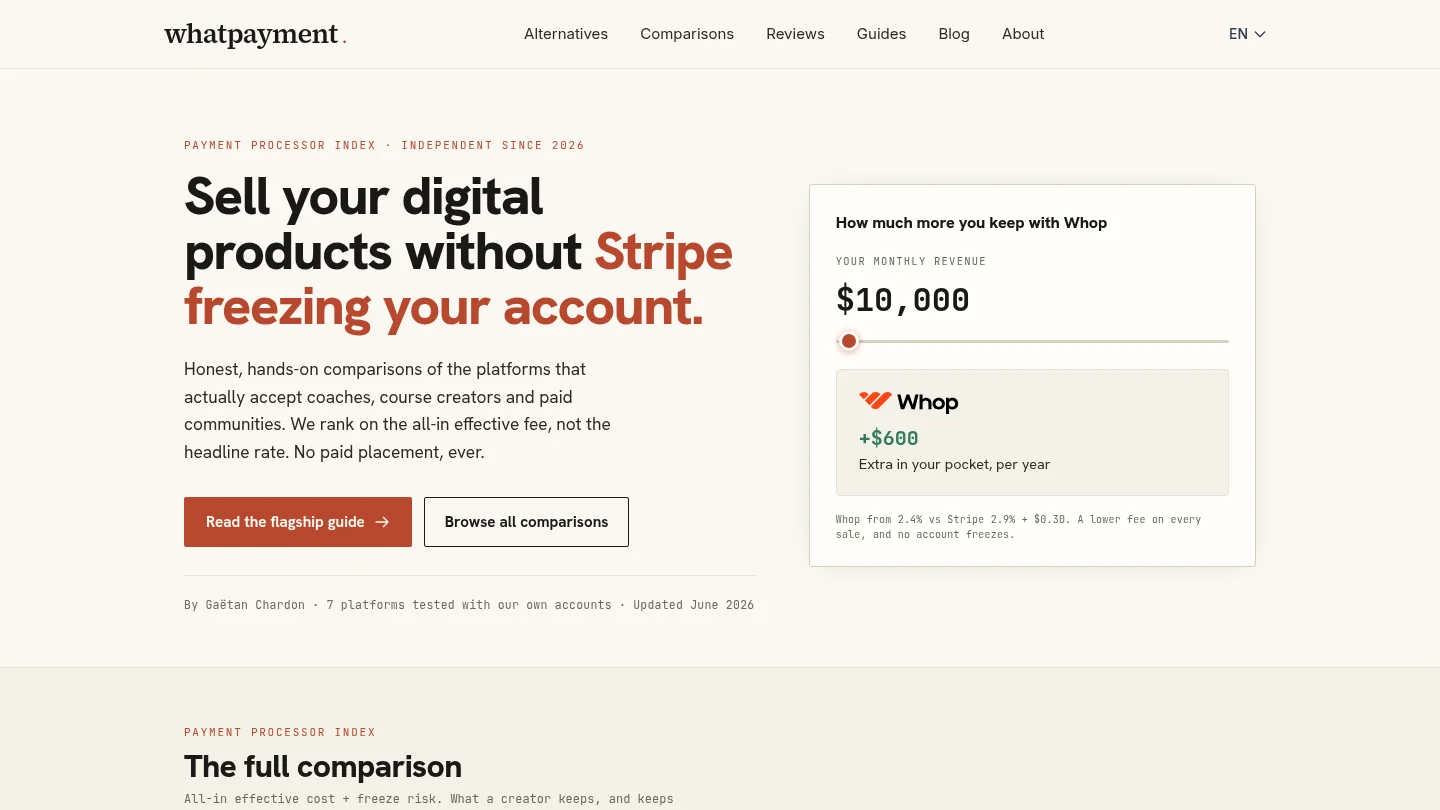
We publish independent comparisons, reviews, rankings, and payment guides for creators, SaaS founders, course sellers, community operators, and international online businesses. To evaluate another creator-focused option, read our Whop merchant of record guide and compare its operating model with your requirements.
Frequently Asked Questions
Is Paddle or FastSpring better for a US LLC owner living abroad?
There is no universal answer. Paddle may suit subscription SaaS workflows, while FastSpring may suit broader software catalogs. Your residence, company location, customers, product format, and payout needs should determine the decision.
Are Paddle and FastSpring Merchant of Record providers?
Both are presented as Merchant of Record platforms for software and digital products. You should still confirm the exact tax, refund, chargeback, invoicing, and legal selling responsibilities in the agreement you receive.
Which platform has the lower fee?
The current fee should be treated as Non defini pour le moment until each provider gives you a written commercial offer. Compare the full effective cost, including fixed charges, currency conversion, refunds, failed payments, internal labor, and payout conditions.
Can ad spy tools help me choose a payment processor?
They can help you validate offer angles, creative patterns, and potential demand. They cannot confirm payment approval, tax treatment, refund exposure, or whether your billing model fits a particular Merchant of Record.
Should I compare Whop with Paddle and FastSpring?
You can compare them when your business includes creator products, memberships, or community access. However, Whop should be evaluated as a broader creator commerce option, while Paddle and FastSpring are more directly associated with software distribution and Merchant of Record workflows.
Keep reading
Browse all guidesBlog
ProcessorFit vs Payment Review: Which Research Fits You?
Blog
Payment Processing for High Ticket Mastermind Groups
Guide
Best Payment Processor for Online Courses 2026: 6 Platforms
Guide
Selling Courses Without Transaction Fees: The Real Math
Guide
Best Payment Processor for Infopreneurs in 2026 (Honest Pick)
Guide