What you'll get
How to Reduce Involuntary Churn in SaaS Subscriptions
Learn how to reduce involuntary churn for saas subscriptions with smart retries, clear payment notices, global billing checks, and recovery metrics.

Founder & Editor
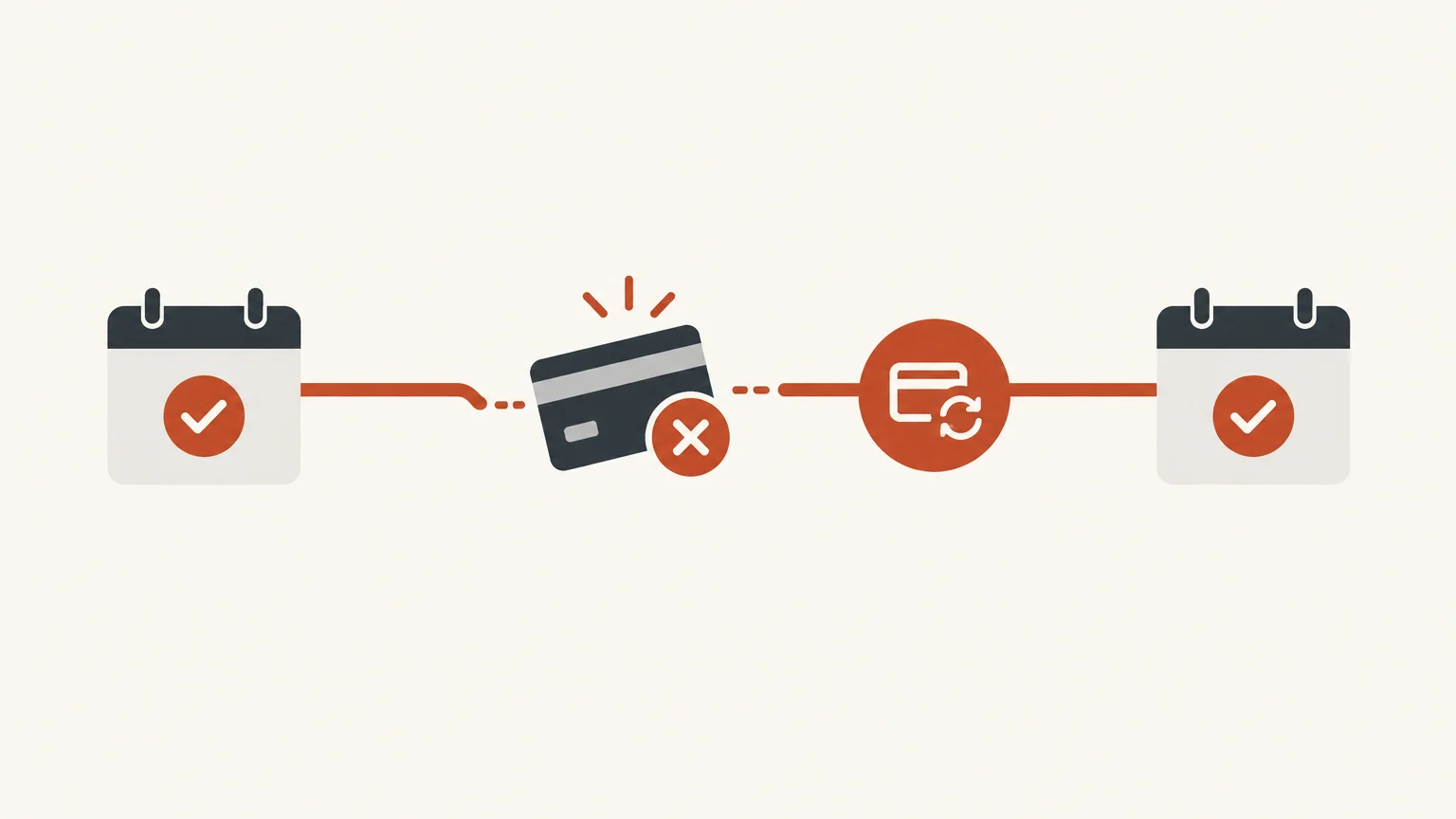
A renewal can fail even when a customer still wants your software. The first step is to separate that payment problem from a deliberate cancellation. Our analysis of payment processing for SaaS with high involuntary churn looks at the infrastructure questions behind that distinction, including billing, recovery, and cross-border payment operations.
For a US LLC owner living abroad, a renewal can involve customers, banks, and payment methods across several countries. A recovery plan should therefore make failures visible, give customers a straightforward way to fix them, and measure whether a payment actually recovered, without mistaking a failed charge for a decision to leave.
- Involuntary churn follows a payment or billing failure, unlike customer-initiated cancellation.
- Group failed payments by decline reason, payment method, customer country, and subscription plan.
- Retry recoverable failures thoughtfully and stop treating every decline as the same problem.
- Make payment details easy to update and explain the next step clearly to the customer.
- Measure recovered subscriptions and revenue, not just the number of retry attempts.
Which churn is actually caused by a payment failure?
- Separate subscription loss caused by failed collection from a customer’s decision to cancel.
- Track payment-related churn and customer-initiated cancellations as distinct outcomes.
Involuntary churn occurs when a subscription ends after a payment fails, not because the customer chose to leave. A card may have expired or been replaced, a bank may decline a charge, or a billing or processing issue may interrupt renewal. Those situations require a recovery response. A customer who cancels because the product no longer fits needs a different response.
Do not assume that every failed renewal represents a willing subscriber who will return. Instead, establish a consistent record of the event: was a renewal due, did collection fail, what reason did the payment system return, and was the subscription eventually recovered? Keep customer cancellations in a separate category so product retention work and payment recovery do not blur together.
A 2025 American Economic Review study using payment card network data found that card-replacement months were associated with higher subscription cancellation rates across the ten subscriptions it examined. The finding is not proof that every cancellation around a card replacement was involuntary. It does support monitoring card lifecycle events rather than treating an expired or replaced card as an isolated billing glitch.
For a first review, compare the number of failed renewals with the number eventually collected and the number of subscriptions that ended. Calculate recovery on failed renewal events, then separately calculate the share of subscribers who lost access after an unrecovered payment. That gives your team a clearer baseline than a single overall churn figure.
What does each failed payment tell you?
- Review failure reasons before setting retry rules.
- Separate failures that need another attempt from those requiring customer action.
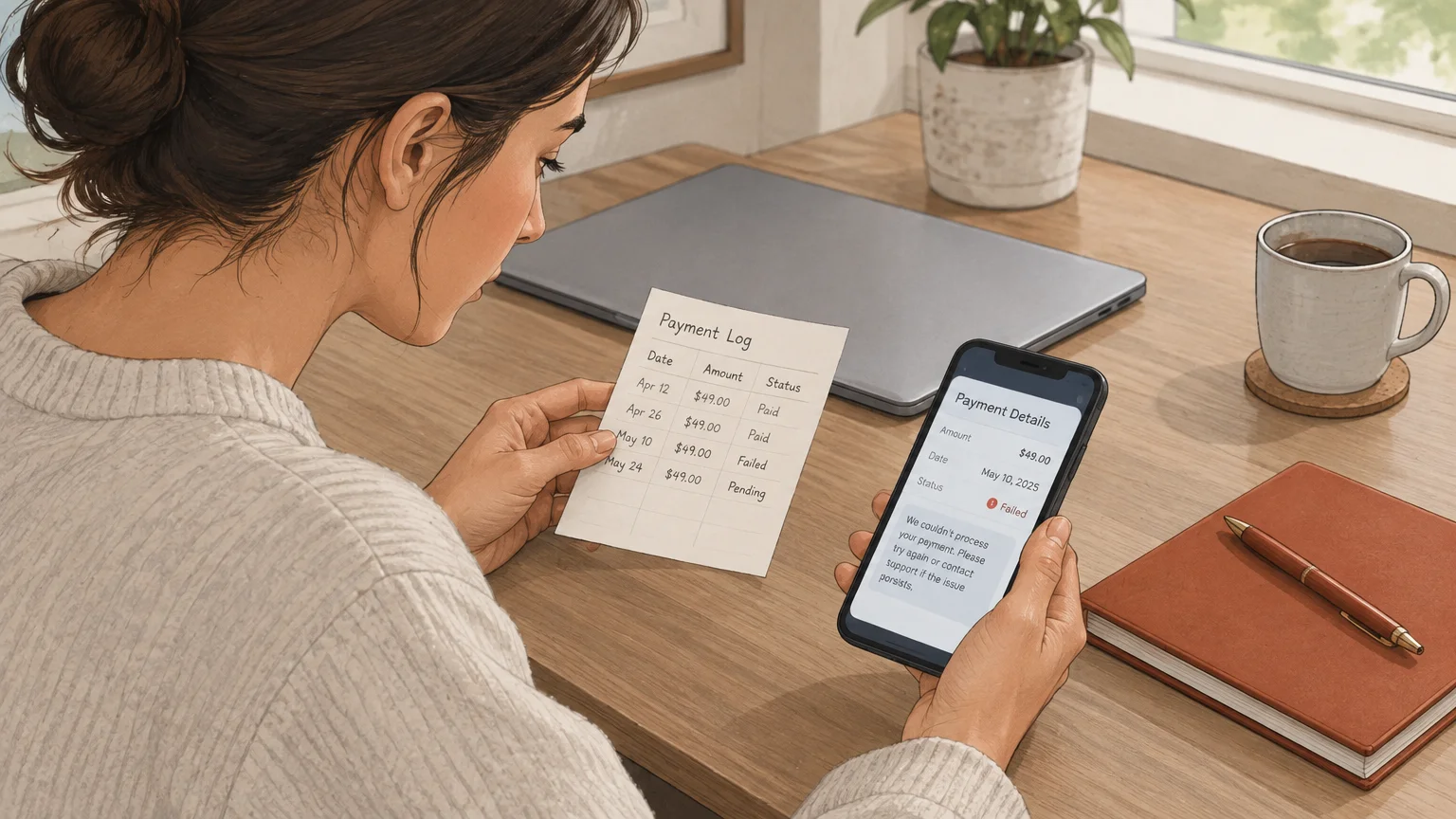
Start by reviewing the decline information your billing or payment system makes available. The goal is not to retry every failed charge repeatedly. Identify which events appear temporary, which require updated payment details, and which should be handled through support or another payment method. A repeated attempt cannot repair invalid credentials or resolve a customer’s bank-side block without their involvement.
Look for patterns by customer location, issuer country, payment method, plan, and renewal timing. A cluster of failures tied to one country or payment route points to a different investigation than failures concentrated among cards with outdated details. Keep the category used in your own records consistent over time, so changes in recovery reflect actual improvement rather than a change in how failures are counted.
Use the results to decide where to act first. For example, when a segment’s failures repeatedly require customers to update payment details, prioritize the update path and the message that leads customers to it. When failures appear concentrated around one payment route, investigate the billing configuration and processor support for that market before simply increasing retry volume.
How should a failed-payment recovery sequence work?
- Notify the customer promptly and explain a clear next action.
- Retry only when another attempt is appropriate for the failure.
- Confirm whether the payment and subscription were restored.
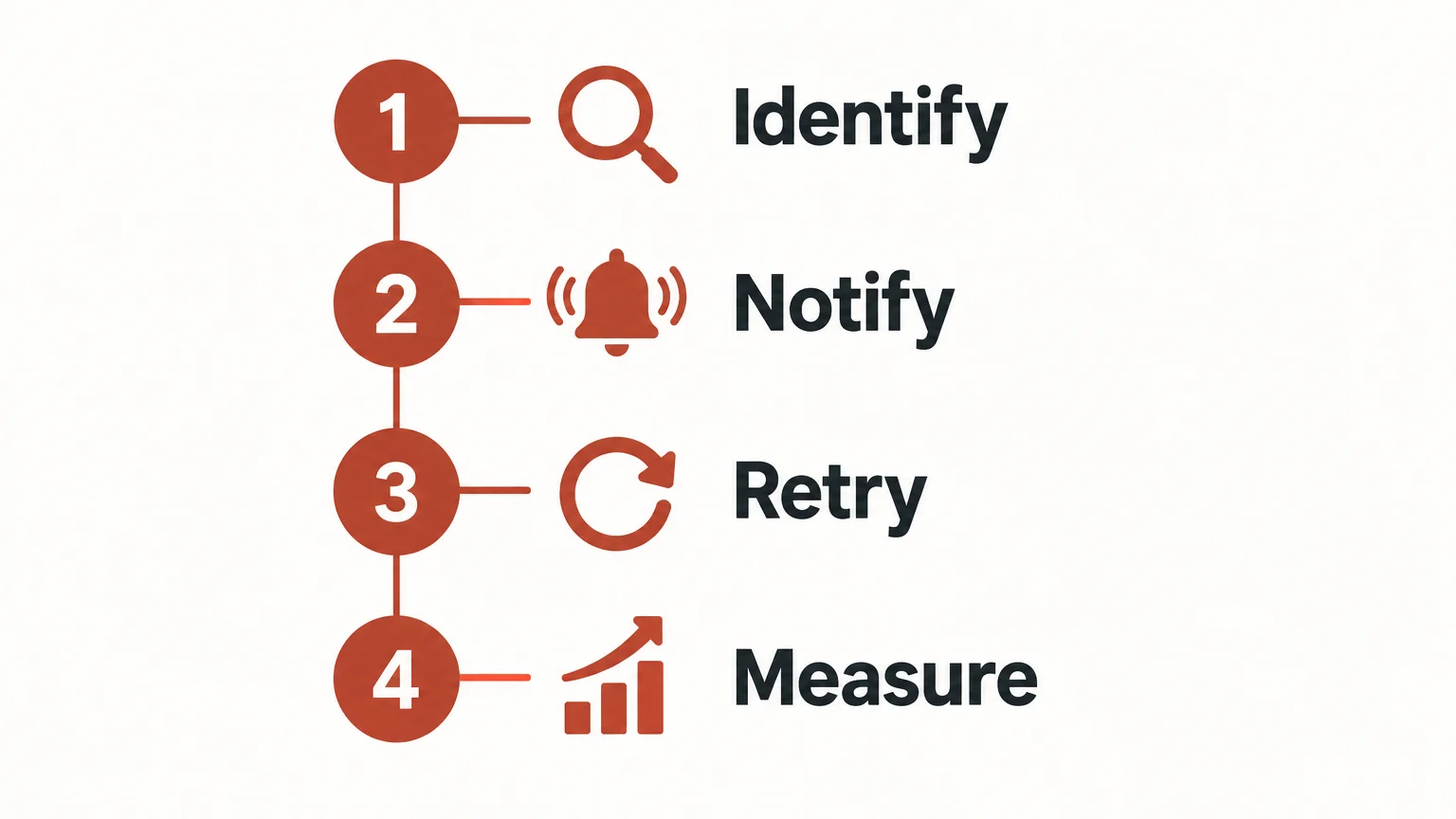
A practical payment update flow starts with a timely, plain-language notice. Tell the customer that a renewal did not go through, identify the subscription in recognizable terms, and provide a direct route to review or update payment details. Keep the message helpful rather than accusatory, and explain what will happen if the issue remains unresolved.
Coordinate messages with your retry schedule. Duplicate notifications can confuse customers, while repeated generic emails can make it harder to notice the one that contains the useful action. Make sure a successful payment stops outstanding failure reminders and restores the subscription status your customer sees. If another attempt is unlikely to help, direct the customer to update their details or contact support instead.
A useful workflow distinguishes automated actions from customer actions. Retry a payment when your billing rules indicate another attempt is appropriate. Ask the customer to act when details need attention. Escalate to support when the reason is unclear or a customer cannot complete the update. Document the final outcome so the team can see whether the sequence recovered the payment, not simply whether it sent messages.
These are practical SaaS dunning strategies, but automation should not make cancellation difficult or obscure what is owed. Give customers an understandable explanation and a usable way to resolve a billing issue, then track the outcome. Review the messages and the retry logic together, since a well-timed attempt is less useful when customers cannot see how to fix a failed payment.
How do you handle renewals across countries?
- Compare payment outcomes by customer market and payment method.
- Verify supported currencies, payment routes, and account requirements before changing infrastructure.
For international subscriptions, one global failure rate can hide important differences. Break down renewal outcomes by customer country, currency, payment method, and available issuer or decline details. If one market has more failed renewals, investigate whether the cause is payment acceptance, customer credential updates, or an operational configuration issue before assuming the same fix applies everywhere.
A RevenueCat 2026 report on subscription apps says nearly a third of Google Play subscription cancellations are involuntary billing failures, compared with 14% on the App Store. Those figures describe app subscriptions, not a general benchmark for web-based SaaS. They illustrate why payment outcomes should be assessed in the context of the billing channel rather than copied from an unrelated subscription population.
For a US LLC owner who lives abroad, separate the location of the business, the customer’s market, and the payment route in your review. Check which countries and currencies your setup supports, whether local payment methods matter to your audience, and what requirements apply to the relevant entity or account. A payment provider and a Merchant of Record also assign responsibilities differently, so assess tax and seller-of-record obligations separately from failed-payment recovery.
When reviewing payment processors for SaaS, compare the operational details that affect renewals, not just headline pricing. Our coverage of a subscription payment processor also gives operators a way to examine billing capabilities and market fit. Neither a processor switch nor another payment method should be treated as a recovery fix until the failure pattern is clear.
| Approach | What it addresses | Check before adopting |
|---|---|---|
| Improve the current billing setup | Retry rules, notices, and customer payment updates within the existing arrangement. | Confirm which settings you can control and whether each failure reason gets an appropriate response. |
| Add a separate recovery layer | Additional coordination of retries, customer messages, and recovery reporting. | Review integration work, data synchronization, duplicate notifications, and the total cost. |
| Change processor or seller-of-record model | Payment routes, supported methods, billing operations, or allocation of seller responsibilities. | Assess migration risks, saved payment details, market coverage, fees, and tax responsibilities. |
A gateway is only one part of the arrangement. Use our discussion of subscription payment gateways when you need to distinguish the gateway’s role from the wider billing, recovery, and processor setup. For any change, verify how existing subscriptions will migrate and what customers must do to keep their renewals active.
Which metrics show whether recovery is working?
- Measure unique failed renewals, recovered payments, and subscriptions that still ended.
- Review revenue and subscriber outcomes by segment, not just retry counts.
Track unique payment events rather than counting every attempt as a separate failure. A single renewal can generate more than one attempt, so attempt totals alone can make the problem look larger without showing how many subscriptions were at risk. Record the original failure, subsequent attempts, whether money was collected, and whether the subscription remained active.
Use a consistent recovery rate: recovered failed renewal events divided by eligible failed renewal events in the period. Also report the share of those subscriptions that ultimately lost access, plus recovered recurring revenue. Segment these measures by plan, country, payment method, and failure category. That makes it possible to spot when a better recovery rate is concentrated in a small segment or when the failure mix itself has changed.
Set a clear observation window and use it consistently in internal reporting. Do not claim a recovery simply because an automatic retry was scheduled, and do not count a customer who deliberately cancelled as a payment-recovery success. If subscriptions are sold through an app store, use the platform’s own billing rules in the analysis. Apple’s StoreKit guidance, for example, describes a billing-retry state of up to 60 days and options that include a grace period or prompting customers to update billing information. Those rules apply to App Store subscriptions, not to every SaaS billing setup.
Review the figures alongside support contacts and customer complaints. If collections rise but customers report confusing messages or repeated charges, refine the communication and retry process. If payment acceptance is stable but unrecovered failures remain, focus on the customer update experience or the recovery steps your current setup does not cover.
Verdict: Fix the failure pattern before switching providers
To reduce involuntary SaaS churn, separate payment-related subscription loss from voluntary cancellation, classify failures before retrying, and make payment updates simple. Then measure recovered payments and restored subscriptions by customer market and payment method. Improve the current workflow first; consider another recovery layer or a different payment setup only when your data shows a specific gap it can address.
Compare payment options for your SaaS business
When failed renewals point to a gap in payment acceptance, billing controls, or international coverage, a structured comparison helps clarify what to review before changing infrastructure. Our editorial research examines payment platforms, their documented terms, and fit for different online business models.

Our comparisons use test accounts, official documentation, fine print, and effective fee analysis where relevant. WhatPayment is an independent editorial publication, not a processor, billing provider, or implementation service. Use our Stripe alternatives for SaaS comparison to assess platforms against your customer markets, subscription needs, and seller-of-record responsibilities.
Frequently Asked Questions
What causes involuntary churn in SaaS?
It occurs when a subscription ends after a payment or billing failure rather than a customer choosing to cancel. Common issues include expired or replaced payment details, declines, and processing problems.
Should I retry every failed subscription payment?
No. Review the failure reason and use retry rules that fit the issue. When customer action is required, send a clear notice with a direct payment-update path instead of relying on repeated attempts.
How do I calculate payment recovery?
Divide recovered failed renewal events by eligible failed renewal events for the same reporting period. Track restored subscriptions and revenue separately, and avoid counting repeat attempts as separate failed renewals.
Do international customers need a different recovery workflow?
Review results by customer country, currency, and payment method because a single overall metric can hide market-specific problems. Confirm provider coverage and account requirements before changing routes or adding payment methods.
How can WhatPayment help with payment decisions?
Our payment processor index and editorial comparisons help readers assess payment infrastructure, subscription capabilities, fees, geographic coverage, and seller-of-record responsibilities. WhatPayment publishes research and comparisons, it does not process payments or implement recovery workflows.
Keep reading
Browse all guidesBlog
Best BNPL for Membership Sites in 2026: 8 Options Compared
Blog
WhatPayment vs Payment Review: Which Research Site Fits?
Guide
High-Risk Payment Processors for Creators (2026): What Works
Guide
Best Coaching Payment Processor 2026: Whop vs Stripe
Guide
Whop Finance Review: 6% APY Treasury Plus Debit Card
Guide