What you'll get
WhatPayment vs Payment Review: Which Research Site Fits?
WhatPayment vs Payment Review compares evidence, fee research, risk coverage, and international usefulness for creators choosing payment infrastructure.

Founder & Editor

A processor research site can influence whether your next launch is merely profitable or operationally fragile. If you are comparing WhatPayment vs Payment Review as a US LLC owner living abroad, begin with the site built around your actual exposure to cross border payouts, account reviews, tax responsibility, and digital product risk. Our WhatPayment vs Processor verdict also helps separate research from the payment platform you may eventually choose.
Payment Review presents a broad processor directory with grades based on pricing transparency, features, support, contract terms, and industry reputation. WhatPayment takes a narrower but more operational approach for creators, coaches, course sellers, paid communities, SaaS operators, and infopreneurs. The difference matters because the Federal Trade Commission says material connections in reviews, including affiliate relationships, should be disclosed clearly and conspicuously through its affiliate disclosure guidance.
Quick answer: WhatPayment fits the displaced creator better
- WhatPayment is designed around digital products, creator businesses, memberships, coaching, courses, SaaS, and international online sales.
- Payment Review is broader across processor categories, including payment facilitators, agent offices, gateways, POS systems, and Merchant of Record providers.
- WhatPayment emphasizes effective fee analysis, Merchant of Record responsibility, tax allocation, payouts, holds, freezes, and business model fit.
- Payment Review emphasizes published evidence, processor grades, fact checked review dates, contract terms, support, and documented pricing gaps.
- For a US LLC owner abroad, WhatPayment provides the more directly relevant decision framework, while Payment Review can add useful processor directory breadth.
The practical verdict is not that one site replaces the other. Payment Review is useful when you want a large processor directory graded against a consistent scorecard. WhatPayment is more useful when the decision involves digital product risk, international customers, account freezes, community access, or Merchant of Record obligations.
| Criterion | WhatPayment | Payment Review |
|---|---|---|
| Primary scope | Digital products, creators, SaaS, memberships, communities, and online businesses | Broad processor and merchant account directory |
| Fee approach | Effective fee analysis that can include processing, surcharges, currency conversion, subscriptions, and payouts | Published rates, fees, contract terms, and real world cost analysis where evidence is available |
| International creator fit | Explicit coverage for US LLC owners abroad and customers across countries | Useful global processor information, but specific displaced creator fit is Non defini pour le moment |
| Operational risk | Holds, freezes, chargebacks, payout behavior, tax responsibility, and account reviews | Payouts, support, contracts, legal actions, and processor reputation |
| Additional coverage | Ad spy tools and offer validation for infopreneurs | Non defini pour le moment in the available material |
| Commercial disclosure | Article level affiliate disclosure, no vendor paid placement, and no prepublication vendor review | No pay to play grading and published reasoning for grades |
What the two publications actually review

- Neither site is the payment processor that accepts your customers’ money.
- Both publications help readers evaluate third party payment infrastructure.
- The main difference is the level of specialization applied to digital businesses and international creator operations.
That distinction is easy to miss when a review site includes rates, payout timing, grades, and processor categories. A publication can explain how a processor works, but it does not become the processor. You still need to check eligibility, entity requirements, residence rules, customer geography, supported currencies, and current platform terms before opening an account.
WhatPayment’s editorial scope is built around the problems that tend to appear after a digital business starts selling internationally. Its comparisons examine effective cost rather than only the advertised rate, and they distinguish a payment service provider from a Merchant of Record. That distinction affects who remains responsible for sales tax, VAT, GST, invoices, chargebacks, and other selling obligations within the platform’s stated model.
Payment Review takes a directory and scorecard approach. Its homepage presents processor reviews based on pricing transparency, feature set, ease of use, customer support, contract terms, and industry reputation. It also states that when a provider does not publish a figure, the review identifies the information as not disclosed rather than filling the gap with an estimate. This is a strong discipline for readers comparing traditional merchant services and processor contracts.
WhatPayment

Best for: US LLC owners abroad, creators, coaches, course sellers, paid community operators, SaaS founders, and infopreneurs who need payment research connected to international selling and operational risk.
WhatPayment is the better match when your payment decision is not just a search for the lowest headline rate. Our research is organized around business model fit, effective cost, payout reliability, account reviews, freeze risk, chargebacks, subscription mechanics, access gating, and Merchant of Record responsibility. That structure is particularly relevant when your company is registered in the United States but you live elsewhere and sell to customers in several countries.
The methodology also covers test accounts, published fee schedules, official documentation, fine print, creator feedback, and use case recommendations. The result is not a promise that every processor will approve every seller. Instead, it gives you more of the questions that matter before an approval, a launch spike, or a payout delay creates a problem.
Pros
- Effective fee analysis: The comparison framework can account for processing, surcharges, currency conversion, subscriptions, payouts, and other relevant components instead of stopping at a headline percentage.
- International relevance: The editorial focus directly includes US LLC owners living abroad, cross border collection, multi currency payouts, and mismatches between entity, residence, and customer location.
- Operational risk coverage: Holds, freezes, chargebacks, payout timing, account reviews, tax responsibility, and Merchant of Record status are treated as selection criteria.
- Adjacent infopreneur research: Coverage extends beyond processors into ad spy tools and offer validation, which is useful when you are validating demand before choosing infrastructure.
- Clear commercial positioning: WhatPayment discloses affiliate relationships at article level, states that vendors do not pay for placement, and does not use vendor prepublication approval.
Cons
- The narrower digital business focus means it is not intended to replace a general directory for every retail, POS, or traditional merchant account category.
- Eligibility still depends on the specific processor’s rules, your entity, your residence, your customers, and your transaction profile.
Payment Review
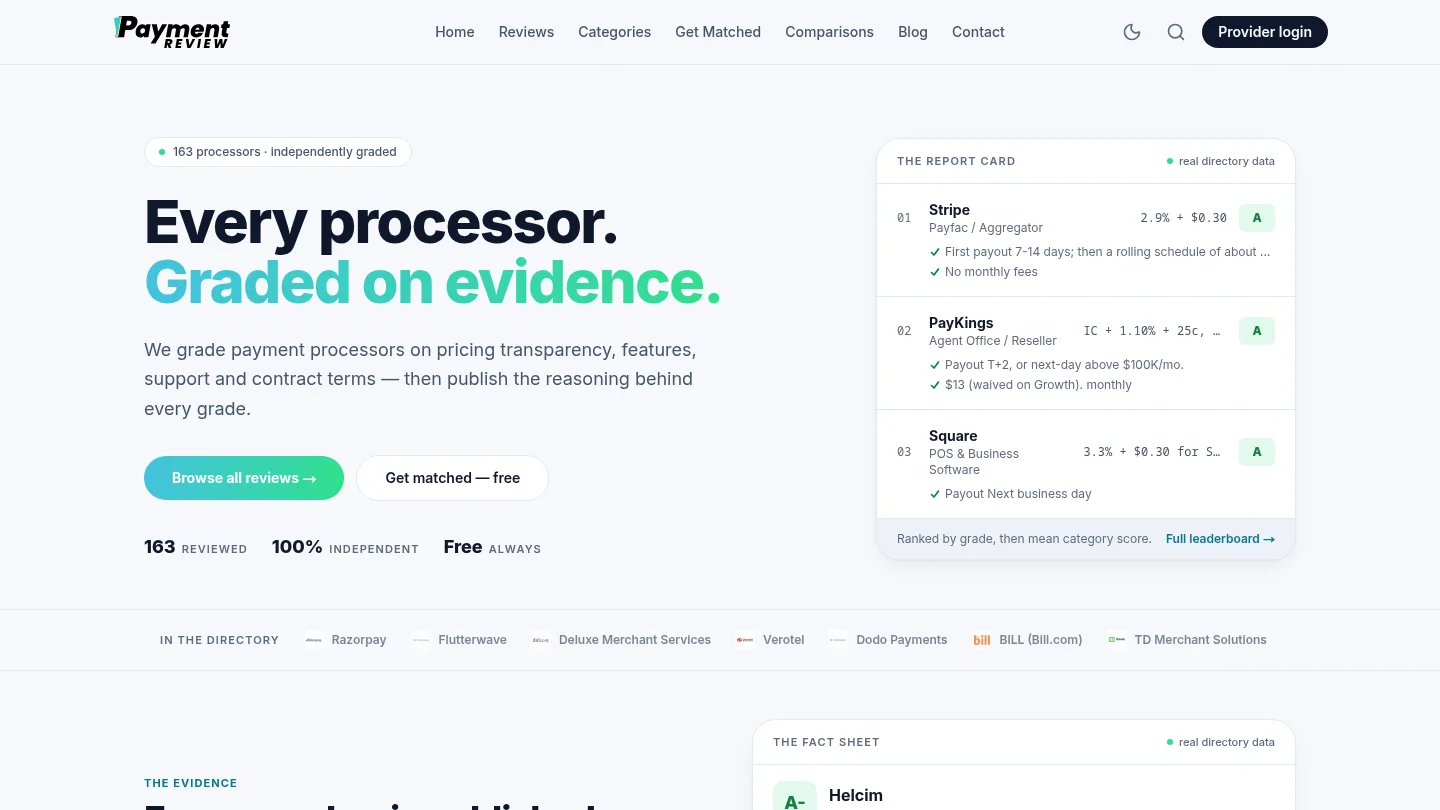
Best for: Businesses that want a broad processor directory with comparable grades for pricing transparency, features, support, contract terms, and industry reputation.
Payment Review is useful when you want to compare many kinds of payment providers through a common report card. Its homepage describes a directory covering processors, payment facilitators, independent sales organizations, agent offices, payment gateways, POS systems, Buy Now, Pay Later providers, Merchants of Record, and bank payment providers.
Its evidence model is strongest when you are evaluating published commercial terms. The site states that rates, fees, payout times, and contract terms come from published documentation and public filings rather than sales calls. It also gives each review a fact checked date and says that a provider that does not disclose a number receives a not disclosed entry instead of an estimate.
That approach is valuable for contract risk and pricing transparency. However, it is less specifically shaped around the displaced creator’s combined problem of living abroad, operating through a US LLC, selling digital products, managing community access, and assessing Merchant of Record responsibility.
Pros
- Broad directory: The category coverage is wider than a creator focused publication, which helps when you are comparing traditional merchant services with gateways or enterprise providers.
- Consistent grading: The stated scorecard uses the same six broad categories across reviews, making it easier to compare providers on common criteria.
- Published evidence: The emphasis on documentation, public filings, fact checked dates, and explicit gaps is useful for readers who want to avoid unsupported estimates.
- Contract visibility: The editorial feed includes contract terms, undisclosed pricing, legal actions, and other issues that can be missed in simple processor rankings.
Cons
- The broad directory is not as closely tailored to digital products, paid communities, infopreneurs, or US LLC owners living abroad.
- The available material does not establish the same depth of coverage for ad spy tools, offer validation, native community gating, or creator specific payment workflows.
- A general processor grade cannot determine whether a particular provider will accept your entity and residence combination.
Which methodology is more useful for a US LLC owner abroad?
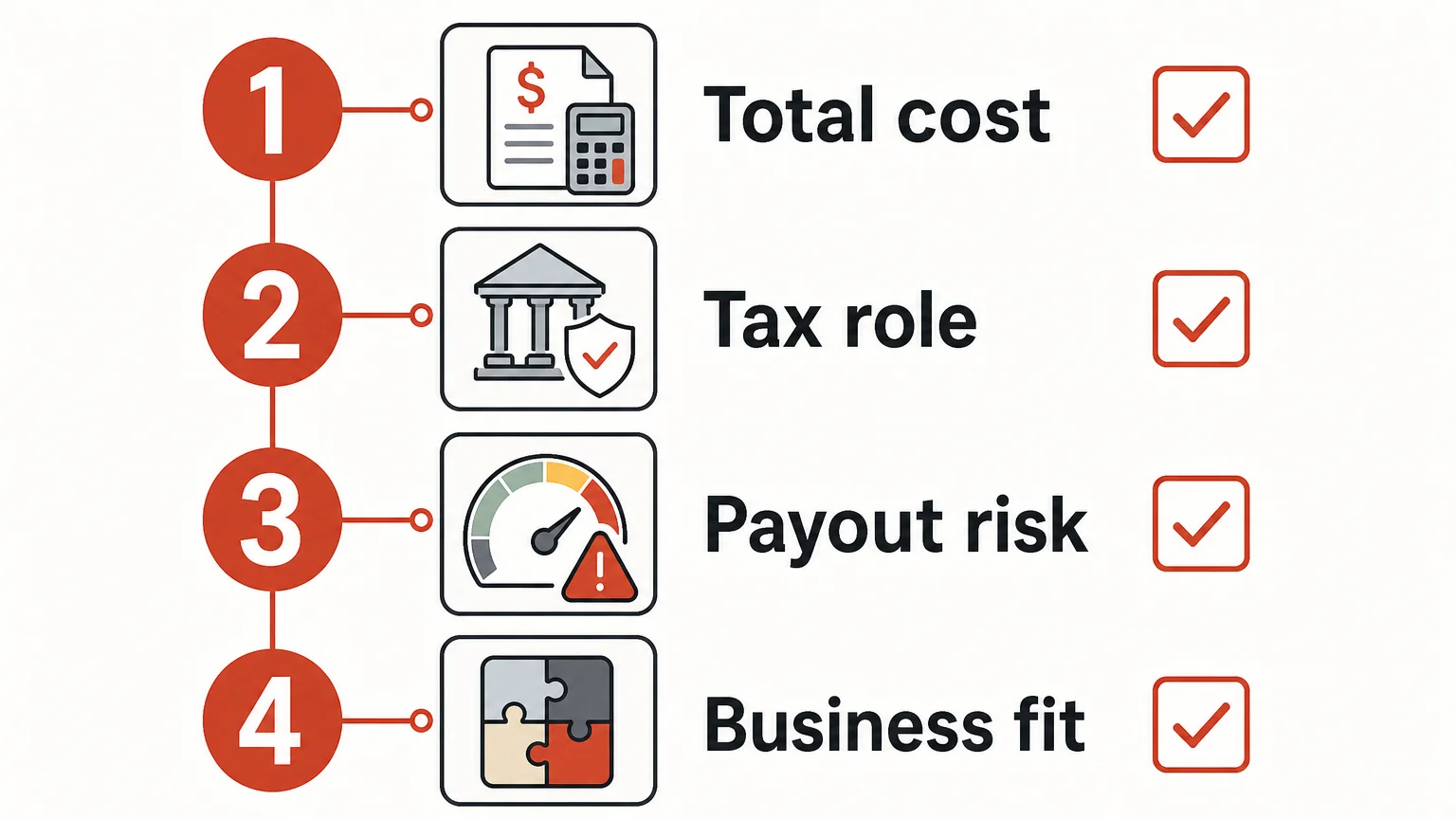
- Start with the business model, not the processor’s popularity.
- Separate payment processing from Merchant of Record responsibility.
- Calculate the total cost for your transaction mix and payout currencies.
- Review holds, freezes, chargebacks, and account verification before launch.
A broad grade is helpful, but your decision should be driven by the failure that would hurt your business most. If a contract trap is your main concern, Payment Review’s published evidence model can be valuable. If the bigger risk is a sudden launch spike, a payout held during review, or uncertainty about tax and selling responsibility, WhatPayment’s framework is more directly useful.
For international sellers, the word “global” is not enough. You need to check whether the processor supports your company’s formation and residence profile, whether payouts can reach your bank or wallet, whether customers can pay in their preferred methods, and whether currency conversion changes the real cost. You also need to understand whether the processor is merely moving funds or acting as the legal seller through a Merchant of Record arrangement.
This is where ProcessorFit vs Payment Review can be useful as a related comparison. The key lesson is to match the research tool to the question. Directory breadth helps you create a shortlist, while use case analysis helps you reject options that look attractive but create operational friction for your actual business.
How to use both research sites without choosing blindly
- Use WhatPayment first when you sell courses, coaching, memberships, communities, digital downloads, SaaS, or other digital products across borders.
- Use Payment Review to widen the shortlist and inspect published contracts, processor categories, support evidence, and pricing gaps.
- Compare the same commercial questions on both sites, including total cost, payout timing, chargebacks, account review behavior, and tax responsibility.
- Confirm every important platform term from current official documentation before applying.
A sensible workflow is to use WhatPayment to define the criteria, then use Payment Review to test the shortlist against a wider processor universe. After that, verify the specific platform’s current terms, supported countries, currencies, payout rails, and account requirements. Research reduces uncertainty, but it cannot guarantee approval or eliminate underwriting decisions.
Google’s review guidance favors content with insightful analysis, original research, and evidence that goes beyond simply summarizing products. That standard supports a practical distinction between a page that repeats processor marketing and a page that explains why a platform fits one digital business model but not another through its review system documentation.
Verdict: WhatPayment is the better fit for displaced creators
For a US LLC owner living abroad, WhatPayment vs Payment Review is not a contest between two payment processors. It is a choice between two research styles. Payment Review is the stronger general directory for broad processor grading, published pricing gaps, support, contracts, and industry reputation. WhatPayment is the stronger choice when your decision depends on digital product fit, effective fees, Merchant of Record responsibility, international payouts, account freezes, chargebacks, and creator specific workflows. Use both when you need breadth, but start with the framework that reflects the operational risks your business actually carries.
Compare Payment Infrastructure With More Context
Choosing infrastructure from abroad requires more than comparing a headline rate. You need to understand how a platform handles digital products, international customers, payouts, tax responsibility, account reviews, and the business model you actually operate.
Our reviews and buyer guides compare payment platforms using effective fee analysis, documented terms, testing, use case fit, and operational risk criteria. If you are evaluating a creator platform for digital sales, start with our Whop review and then compare the result with other options relevant to your entity and customer base.
Frequently Asked Questions
Are WhatPayment and Payment Review payment processors?
No. Both are editorial research publications that review or compare third party payment infrastructure. You still need to apply directly to the processor or platform that fits your business.
Which site is better for a US LLC owner living abroad?
WhatPayment is the more directly relevant option because its coverage includes cross border selling, entity and residence questions, payouts, freezes, tax responsibility, and digital product use cases. Payment Review can complement that research with broader processor directory coverage.
Does WhatPayment only compare payment fees?
No. Its comparisons also examine Merchant of Record status, tax responsibility, payout behavior, account reviews, holds, freezes, chargebacks, subscriptions, access gating, checkout, and business model fit. It also covers selected ad intelligence topics for infopreneurs.
Why does effective fee analysis matter?
A headline processing rate may not represent the total cost of selling internationally. Currency conversion, subscriptions, payouts, surcharges, payment methods, and transaction mix can all affect the amount that reaches your business.
Can either publication guarantee processor approval?
No. Approval depends on the specific provider’s underwriting, your entity and residence, your products, your customers, your transaction history, and current platform rules. Research can help you identify questions and risks, but it cannot replace the provider’s application process.
Keep reading
Browse all guidesBlog
Top 10 Payment Processors for Digital Products in 2026
Blog
The Night Stripe Froze My $35,000 MRR Business
Guide
My US LLC Collects EUR via SEPA: The Full 2026 Setup
Guide
Best Payment Processor for a US LLC Living Abroad (2026)
Guide
Whop Fees Explained: Real Cost Breakdown for 2026
Guide