What you'll get
Top 10 Payment Processors for Digital Products in 2026
Compare the top 10 payment processors for digital products in 2026, including fees, payouts, tax handling, and global fit for creators.

Founder & Editor
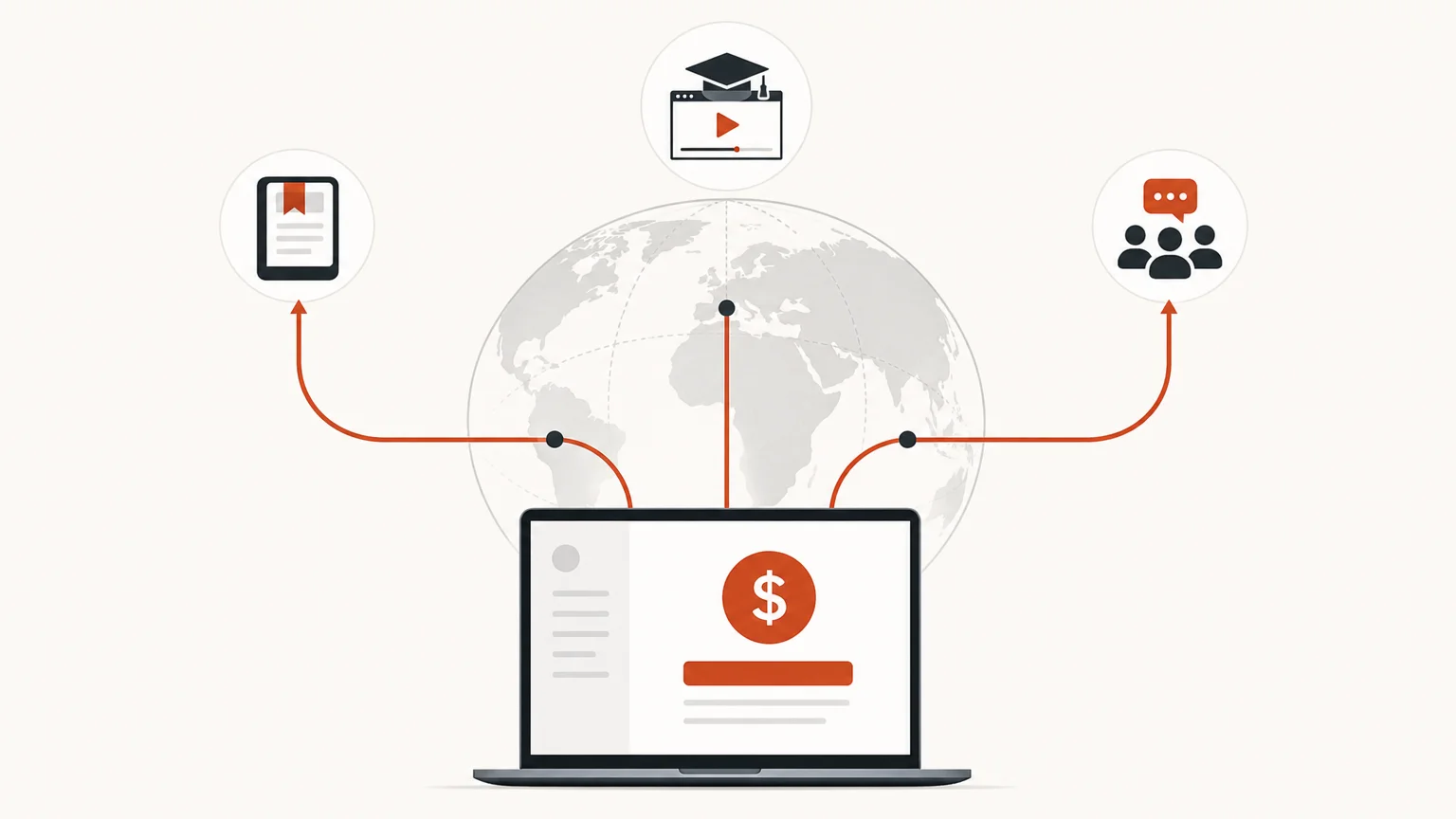
A payment account can be approved and still be operationally wrong for your business. If you run a US LLC while living abroad, the relationship between your residence, entity, customer countries, and product category can influence approval, payouts, and account reviews. The top 10 payment processors for your situation should therefore be judged by practical fit, not processing volume alone. Our best high-risk payment processors guide can also help when your business falls outside mainstream underwriting criteria.
The payments market is broad enough to create confusion between processors, gateways, Merchant of Record platforms, and creator storefronts. The Federal Reserve study released in July 2026 provides a current US benchmark, with national payment data through 2024. That context matters, but a volume ranking does not automatically identify the right platform for a course, membership, software product, or coaching offer.
What should the top 10 payment processors solve?
- They should accept payments from your main customer regions without creating unnecessary currency friction.
- They should make payout timing and account review procedures understandable before launch.
- They should match your legal tax responsibilities, especially when customers are spread across countries.
- They should support digital products rather than forcing you into a physical retail workflow.
A displaced creator needs more than a card form. You need a payment setup that connects checkout, subscriptions, refunds, disputes, tax treatment, and payouts. A conventional processor may give you control, but it usually leaves more operational responsibility with your company. A Merchant of Record platform may reduce tax administration, but it can impose product, country, pricing, or payout constraints.
Volume rankings are also a poor substitute for use-case analysis. The 2026 TSG data reported by the 2026 TSG ranking shows that the ten largest payments companies processed $11 trillion in US card volume in 2025. The top five handled nearly $9 trillion, while Stripe entered the top five with more than $900 billion. Those figures describe scale, not suitability for an individual creator with a foreign residence and a US entity.
Which platforms belong on the practical shortlist?
- Whop suits digital businesses seeking checkout, product delivery, memberships, and payout tools in one operating environment.
- Stripe suits teams that need programmable checkout, subscriptions, marketplaces, or a custom SaaS billing layer.
- Paddle and Lemon Squeezy suit software and digital sellers evaluating a Merchant of Record structure.
- Whop: A platform powered by payment processors, designed for digital products, memberships, communities, and online businesses. The current editorial data supplied for this article lists fees at 2.7% plus $0.30, roughly 3% effective. You should still verify the applicable rate for your country, payment method, and account.
- Stripe: A developer-oriented processor for custom checkout, subscriptions, SaaS, marketplaces, and international card acceptance. It offers control, but the seller generally retains more responsibility for tax, disputes, and payment-risk management.
- Paddle: A Merchant of Record platform focused on software and digital products. Its model can simplify tax administration, but you should review supported product categories, payout rules, and contract terms before migration.
- Lemon Squeezy: A digital commerce platform with Merchant of Record positioning for software and online products. It can reduce administrative work, although its product and payment-method fit should be tested against your actual customer mix.
- Gumroad: A creator commerce platform for digital files, memberships, and simple product launches. It reduces technical setup, but it provides less control than a programmable processor or a custom billing stack.
- PayPal: A familiar wallet and checkout option for online sellers. It can reduce buyer hesitation, but cross-border fees, currency conversion, reserves, and account reviews require careful cash-flow planning.
- Verifone, formerly 2Checkout: A global digital commerce option for software, subscriptions, and online sales. Its suitability depends on underwriting, country coverage, payment methods, and the commercial terms offered to your business.
- GoCardless: A bank debit specialist for recurring payments, invoices, and subscriptions. It can complement card processing, but it is not suitable when your offer depends on immediate card authorization.
- Adyen: An enterprise payment platform for businesses with complex international payment flows. Its integration and onboarding requirements can be disproportionate for a small creator or early-stage digital business.
- PaymentCloud: A high-risk merchant account option for categories that mainstream processors may restrict. Approval, reserves, gateway arrangements, and pricing depend heavily on underwriting.
This is not a universal ranking. It is a shortlist for digital businesses that need to compare control, tax responsibility, operational complexity, and payout risk. The most appropriate option can change when your business moves from one-off products to recurring billing, or from domestic customers to a global audience.
How do the ten options compare for a displaced creator?
- Merchant of Record platforms can reduce tax administration, but they may limit product or country flexibility.
- Traditional processors provide more control, but they leave more compliance and dispute work with you.
- High-risk providers can serve restricted categories, but approval terms may include reserves and higher total costs.
| Option | Primary fit | Tax responsibility | Payout and risk consideration | Fee information |
|---|---|---|---|---|
| WhatPayment editorial index | Processor research, comparisons, and decision support | Explains the difference between models | Reviews holds, freezes, payouts, and underwriting | Editorial access price: Non defini pour le moment |
| Whop | Digital products, communities, memberships, online businesses | Depends on the selected service and seller arrangement | Integrated operating model, but verify account and payout rules | 2.7% plus $0.30, roughly 3% effective, subject to verification |
| Stripe | Custom checkout, SaaS, subscriptions, marketplaces | Usually remains with the seller | Strong control, with direct responsibility for payment operations | Non defini pour le moment |
| Paddle | Software and digital products using a Merchant of Record model | Platform model may cover applicable obligations | Review reserves, payout schedule, and product eligibility | Non defini pour le moment |
| Lemon Squeezy | Software, subscriptions, and digital sales | Merchant of Record approach, subject to terms | Review country coverage and payout timing | Non defini pour le moment |
| Gumroad | Digital files, memberships, and simple launches | Platform treatment varies by transaction and seller situation | Simple setup, with less infrastructure control | Non defini pour le moment |
| PayPal | Wallet checkout and broad buyer familiarity | Usually remains with the seller | Review reserves, conversion costs, and account limitations | Non defini pour le moment |
| Verifone, formerly 2Checkout | International digital commerce and subscriptions | Depends on the commercial structure | Underwriting and settlement terms require review | Non defini pour le moment |
| GoCardless | Recurring bank debit and invoice collection | Usually remains with the seller | Useful for scheduled collections, not instant card checkout | Non defini pour le moment |
| Adyen | Enterprise international payment infrastructure | Usually remains with the seller | More demanding onboarding and technical implementation | Non defini pour le moment |
| PaymentCloud | High-risk digital businesses | Usually remains with the seller | Approval, reserves, and monitoring depend on underwriting | Non defini pour le moment |
Fee comparisons should use your actual order value, refund rate, international mix, payout method, and currency exposure. A lower headline percentage can become more expensive after fixed fees, currency conversion, monthly costs, reserve requirements, and external tax tools.
Why does Merchant of Record status matter so much?
- A processor normally provides payment infrastructure while your company remains the seller.
- A Merchant of Record can assume defined selling and tax-related responsibilities under its contract.
- The legal label matters only when it matches the countries, products, and transactions you actually operate.

For a creator with customers in several countries, the difference can affect VAT, sales tax, GST, invoices, refunds, and chargebacks. It can also change who communicates with customers when a payment is disputed. You should not assume that a platform handles every tax obligation simply because it uses Merchant of Record language.
Read the contract for the exact legal seller, covered jurisdictions, excluded products, refund authority, payout timing, and reporting documents. When you need a clearer explanation of these responsibilities, our merchant of record payment solutions guide compares the model with conventional payment service providers.
The choice is also strategic. A Merchant of Record structure may reduce administrative work during international growth. A conventional processor may give you more control over checkout, customer relationships, pricing, and payment routing. Neither structure removes the need to document your business model and maintain accurate records.
The 2026 World Payments Report draws on research involving 2,600 merchants, more than 420 payment executives, and over 65 focused interviews. Its scope reflects a broader industry movement toward payment services that connect acceptance with operational tools, analytics, and localized customer experiences. For creators, that means the payment decision increasingly affects the whole revenue workflow.
What should you test before sending paid traffic?
- Test a real customer journey from checkout to successful payout.
- Test at least one international card, one refund, and one failed payment scenario.
- Confirm whether your product, country of residence, and US entity create additional review requirements.
- Document the support route for disputes, account reviews, and payout delays.
Do not wait until a launch spike to discover that your account cannot support the expected payment mix. Begin with a controlled transaction and verify the settlement report, payout destination, currency conversion, refund process, and customer receipt.
For subscriptions, test renewal failures and plan changes. For communities, test access removal after a refund. For courses, test whether a chargeback affects access automatically or requires manual intervention. For software, test license delivery after payment confirmation and after a delayed payment event.
International customers also create operational differences. Card authorization, bank debit timing, local payment methods, and currency conversion can vary by country. The 2026 J.D. Power merchant services study describes small businesses accepting more payment forms while facing greater pressure around processing costs and customer experience. That combination makes payment testing part of conversion planning, not only finance administration.
Where do ad-intelligence tools fit into the decision?
- Use ad intelligence to validate the offer before you commit to payment infrastructure.
- Study creative angles, landing page language, pricing presentation, and audience objections for digital products.
- Do not confuse ad engagement with payment demand or processor approval.
Infopreneurs often solve a payment problem after investing in an offer that has not been validated. Tools such as Minea and PiPiADS can help you research advertising patterns, creative formats, competitor positioning, and audience language. Their value is strongest when you use them to refine a digital offer, course angle, coaching promise, or membership concept.
They do not replace customer interviews, payment testing, or underwriting checks. A promising advertisement can still produce refunds, disputes, or weak renewal rates. You should validate the offer, then select a payment model that can support the expected product category and customer geography.
Keep the workflows separate. Ad intelligence informs demand and positioning. Payment infrastructure determines how customers pay, how funds reach your bank, who handles tax responsibilities, and what happens when transactions are reviewed.
How can you choose without relying on a generic ranking?
- Start with your product category, customer countries, and legal business structure.
- Compare the total operational cost, not only the advertised transaction rate.
- Choose the simplest platform that still gives you reliable payouts and adequate control.
- Keep a documented fallback plan before a major launch or promotion.
Begin by writing a one-page payment profile. Include your residence, US entity type, product category, average order value, monthly volume, subscription share, customer countries, expected currencies, and preferred payout rails.
Then separate non-negotiable requirements from preferences. A creator selling coaching may prioritize payout reliability and manual review support. A SaaS business may prioritize recurring billing, dunning, proration, and tax documentation. A paid community may prioritize native access gating and fast refund handling.
Use the same test questions for every shortlisted provider. Ask who is the legal seller, which entity receives the funds, how long payouts can be held, whether reserves apply, which countries are supported, and what happens after a chargeback. If the answer is unclear, treat that uncertainty as a cost.
When you are comparing two specific billing models, our Stripe vs. Paddle comparison can help clarify the trade-off between processor control and Merchant of Record convenience. For a deeper platform review, our Paddle review examines the operational questions separately from headline positioning.
Verdict
The right choice among the top 10 payment processors depends on the relationship between your US LLC, foreign residence, customer countries, product category, and payout needs. Whop provides the most integrated option in this shortlist for creators who want payments and digital-business operations together. Stripe provides greater technical control, while Paddle and Lemon Squeezy address Merchant of Record considerations. The remaining options serve narrower needs, from simple digital storefronts to recurring bank debit and high-risk underwriting. Before you launch, test the entire money flow, document your responsibilities, and select the platform whose limitations you can manage.
Take action with WhatPayment
Payment infrastructure becomes easier to compare when you evaluate it against your actual product, customer geography, tax position, payout needs, and account-review risk. WhatPayment organizes that research around practical use cases rather than headline rates alone.
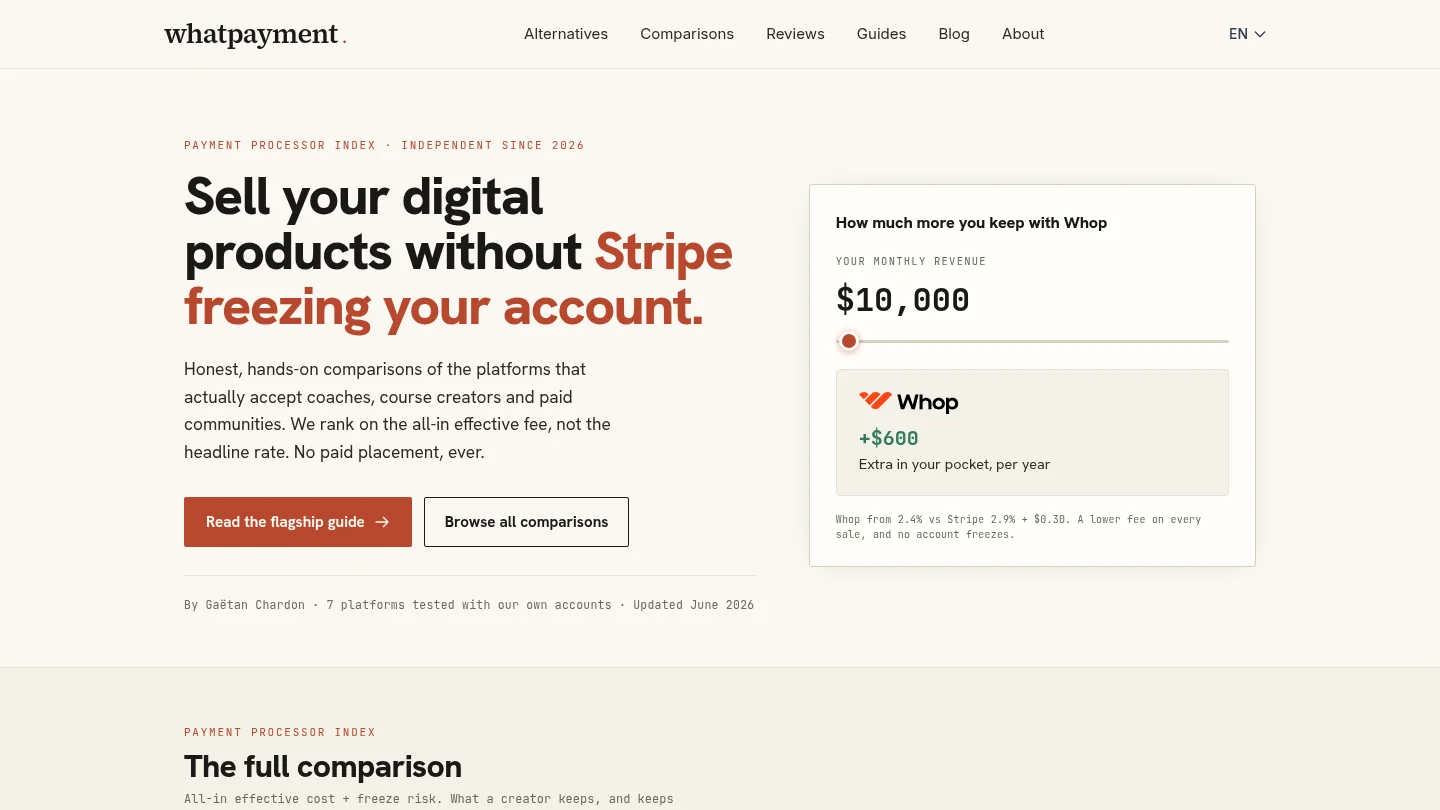
Use our independent comparisons, reviews, fee analysis, and decision guides to assess platforms before you commit to a launch or migration. If Stripe no longer fits your SaaS model, explore our Stripe alternatives for SaaS research and compare the relevant trade-offs with greater clarity.
Frequently Asked Questions
What is the best payment processor for a creator living abroad?
There is no universal answer because your residence, US entity, product category, customer countries, and payout requirements all affect suitability. Start with a platform that clearly explains underwriting, settlement, tax responsibility, and account review procedures.
Should a digital creator use a Merchant of Record?
A Merchant of Record can reduce some tax and selling administration for eligible digital products. You should still review the contract, supported countries, excluded categories, refund rules, payout terms, and customer relationship implications.
Are payment processors ranked by transaction volume automatically better?
No. Processing volume measures scale, not fit for a displaced creator. A smaller platform may provide a more suitable payout workflow, product model, or risk policy for your specific business.
How should I compare payment fees?
Compare the complete cost of a realistic transaction mix, including fixed fees, international cards, currency conversion, refunds, disputes, subscriptions, payout charges, and any required external tools. If a fee is not verified for your account and market, treat it as Non defini pour le moment.
Can ad-intelligence tools replace payment validation?
No. Ad-intelligence tools can help you research creative angles and offer positioning for digital products. They cannot confirm processor approval, payout reliability, tax treatment, customer demand, or chargeback exposure.