What you'll get
SaaS Payment Processing Architecture for High Involuntary Churn
payment processing for saas with high involuntary churn architecture: design retry, recovery, and billing systems for global SaaS.

Founder & Editor
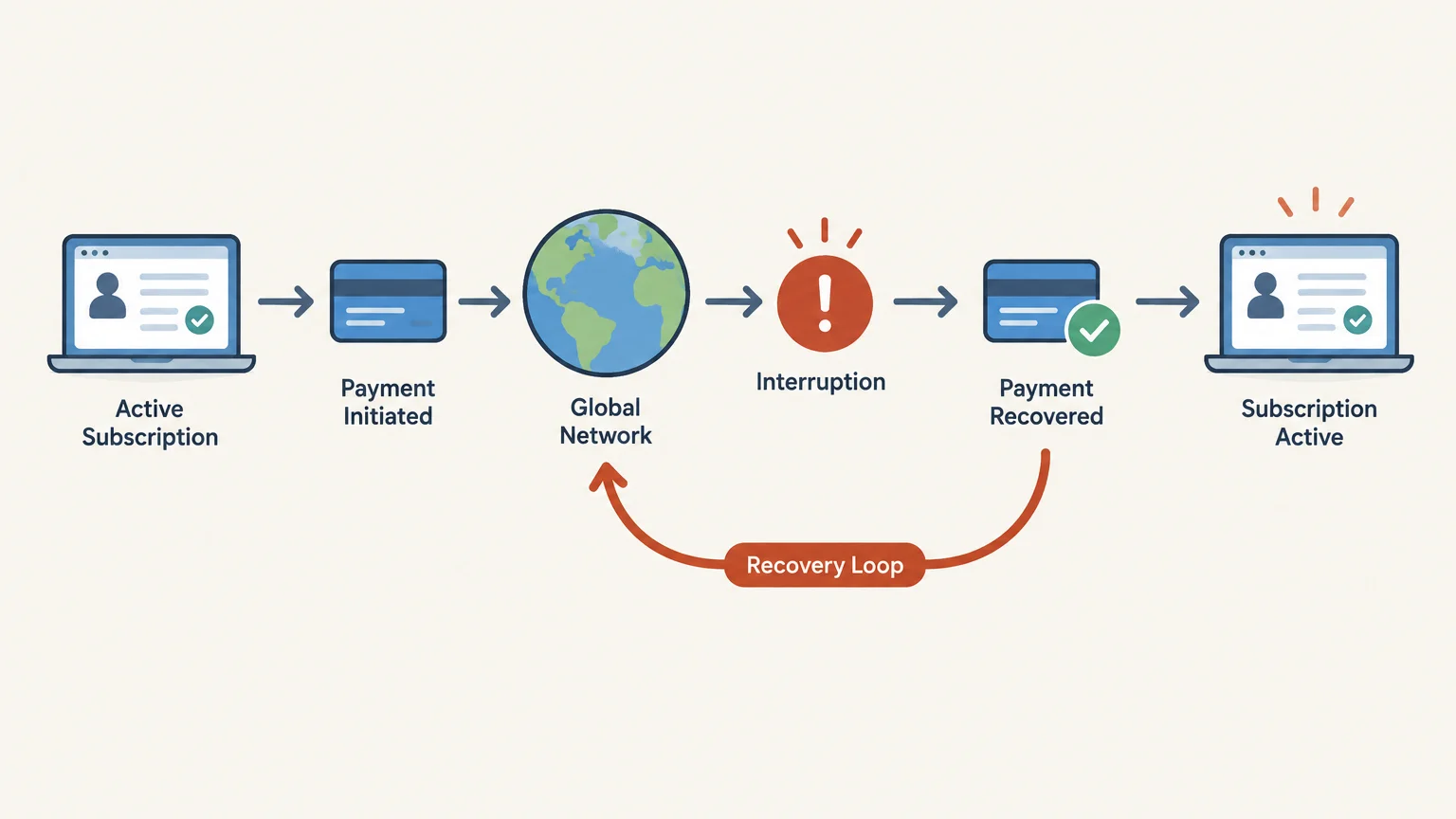
A renewal failure does not always mean a customer chose to leave. It can mean that a card expired, an issuer declined a charge, or a temporary issue interrupted collection. The architecture should make those events visible and give each one a defined recovery path. When comparing payment processors for SaaS, look beyond checkout: recurring billing, recovery controls, supported locations, and the consequences of a payment hold all affect how reliably a subscription stays paid.
For a US LLC owner living abroad, the design has another constraint: the owner’s residence, company details, customer countries, and settlement arrangements may not line up neatly. That makes it important to separate the billing system from the processor and to check the actual provider terms before choosing a setup. Ad intelligence tools that monitor ads or help validate offers answer a different question: whether an offer attracts demand. They do not recover a failed renewal once a customer has subscribed.
- Track failed renewals separately from customer initiated cancellations.
- Use payment failure reasons to decide whether and when another attempt is appropriate.
- Send a clear update request when the customer needs to change payment details.
- Keep subscription status, product access, and payment events aligned.
- Check provider eligibility, payout currency, and tax responsibilities for the company’s actual setup.
• Separate failed payments from customer cancellations
- Start with one operational distinction: a billing failure and a customer decision to cancel are different events.
A churn dashboard that combines the two can hide a recoverable problem inside an ordinary retention metric. Record the subscription’s status, the invoice or renewal attempt, the payment outcome, the processor’s decline information, and any recovery action. This lets the team identify whether a customer intentionally ended the service, a payment method needs attention, or a temporary issuer response might justify another attempt.
The distinction is useful even before adding new payment infrastructure. A 2023 PYMNTS report, based on a survey of 200 subscription industry executives conducted in 2022, found that 17% of surveyed firms tracked failed payments. The figure describes that survey, not the whole SaaS market in 2026, but it illustrates why a team should measure failed payments directly rather than infer them from total churn. The report is available in PYMNTS’ survey report.
Define the event flow before you set targets. For example, an invoice can move from due, to payment attempt, to failed, to recovery pending, then to paid or closed. A cancellation initiated by the customer should follow a separate path. Keep the event history when a subscription changes state, so support and engineering can see whether access ended after an explicit cancellation or after an unresolved payment failure.
Choose recovery metrics that explain what happened. Track failed renewal count and value, recovery by failure reason, time to successful payment, customer payment updates, and subscriptions closed after recovery attempts. Compare similar billing periods and customer groups. Do not treat every failed attempt as recoverable revenue, and do not assume a retry worked just because a later webhook arrived. Confirm the final invoice and subscription state.
• Build a payment recovery lifecycle around events
- For each payment failure, connect the billing event to an appropriate retry, customer message, or payment update.

A recovery workflow begins when your billing system receives a result, not when a customer complains about losing access. The system should record the result, classify it using the information available from the processor, and decide whether the next action is an eligible retry, a request for updated payment details, a support review, or no further attempt. Avoid treating every decline as a signal to charge repeatedly. A retry policy should respect processor guidance and applicable network rules.
Customer communication is part of the recovery system, not an afterthought. Tell the customer that a renewal did not complete, explain what action they can take, and provide a secure route to update payment details. Avoid exposing sensitive payment information in email or support notes. If you provide a grace period before restricting product access, make its start and end conditions explicit and ensure they match the subscription records.
Apple’s StoreKit documentation offers a useful example of explicit billing states in an app store environment: it describes a billing retry state and gives subscribers a way to update payment details. Its retry process applies to App Store subscriptions, not direct web billing, so it should not be copied as a universal SaaS rule. The relevant design principle is to make the recovery state and customer action visible, as shown in Apple’s StoreKit guidance.
Make the workflow safe to repeat. Payment providers can send duplicate or delayed event notifications, so process events idempotently: the same event should not create duplicate invoices, retry sequences, emails, or access changes. Reconcile the billing system’s record with the processor’s final payment status before changing a subscription to paid or permanently ending service.
• Keep billing, processing, and international settlement distinct
- Separate the subscription rules from the processor connection so that plan state and payment outcomes remain understandable.
Billing determines what is owed, when renewal is due, how plan changes affect the next invoice, and what happens to access after a failed payment. The processor handles payment attempts and returns outcomes. A payment gateway can connect the checkout or billing application to processing services, while an orchestration layer coordinates multiple providers where a business has a real need for that complexity. These roles can overlap in a vendor’s product, so assess the actual contract and implementation rather than relying only on labels.
A practical architecture keeps a stable internal subscription record and maps provider events into it. Store a provider reference for the customer and payment method, invoice state, attempt history, currency, and the reason for the latest outcome. Keep payment credentials with the provider through its supported tokenization approach rather than copying sensitive card data into your own application. Use webhooks or equivalent event notifications to update your system, then reconcile against provider records when events are missing or inconsistent.
| Setup | Who handles the payment layer | Key design consideration |
|---|---|---|
| One processor with subscription billing | A processor or billing provider handles the configured recurring payment workflow. | Confirm how retries, customer updates, plan changes, and event reporting work in your account and countries. |
| Separate billing system and processor | Your billing system manages subscription rules, while the processor handles payment attempts. | Keep invoice status, processor outcomes, and product access synchronized through reliable event handling. |
| Merchant of Record arrangement | The Merchant of Record is the legal seller under its terms and takes on stated tax related responsibilities. | Review the agreement, eligible business locations, customer coverage, payout terms, and tax allocation. |
For an international operator with a US LLC and a different country of residence, check eligibility against the actual company, owner, and payout details before migrating subscriptions. Also verify which customer countries and currencies are supported, how conversion is handled, what settlement currency is available, and how account reviews or reserves affect access to funds. These are separate questions from whether the provider can retry a failed renewal.
When evaluating subscription payment processors, we examine subscription capability alongside effective costs, geographic coverage, payouts, account holds, and the allocation of tax responsibilities. That comparison helps distinguish a tool that merely accepts recurring payments from an arrangement that fits the business’s wider operating and compliance needs.
• Add routing and recovery controls only for defined failure cases
- Add a second processor or a dedicated recovery layer only after data shows which failure it is meant to address.
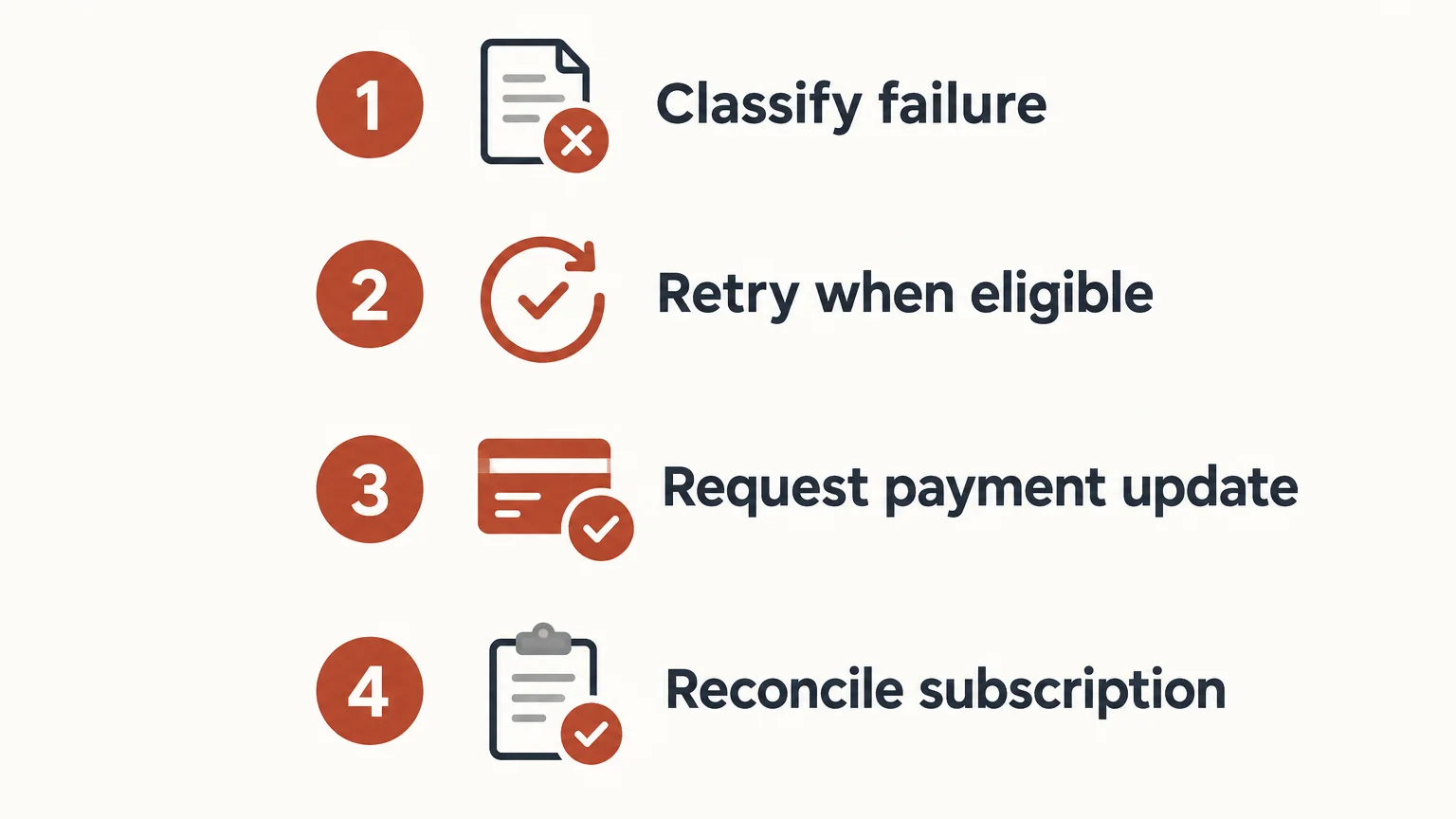
A second processor can address processor outages, local payment acceptance needs, or concentration risk, but it adds operational work. The system needs a routing policy, provider specific payment references, consistent invoice reporting, dispute handling, refund procedures, and a plan for deciding which processor owns each subscription. Do not send a failed payment to another processor automatically without first checking why it failed. A decline tied to an expired card will not necessarily be fixed by changing the processor.
Separate retry logic from failover logic. A retry means attempting the same payment again under conditions where another attempt is appropriate. Failover means sending a transaction through a different provider because a defined routing condition has been met. Keep a record of the reason for each decision, and ensure that neither process creates duplicate charges. Before enabling automated routing, test declines, timeouts, duplicate events, refunds, disputes, and reconciliation across providers.
A 2026 Recurly analysis reported that optimized retry strategies improved recovery in its enterprise transaction data from approximately 53% to 71%. Those figures describe the analysis, not a guaranteed result for a different SaaS business, processor, or customer mix. The useful takeaway is to test retry policy against your own failure reasons before assuming that replacing the entire billing stack is necessary. The findings appear in Recurly’s recovery analysis.
Ad intelligence belongs earlier in the customer lifecycle. Ad spy tools and offer validation research can help an infopreneur assess what messages and offers appear in paid advertising, but they do not diagnose a renewal decline or update a failed payment method. Keep acquisition analysis separate from billing recovery, then connect the two through cohort reporting: compare payment failures and retention across acquisition sources without treating ad engagement as evidence that a renewal will succeed.
For a smaller stack, resilience can mean clear alerts, working recovery messages, a secure update flow, and a tested manual support procedure rather than multiple processors. For a larger or more geographically diverse operation, compare the measurable value of local payment methods and provider redundancy with the cost of maintaining routing, reconciliation, and support across providers. Our guide to payment gateways for subscriptions helps frame that choice around subscription requirements rather than checkout alone.
Verdict: Design recovery before adding complexity
Payment processing architecture for SaaS with high involuntary churn starts with accurate event tracking, a reason aware recovery path, clear customer updates, and consistent subscription state. Add routing or a second processor only when measured failures show that one provider or payment method is a material constraint. For an international US LLC operator, verify the company’s eligibility, settlement options, customer coverage, payout conditions, and tax allocation before migrating live subscriptions. The right design is the simplest one that recovers eligible payments without creating duplicate charges or unclear access decisions.
Compare SaaS payment infrastructure with clearer criteria
Choosing a processor is only one part of reducing billing risk. The operating model, country eligibility, payout terms, tax responsibilities, recovery features, and effective cost all shape whether an arrangement fits a SaaS business whose owner and customers are spread across borders.

Our editorial comparisons use hands on testing, test accounts, official documentation, fee research where available, defined evaluation criteria, and creator feedback. We compare platforms by business model rather than presenting one provider as right for every operator. We disclose affiliate relationships, vendors do not pay for placement, and our articles are revisited quarterly with stale information corrected. Explore our Stripe alternatives for SaaS to compare options for your own billing requirements.
Frequently Asked Questions
What is involuntary churn in SaaS?
Involuntary churn occurs when a subscription ends because a renewal payment fails rather than because the customer chose to cancel. Track it separately from customer initiated cancellations so the recovery process can address the cause.
Should every failed subscription payment be retried?
No. Use the processor’s outcome information and retry rules to determine whether another attempt is appropriate. Some failures need a payment method update or customer support instead of another charge attempt.
Does a second processor automatically prevent involuntary churn?
No. A second processor can address specific routing or provider availability needs, but it also adds reconciliation, refund, dispute, and support work. First identify the failure cases a second provider is intended to solve.
What should a US LLC owner living abroad verify?
Check provider eligibility against the company and owner details, supported customer countries, settlement currencies, payout arrangements, account review terms, and tax responsibilities. Confirm these points in the provider’s current terms before moving subscriptions.
How can WhatPayment help with processor selection?
Our reviews and buyer guides compare payment platforms using criteria such as effective fees, Merchant of Record status, geographic coverage, payouts, holds, and subscription capabilities. They are editorial resources for comparing third party services, not payment processing or implementation services.
Keep reading
Browse all guidesBlog
FastSpring vs Paddle for Software Distribution: 2026 Guide
Blog
Best Payment Processor for Online Courses in 2026 for Creators
Comparison
Minea vs Pipiads for Infopreneurs: Honest Verdict
Comparison
Whop vs Gumroad (2026): Which Costs Less for Creators?
Comparison
Whop vs Teachable (2026): Honest Cost Breakdown and Verdict
Comparison