What you'll get
Payment Processor Selection for Global Digital Products
Payment processor selection for a US LLC abroad: compare eligibility, fees, payout reliability, global coverage, and tax responsibility.

Founder & Editor
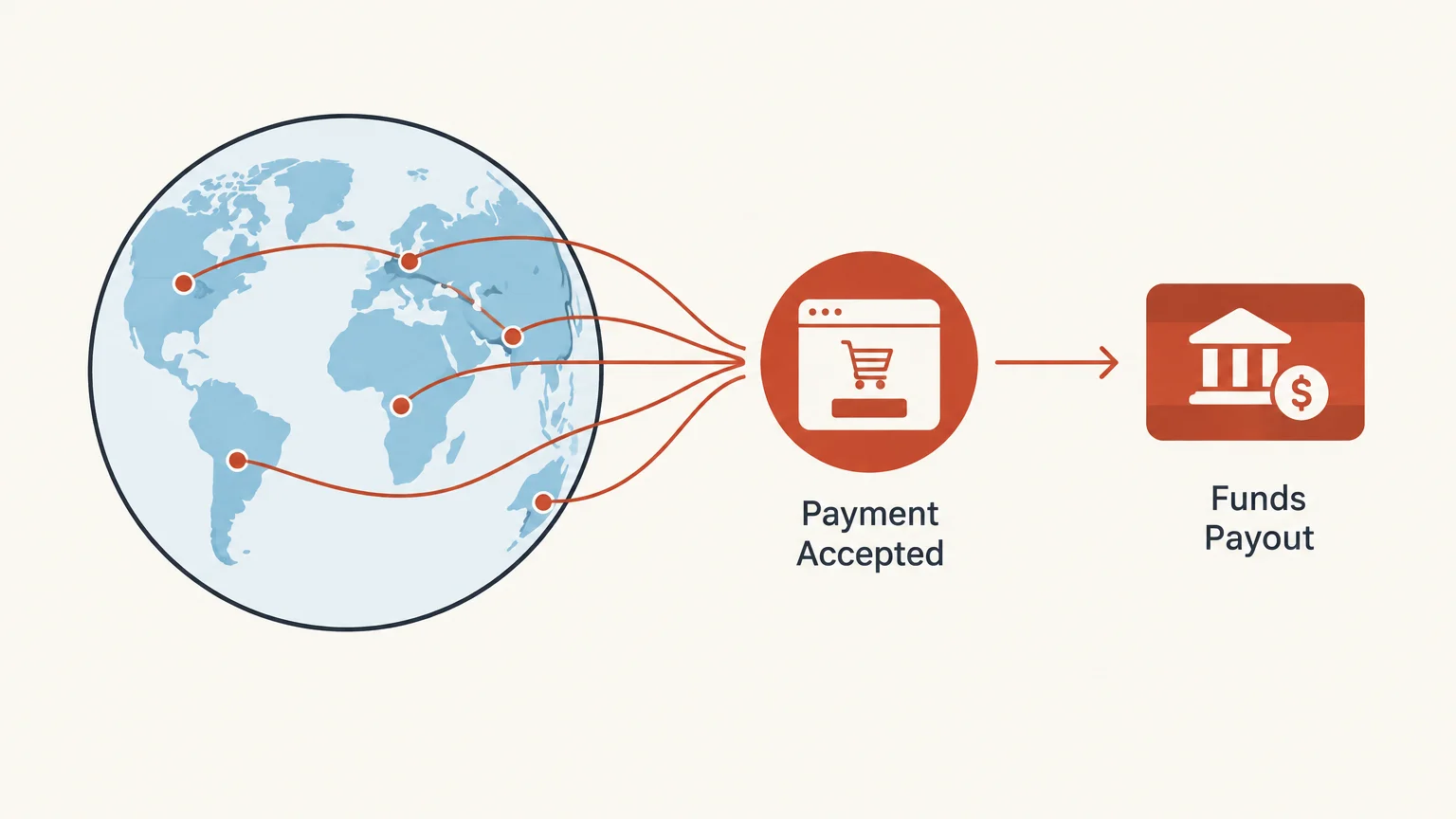
A processor that accepts a US LLC may still require the owner’s residence, identity documents, and payout account to meet its onboarding rules. For this payment processor selection, compare the full account setup, not just the checkout rate. Our guide on how to compare merchant service providers is a useful starting point for looking beyond headline pricing.
Living abroad can add practical complications: your legal entity, personal address, customer locations, and bank accounts may be in different countries. Treat those details as selection criteria from the start. A platform’s country list or currency support does not, by itself, confirm that your specific LLC and residence combination is eligible.
Key takeaways for a US LLC owner abroad
Confirm that the provider accepts your LLC’s country of formation and your actual country of residence.
Compare transaction charges alongside currency conversion, payout charges, subscriptions, and other applicable costs.
Check which currencies customers can use and which currencies you can receive in your payout account.
Determine whether you remain the legal seller or the platform acts as a Merchant of Record.
Ask how payouts, reserves, account reviews, refunds, and disputes work for your business model.
These are connected questions, not separate boxes to tick once. For example, accepting customer payments in a currency does not establish that you can receive payouts in that currency, or that a conversion will not be applied. Likewise, a payment provider’s tax features do not automatically determine your company’s own income tax or filing responsibilities.
Will your LLC and residence qualify?
Verify the account holder requirements for both your business entity and your personal residence.
Check which address, identity, tax, and bank documents are required before moving a launch or subscription base.

A US LLC does not erase the difference between the company’s legal details and its owner’s current circumstances. Before applying, ask the provider directly whether it supports your exact combination of entity type, formation country, residence, and payout bank. Keep answers in writing, and do not assume a general statement that a service supports US businesses answers the nonresident-owner question.
Prepare consistent records for your legal business name, company formation, tax identification, personal identity, operating address, website, product description, and bank details. If the names or addresses differ across documents, find out which explanation or supporting record the provider requires before submitting the application. Make sure the product description matches what customers actually buy, such as a course, membership, download, coaching offer, or software subscription.
U.S. payment activity is substantial, but domestic transaction totals do not establish international eligibility. The Federal Reserve’s 2026 release reports 236.6 billion U.S. noncash payments in 2024, with cards accounting for over three quarters of payments by number, as summarized in the Federal Reserve findings. For a seller abroad, those figures are context, not a substitute for checking provider rules for your residence and customers’ countries.
Compare the payment model, not just the platform name
A direct payment service provider generally processes transactions while you remain the seller.
A Merchant of Record can take the legal seller role and specified tax-related responsibilities.
A creator platform may bundle selling or delivery functions, so check the contract to understand its exact role.
The model affects your bookkeeping, tax workflow, checkout setup, and responsibilities when something goes wrong. In a direct processor arrangement, do not assume that a payment provider’s checkout or tax calculation feature makes it responsible for your tax filings. With a Merchant of Record, read the terms to identify which transactions and tax obligations it covers, and which business or income-tax duties remain yours.
| What to compare | Direct processor | Merchant of Record | Bundled creator platform |
|---|---|---|---|
| Who sells to the customer | You generally remain the seller and contract directly with the customer. | The platform takes the legal seller role for covered sales. | Check the terms to identify whether you or the platform is the seller. |
| Tax responsibility | You remain responsible for your seller obligations under the applicable rules. | The platform takes specified tax-related liability for covered sales, as defined by its terms. | Do not infer tax responsibility from a tax feature or checkout label. |
| Product and checkout fit | Check whether it connects to your delivery, subscription, and access systems. | Check supported product types, subscription terms, and customer workflow. | Check which selling, delivery, and access features are included in your plan. |
| Fees and payouts | Compare processing, currency conversion, payout, dispute, and monthly charges. | Compare the complete deduction from a sale and the payout schedule. | Check platform charges as well as processing and withdrawal costs. |
Use the same questions for every option. A percentage that looks low may not describe the full cost, while an all-in platform charge may include services you would otherwise arrange separately. Precise provider-specific fee schedules are Non defini pour le moment in this comparison, so check each provider’s official pricing and terms before estimating your margin.
Check customer-country coverage and payout routes
List your highest-priority customer countries and the payment methods those buyers can use.
Trace how each sale moves from customer payment to your usable bank balance.
International payment processors differ in the markets and currencies they support, how they handle conversion, and where they can send payouts. Separate three checks: the customer’s ability to pay, the currency the provider settles, and the currency and country of your receiving account. Ask whether a conversion occurs at checkout, during settlement, or when funds reach your bank, and identify the rate or charge that applies at each step.
A 2026 global e-commerce report from the Merchant Risk Council says surveyed merchants accepted cards at 76%, digital wallets at 68%, and bank transfers or direct debit at 63%. These are merchant acceptance figures, not a guarantee that a particular customer in a particular country will see those methods. Still, they show why a global seller should compare payment methods alongside card coverage. See the 2026 global payments report for its survey context.
Then map payouts end to end. Confirm the available payout methods, expected timing, minimum thresholds, fees, currency conversions, and what happens when an account is under review. Ask whether the provider uses reserves or can delay funds, and whether the policy differs for a new account, a sudden sales increase, or your product category. These answers matter especially when course launches or annual renewals concentrate revenue into short periods.
Calculate the full cost and shortlist providers
Use your own order value, monthly sales, customer locations, and refund or dispute history.
Compare total deductions and operational requirements on the same sales scenario.
Build a simple worksheet with the average order value, expected transaction count, share of international payments, currencies charged, currencies received, and any recurring billing. Add every applicable cost: percentage and fixed transaction charges, foreign-card or cross-border surcharges, currency conversion, monthly fees, payout charges, refund treatment, and dispute fees. Where a provider does not publish a value, write Non defini pour le moment and request a written answer rather than treating an unknown as zero.
For instance, a creator selling a low-priced template has many fixed charges relative to each sale. A coach with fewer high-value payments may care more about percentage charges, payout delays, and dispute handling. A subscription seller should check recurring billing, failed-payment recovery, plan changes, and whether customer access can be managed without stitching together several services.
Make the shortlist from those actual needs, then compare official terms and product documentation. Our best payment processors coverage and payment processor rankings help readers compare platforms by effective cost, payout behavior, tax responsibility, and business-model fit. Our editorial process combines test accounts, public documentation, fee calculations, and defined criteria. We disclose affiliate relationships, do not accept paid placement, and revisit articles quarterly, but pricing and eligibility still need confirmation with the provider before you commit.
Finally, test the operational path before switching all customers. Confirm onboarding, process a limited number of real transactions, reconcile sales with payouts, and test refunds and customer support. For subscriptions or paid communities, verify that billing status and access changes stay in sync. A second approved payment route can reduce dependence on one account, but it should be reviewed and tested rather than left as an unverified emergency option.
Keep ad intelligence separate from payment readiness
Use ad-intelligence tools to research creative patterns and assess interest in an offer before committing to a build.
Use payment-provider checks to confirm that the offer, entity, location, and payout path are acceptable.
Ad-spy research and offer validation can inform what you choose to sell, but they do not answer whether your payment provider will onboard your business or support a particular customer market. Treat these as two separate decisions. First, use a clear test to evaluate the product idea, such as checking whether the intended audience responds to the problem and offer. Then independently confirm that your provider’s terms allow the product category and your operating setup.
This distinction matters for infopreneurs testing courses, coaching, templates, memberships, or other digital products. A promising ad angle does not demonstrate that the business model meets a processor’s risk rules, and an approved account does not demonstrate that a product has demand. Keep notes on the offer being tested, the provider’s written eligibility answer, and any conditions that affect checkout or payouts.
Payment infrastructure also changes as payment options and providers develop. A 2026 Bank for International Settlements bulletin describes retail payments as increasingly digital while noting that banks and card networks remain important alongside newer entrants. Its payment competition analysis supports a practical point for sellers: compare the actual markets and services you need rather than assuming that a provider’s global positioning guarantees local suitability.
Verdict on payment processor selection
The right payment processor choice for a US LLC owner living abroad starts with eligibility, then follows the money from the customer’s country to your payout account. Compare direct processors, Merchant of Record arrangements, and bundled creator platforms according to who sells, who handles specified tax responsibilities, what each sale costs, and how payouts and account reviews work. Shortlist only providers that confirm your entity and residence combination, then test the customer and payout workflow before relying on it for a launch.
Compare options for your digital business
When you are comparing providers, a headline rate is only one part of the decision. Your LLC’s location, your residence, customer countries, product type, tax responsibilities, and payout route all affect the practical fit.

Our editorial comparisons use test accounts, public documentation, fee analysis, and defined criteria to help readers assess those trade-offs. If your business sells software or subscriptions, explore our Stripe alternatives for SaaS coverage as one part of your research. Affiliate links may generate a commission after a qualifying action, while readers pay the same vendor price. Vendors do not pay for placement or review content before publication.
Frequently Asked Questions
Can a nonresident owner use a US LLC with a payment processor?
Some providers may accept a US LLC while applying separate requirements to its owner’s residence, identity documents, and payout account. Confirm your exact combination with the provider before you build your checkout around it.
Should I choose a direct processor or a Merchant of Record?
A direct processor may suit a business prepared to remain the legal seller and handle its own obligations. A Merchant of Record takes the seller role and specified tax-related responsibilities for covered sales, subject to its terms.
What should I include when comparing international payment processors?
Compare country eligibility, customer payment methods, supported currencies, conversion costs, payout methods and timing, account review policies, and tax responsibility. Check customer payment and seller payout coverage separately.
How do I calculate payment processing costs for digital products?
Model your typical order value and transaction count, then add all relevant processing, conversion, platform, payout, recurring billing, refund, and dispute charges. Replace unpublished figures with Non defini pour le moment until the provider confirms them.
Can ad-spy tools help me choose a payment processor?
Ad-intelligence tools can support offer research, but they do not confirm a payment provider’s eligibility rules or tax arrangements. Our payment processor comparisons and rankings focus on those separate infrastructure questions.
Keep reading
Browse all guidesBlog
Payment Processor Rankings 2026 for Digital Creators Abroad
Blog
Best BNPL for Membership Sites in 2026: 8 Options Compared
Guide
How to Get Whop Earnings to a Bank You Control (2026)
Guide
Stripe Account Frozen: The 2026 Recovery Playbook
Guide
Stripe Banned My Account: 48-Hour Migration Playbook
Guide