What you'll get
Payment Processor Rankings 2026 for Digital Creators Abroad
payment processor rankings 2026 for digital creators abroad, comparing fees, tax responsibility, payouts, risk, and global customer fit.

Founder & Editor
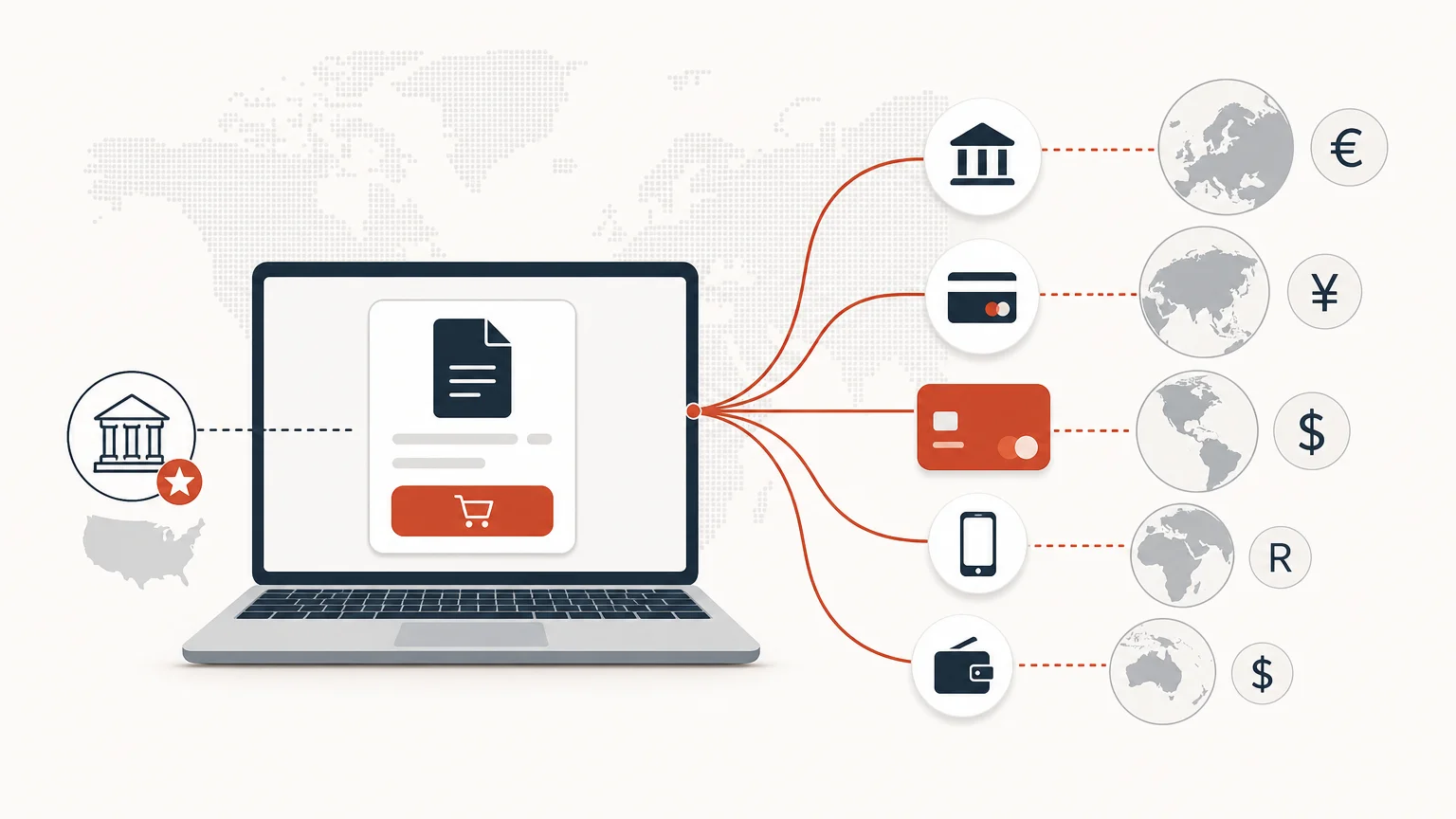
What happens when your customers live in several countries, your company is a US LLC, and you operate from abroad? The cheapest advertised rate may not be the best answer. You need to compare payment access, currency conversion, payout reliability, account reviews, tax responsibility, and fit for digital products. Our broader top payment processors research uses that wider lens, rather than ranking platforms only by brand recognition.
These payment processor rankings 2026 focus on digital products, courses, memberships, communities, software, and SaaS. A published online card benchmark for small businesses is around 2.9% plus $0.30, but your effective cost can change materially with international cards, currency conversion, disputes, subscriptions, and payout terms. NerdWallet’s processor research also shows why the right choice depends on the business model, not just the headline percentage.
Key takeaways
- Whop ranks first when a creator wants payment collection and digital business operations closely connected.
- Stripe ranks first for developers who need flexible checkout, subscriptions, APIs, and international payment methods.
- Paddle is the clearest candidate when Merchant of Record responsibilities are more important than full processor control.
- PayPal can support international checkout, but its published fee structure varies by payment type and includes an additional international percentage for many commercial transactions.
- Adyen, , and Worldpay are more naturally suited to high growth or enterprise operations than to an early stage creator business.
How these payment processor rankings were built
- Cost: We prioritize effective all in cost, including fixed fees, international charges, currency conversion, subscriptions, disputes, and payouts.
- Tax responsibility: We separate ordinary payment processing from Merchant of Record coverage, because the seller and the tax obligations may not be the same.
- Operational risk: We consider account reviews, reserves, holds, freezes, chargebacks, support, and payout reliability.
- Business fit: A course creator, paid community, SaaS company, and enterprise marketplace do not need the same infrastructure.
- Evidence: Our editorial process uses test accounts where available, official documentation, fee information, fine print, creator feedback, external sources, and quarterly article reviews.
Large payment volume does not automatically mean strong creator fit. The 2026 TSG directory shows that the U.S. market includes merchant acquirers, payment facilitators, gateways, and embedded payment companies with very different roles. TSG’s merchant acquiring directory is useful context, but a creator should not confuse processing scale with suitable checkout, tax, or payout operations.
Your company structure also deserves separate advice. The IRS explains that an LLC may receive different federal tax treatment depending on its ownership, elections, and number of members. A nonresident owner should therefore treat processor selection and tax compliance as connected decisions, but not as the same decision. The IRS LLC guidance is a starting point, not a substitute for advice from a qualified professional.
2026 ranking at a glance
| Rank | Processor | Best fit | Merchant of Record position | International operations | Fee visibility |
|---|---|---|---|---|---|
| 1 | Whop | Creators, communities, and digital products | Non defini pour le moment | Strong platform oriented fit | 2.7% plus $0.30, roughly 3% effective |
| 2 | Stripe | Developer led digital businesses and SaaS | Standard processing is not MoR | Broad methods and currency coverage | Published baseline, extras vary by use |
| 3 | Paddle | Software and digital products needing MoR coverage | MoR model | Designed for global digital selling | Non defini pour le moment |
| 4 | PayPal | Trusted wallet checkout and international buyers | Not a standard MoR solution | Broad consumer recognition | Varies by payment type and market |
| 5 | Braintree | Custom checkout, mobile products, and subscriptions | Not a standard MoR solution | International support available | Custom and volume pricing may apply |
| 6 | High growth digital businesses | Not a standard MoR solution | Strong local acquiring orientation | Custom pricing | |
| 7 | Adyen | Enterprise digital businesses and unified commerce | Not a standard MoR solution | Very broad enterprise coverage | Custom or method based |
| 8 | Worldpay | Large companies with complex processing needs | Not a standard MoR solution | Enterprise cross border infrastructure | Custom contracts |
1. Whop
Best for: Digital creators who want payments, products, memberships, communities, and daily business operations close together.
Whop takes the top position because its model is closer to the way many modern creators actually operate. A course, paid community, coaching offer, software product, or digital download may need checkout, recurring billing, customer access, and payouts rather than a standalone card processor alone. Whop’s stated fee is 2.7% plus $0.30 per transaction, which is roughly 3% effective for a typical digital sale. Any older figure suggesting around 6% is obsolete.
Pros:
- The platform is closely aligned with digital products, memberships, communities, and creator led businesses.
- The published fee is easy to understand compared with a stack of separate processing and access tools.
- It can reduce the operational gap between collecting payment and granting access.
Cons:
- It may be less suitable if you need a deeply customized processor architecture outside an integrated platform model.
- Merchant of Record status and the exact allocation of tax responsibility should be confirmed for your specific offer.
2. Stripe
Best for: Developers, SaaS companies, marketplaces, and digital businesses that need flexible payment infrastructure.
Stripe ranks second because it offers the strongest general purpose technical foundation in this group. Its payment methods, APIs, checkout tools, subscription billing, fraud controls, and payout capabilities make it suitable for a business that expects to build a custom customer journey. It is also a strong choice when your product needs usage based billing, trials, upgrades, downgrades, or more complex subscription logic.
The trade off is responsibility. Standard Stripe processing does not make Stripe the legal seller of your digital product. You remain responsible for the commercial relationship and related tax questions unless you use a separate Merchant of Record service. International cards, currency conversion, disputes, and additional products can also increase effective cost beyond the basic rate.
Pros:
- Strong APIs and documentation for custom checkout and SaaS billing.
- Broad international payment method and currency coverage.
- Good support for subscriptions, retries, plan changes, and payment links.
Cons:
- The business usually retains more tax, dispute, and compliance responsibility.
- Costs can become harder to model when several international and billing features are active.
3. Paddle
Best for: Digital products and software businesses that want a Merchant of Record model.
Paddle ranks third because it addresses the problem that many displaced creators underestimate: accepting a payment is not the same as managing the legal selling relationship in every customer market. As a Merchant of Record candidate, Paddle can be more relevant than a conventional processor when indirect tax collection, remittance, invoicing, and global digital selling are central concerns.
The main limitation is control. A Merchant of Record model can simplify responsibility, but it may not provide the same level of control as a processor that sits directly inside your own billing architecture. Current pricing, eligibility for your exact product category, payout details, and treatment of communities or services are Non defini pour le moment in this ranking. Our Stripe vs Paddle for payments comparison is useful when the core decision is control versus operational simplicity.
Pros:
- Merchant of Record positioning is highly relevant to global digital products.
- It can be a better fit than ordinary processing when tax administration is a major concern.
- It is more naturally aligned with software and digital goods than with physical commerce.
Cons:
- Current fees and eligibility need to be confirmed before any financial model is finalized.
- The model may be less attractive when you need complete control over the merchant relationship and checkout stack.
4. PayPal
Best for: Creators who want a familiar wallet option that many international customers already recognize.
PayPal remains relevant because checkout familiarity can matter when a buyer is purchasing from a creator who operates across borders. It can work as an additional payment option alongside another processor, especially when customers prefer to pay from an existing wallet rather than enter card details.
Its weakness is cost and operational complexity. PayPal’s U.S. commercial fee schedules distinguish between card payments, PayPal Checkout, Venmo, invoicing, Pay Later, international transactions, and optional services. The published schedule also adds an international percentage to many commercial transactions. That makes a simple headline comparison unreliable. Account reviews, reserves, disputes, and support should be part of the decision, particularly if your sales volume can change quickly.
Pros:
- Strong consumer recognition in many international markets.
- Useful as a secondary checkout option for buyers who prefer wallet payments.
- Fast deployment for creators who do not want to build a custom payment experience.
Cons:
- Fees vary substantially by payment method and international transaction type.
- Creators should investigate review, hold, reserve, and dispute procedures before relying on it as the only rail.
5. Braintree

Best for: Subscription products, mobile applications, and businesses needing custom checkout with PayPal group reach.
Braintree is a credible option for a digital business that wants more control than a hosted wallet checkout provides. Its positioning is relevant to mobile and web applications, recurring billing, tokenized payment details, and customized user journeys. It may suit a SaaS product or digital service with an engineering team that wants to manage more of the checkout experience.
For a creator selling courses, communities, or downloads, the question is not only whether Braintree can process a payment. You also need to consider access gating, tax responsibility, subscription recovery, customer support, and the tools required to connect payment status with customer access. Current pricing for your business model and volume is Non defini pour le moment, so a direct quote is necessary.
Pros:
- Suitable for custom web and mobile payment experiences.
- Relevant subscription and tokenization capabilities.
- Access to payment methods associated with the wider PayPal ecosystem.
Cons:
- It may require more technical work than a creator platform with built in access operations.
- Community gating and digital product workflows may require separate tools or integrations.
6.
Best for: High growth digital businesses expanding internationally and optimizing payment performance.
ranks sixth because its strengths are more relevant to a scaling payments team than to a new creator. The platform focuses on online payment acceptance, fraud controls, payment performance, local acquiring, and operational visibility across currencies and markets. It can become attractive when authorization rates, cross border routing, and payment analytics have a direct impact on revenue.
The practical limitation is access and commercial complexity. is usually evaluated through a sales led process, and pricing is custom. A displaced creator should not choose it merely because it supports many markets. The business must have sufficient volume, technical resources, and a clear reason to move beyond a creator oriented or self serve platform.
Pros:
- Strong fit for international digital businesses with meaningful transaction volume.
- Payment performance and fraud controls are central to its positioning.
- More relevant than a basic PSP when local acquiring and routing require attention.
Cons:
- Custom pricing makes early stage cost modeling difficult.
- Onboarding and integration may be disproportionate for a solo creator or small infopreneur.
7. Adyen
Best for: Enterprise digital businesses that need global acquiring, advanced risk tools, and unified payment operations.
Adyen is one of the strongest choices in the ranking for a large international company, but it is not automatically a strong choice for an individual creator. Its value increases when a business operates across multiple regions, payment methods, entities, and sales channels. Global acquiring and centralized payment data can matter when transaction volume is high and payment performance deserves dedicated management.
For a US LLC owner living abroad, Adyen may be worth considering only after the business has outgrown simpler infrastructure. Enterprise onboarding, underwriting, integration, and commercial requirements can create more work than they solve for a course seller or small SaaS founder. Its pricing for a specific creator business is Non defini pour le moment.
Pros:
- Strong international and enterprise payment infrastructure.
- Relevant fraud and authorization capabilities for large transaction volumes.
- Good fit for businesses that need more control across regions and channels.
Cons:
- Likely excessive complexity for an early stage creator business.
- Custom commercial terms make comparison with simple creator platforms difficult.
8. Worldpay
Best for: Large companies that need established enterprise processing and cross border infrastructure.
Worldpay completes the ranking because it remains relevant to larger merchants with complex processing requirements, established finance teams, and negotiated commercial agreements. Its enterprise orientation can support businesses that value scale, acquiring relationships, and broad payment operations over a simple self serve launch.
For the displaced creator, Worldpay is usually a later stage option rather than a starting point. The important question is whether your business has the transaction volume, underwriting profile, reporting needs, and technical capacity to benefit from an enterprise processor. Its fit for creator scale digital products, current terms, and effective cost are Non defini pour le moment without a direct assessment.
Pros:
- Relevant enterprise infrastructure for complex international operations.
- Suitable for businesses with dedicated finance, risk, and technical teams.
- Can be considered when a simple PSP no longer meets processing requirements.
Cons:
- Creator scale businesses may receive little practical benefit from the added complexity.
- Custom contracts make transparent comparison difficult before a sales process.
What a displaced creator should check before choosing
- Entity and residence: Your US LLC, personal residence, customer locations, bank account, and payout destination may all affect onboarding and review.
- Tax model: Confirm whether you remain the seller responsible for indirect taxes or whether a Merchant of Record assumes defined responsibilities.
- Customer geography: List the countries where customers actually pay, not only the countries shown on a provider’s marketing page.
- Payout resilience: Ask how long payouts take, what triggers a review, whether reserves can apply, and which payout rails are available.
- Access operations: If you sell a community, course, or membership, determine whether access is native or requires a separate integration.
- Backup planning: A critical digital business should know how it would continue selling if one account is reviewed, restricted, or delayed.
Ad intelligence belongs earlier in the workflow than many creators expect. An ad spy tool can help you study creative patterns, angles, and market activity, while an offer validation tool can help you test whether the promise, audience, and price deserve more acquisition spending. These tools do not replace payment diligence, but they can reduce the risk of building payment infrastructure around an offer that has not been validated.
Payment and acquisition should still be judged separately. A strong ad signal does not guarantee approval by a processor, and a reliable processor does not prove that an offer will convert. For higher risk categories or unusual business models, our guide to high-risk payment processors explains why category eligibility, underwriting, reserves, and dispute exposure deserve specific attention.
Verdict
For most displaced creators, Whop is the most practical first option when the priority is a connected digital business environment and a clearly stated 2.7% plus $0.30 processing fee. Stripe is the better technical foundation for a custom SaaS or subscription stack, while Paddle deserves serious attention when Merchant of Record responsibilities are central. PayPal can complement another processor, and the remaining enterprise platforms belong on a shortlist only when volume and operational complexity justify them. The best payment processor rankings 2026 are therefore use case rankings, not universal popularity contests.
Need a clearer processor shortlist?
Choosing between a processor, a Merchant of Record, and an integrated creator platform becomes harder when you live abroad and sell across several customer markets.

We compare payment infrastructure using effective all in fees, tax responsibility, payout behavior, account reviews, holds, chargebacks, subscriptions, access gating, and business model fit. If your next step is evaluating Stripe alternatives for SaaS payments, our editorial comparisons can help you narrow the field before committing to a provider.
Frequently Asked Questions
What is the best payment processor for a creator living abroad?
Whop is the strongest starting point when you want digital products, memberships, communities, and payments connected in one environment. Stripe may be better when you need a custom technical stack, while Paddle is more relevant when Merchant of Record responsibilities are the priority.
Is Whop still around 6% in fees?
No. The fee used in this ranking is 2.7% plus $0.30 per transaction, which is roughly 3% effective for a typical digital sale. The older around 6% figure is obsolete.
Should a US LLC owner abroad use a Merchant of Record?
A Merchant of Record can be relevant when indirect tax administration and the legal selling relationship across countries are major concerns. It does not remove every company, income tax, banking, or compliance responsibility, so professional advice remains important.
Is Stripe a Merchant of Record?
Standard Stripe processing is not the same as using a Merchant of Record. Stripe offers separate products and models that may address tax and global selling responsibilities, so you must distinguish ordinary processing from any additional service you activate.
Do ad spy tools replace payment processor research?
No. Ad intelligence can help validate demand, creative angles, and offers before you spend heavily on acquisition. It does not tell you whether a processor will approve your business, how payouts will behave, or who is responsible for tax and disputes.
Keep reading
Browse all guidesBlog
Best Payment Processor for Coaching Businesses Over 100k per Month
Blog
Best Payment Processor in 2026 for Global Digital Businesses
Comparison
Whop vs Kajabi (2026): Community vs Course Suite
Comparison
Whop vs Stan Store (2026): Which Platform Wins for Creators?
Comparison
Minea vs Pipiads for Infopreneurs: Honest Verdict
Comparison