What you'll get
Best Payment Processor for Coaching Businesses Over 100k per Month
Compare the payment processor for high volume coaching businesses over 100k per month, including fees, risk controls, payouts, and global support.

Founder & Editor

If you operate a US LLC while living abroad, the best payment processor for high volume coaching businesses over 100k per month must do more than authorize cards. It must handle launch spikes, recurring plans, international customers, account reviews, and predictable payouts. Our payment processing for high-ticket mastermind groups research is especially relevant when your offers combine coaching, cohorts, memberships, or private communities.
At this volume, a small difference in effective fees can become a material operating cost. However, a lower advertised rate is not useful if funds are held, payment plans fail, or your account lacks an escalation path. The right decision depends on your risk profile, transaction mix, customer geography, delivery model, and tax responsibilities.
Key takeaways for coaching businesses above $100,000 per month
- A dedicated merchant account can provide more underwriting context than a shared payment facilitator model, but approval still depends on your business, documents, history, and risk profile.
- Easy Pay Direct publishes a coaching rate of 2.69% plus $0.36 per online card transaction, with custom pricing available for higher volume merchants.
- Whop lists 2.7% plus $0.30 for successful domestic card transactions, with additional charges for international cards and currency conversion.
- Stripe lists standard domestic card pricing of 2.9% plus $0.30, while also offering custom pricing for large payment volumes or unique business models.
- PayPal and PayPal Enterprise Payments can improve buyer familiarity and wallet coverage, but their pricing and account models require careful review at scale.
- Adyen is built for enterprise payment operations, with interchange plus pricing in applicable markets and more complex onboarding than creator focused platforms.
What should you compare before choosing a high volume processor?
- Effective cost: Compare percentage fees, fixed fees, international surcharges, currency conversion, chargeback fees, gateway costs, reserves, and monthly minimums.
- Underwriting: Ask whether the provider reviews your coaching model, refund terms, fulfillment process, sales scripts, and historical processing volume before approval.
- Recurring billing: Confirm support for subscriptions, payment plans, retries, expired cards, failed renewals, refunds, and plan changes.
- International operations: Check customer card coverage, settlement currencies, payout countries, exchange rates, and documentation requirements for a nonresident owner.
- Risk controls: Review reserve policies, dispute alerts, fraud filters, transaction limits, account review procedures, and escalation contacts.
- Tax responsibility: Determine whether you remain the legal seller or whether the platform acts as a merchant of record for coaching businesses.
Do not evaluate the processor only from the checkout screen. A processor can look inexpensive while adding costs through currency conversion, payment failures, support delays, or lost sales during an account review. At your volume, operational continuity is part of the effective fee.
Comparison of payment processors for high volume coaching
| Rank | Provider | Best for | Key differentiator |
|---|---|---|---|
| 1 | Easy Pay Direct | High ticket coaching and recurring programs | Coaching focused underwriting, routing, and support |
| 2 | Whop | Digital products, memberships, and communities | Digital commerce tools with multi processor routing |
| 3 | Adyen | Enterprise international payment operations | Enterprise acquiring and interchange plus pricing |
| 4 | Stripe | Technical teams and customized payment flows | Extensive APIs, billing tools, and global payment methods |
| 5 | PayPal Enterprise Payments | Established businesses needing wallets and custom terms | Cards, PayPal, Venmo, wallets, and negotiated pricing |
| 6 | PayPal | Fast setup and buyer familiarity | Recognized consumer checkout and broad international reach |
Validate your offer before scaling the payment stack
- Ad intelligence: Use advertising research to examine recurring creative patterns, landing page claims, audience language, and offer positioning before increasing traffic.
- Offer validation: Compare the promise, price structure, guarantee, payment plan, and onboarding flow against competing offers in the same coaching category.
- Payment readiness: Confirm that the offer has clear fulfillment evidence, refund terms, customer support procedures, and a realistic dispute prevention process.
Ad spy and offer validation tools are useful complements to payment research, but they do not replace underwriting preparation. A popular advertisement does not prove that an offer is easy to approve or that its chargeback profile is acceptable. Before processing larger volume, document how customers receive the service and how you resolve dissatisfaction.
1. Easy Pay Direct
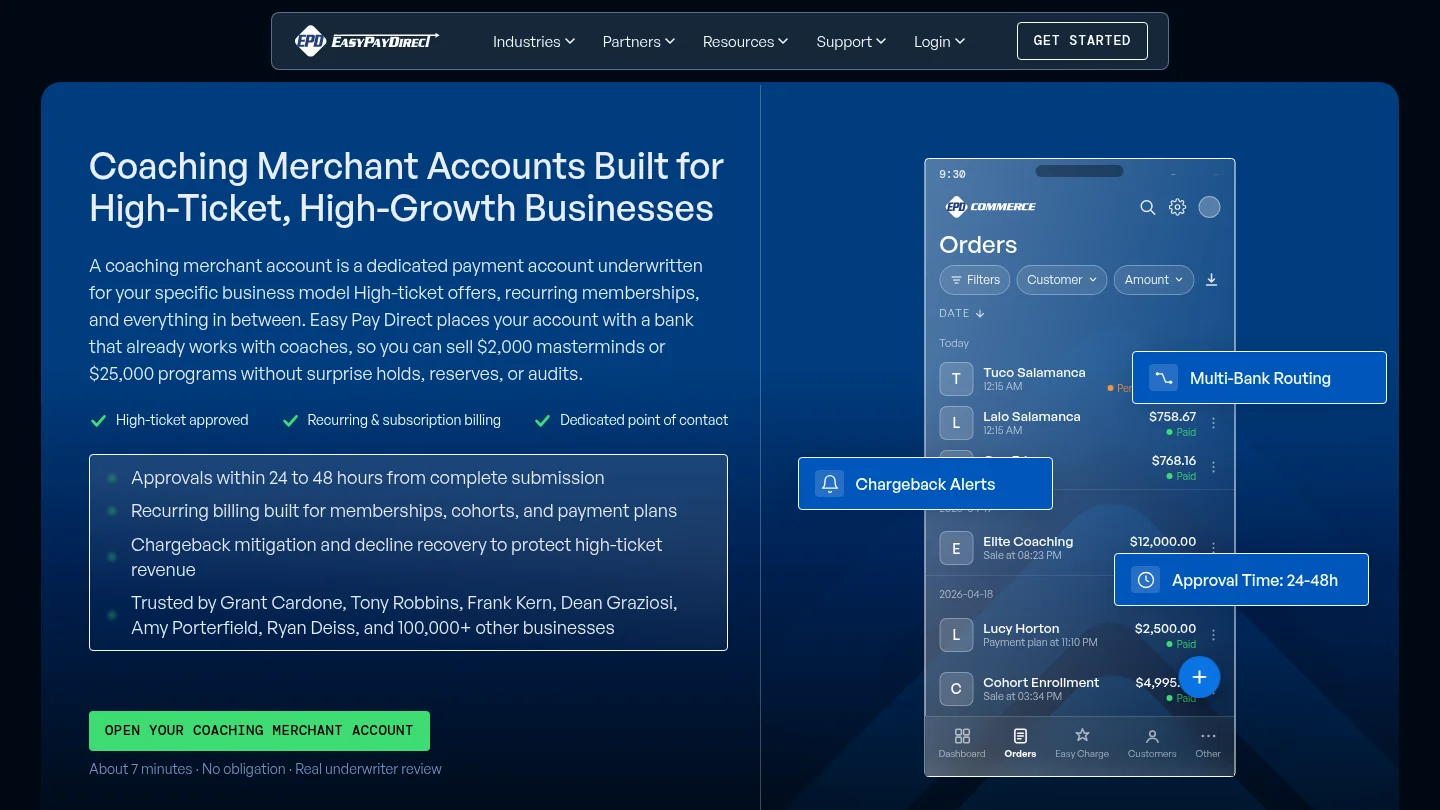
Best for: High ticket coaching, masterminds, cohorts, subscriptions, and payment plans that need specialist underwriting.
Easy Pay Direct is the strongest starting point in this shortlist for a coaching business above 100k per month. Its dedicated coaching page describes underwriting for high ticket and recurring programs, support for US based and international coaching businesses, and custom pricing for higher volume merchants.
The published online card rate is 2.69% plus $0.36 per transaction. The same page lists a typical $25 monthly fee and a $99 setup fee, although higher volume accounts may receive custom terms. These figures should be treated as published starting information, not as a guaranteed quote.
Its broader platform also describes tokenized card storage, recurring billing, chargeback monitoring, and routing across multiple merchant accounts. That structure may reduce dependence on a single account, but it also requires a more involved underwriting process than a simple self serve signup.
Pros
- Designed specifically around coaching and high ticket sales models.
- Supports recurring billing, payment plans, chargeback tools, and decline recovery.
- Offers custom pricing for higher volume merchants.
- Provides access to multiple banking relationships and routing options.
Cons
- Pricing, reserves, and contract terms depend on underwriting.
- Setup requires documentation and business verification.
- It is less suitable for operators seeking a purely self serve account.
2. Whop
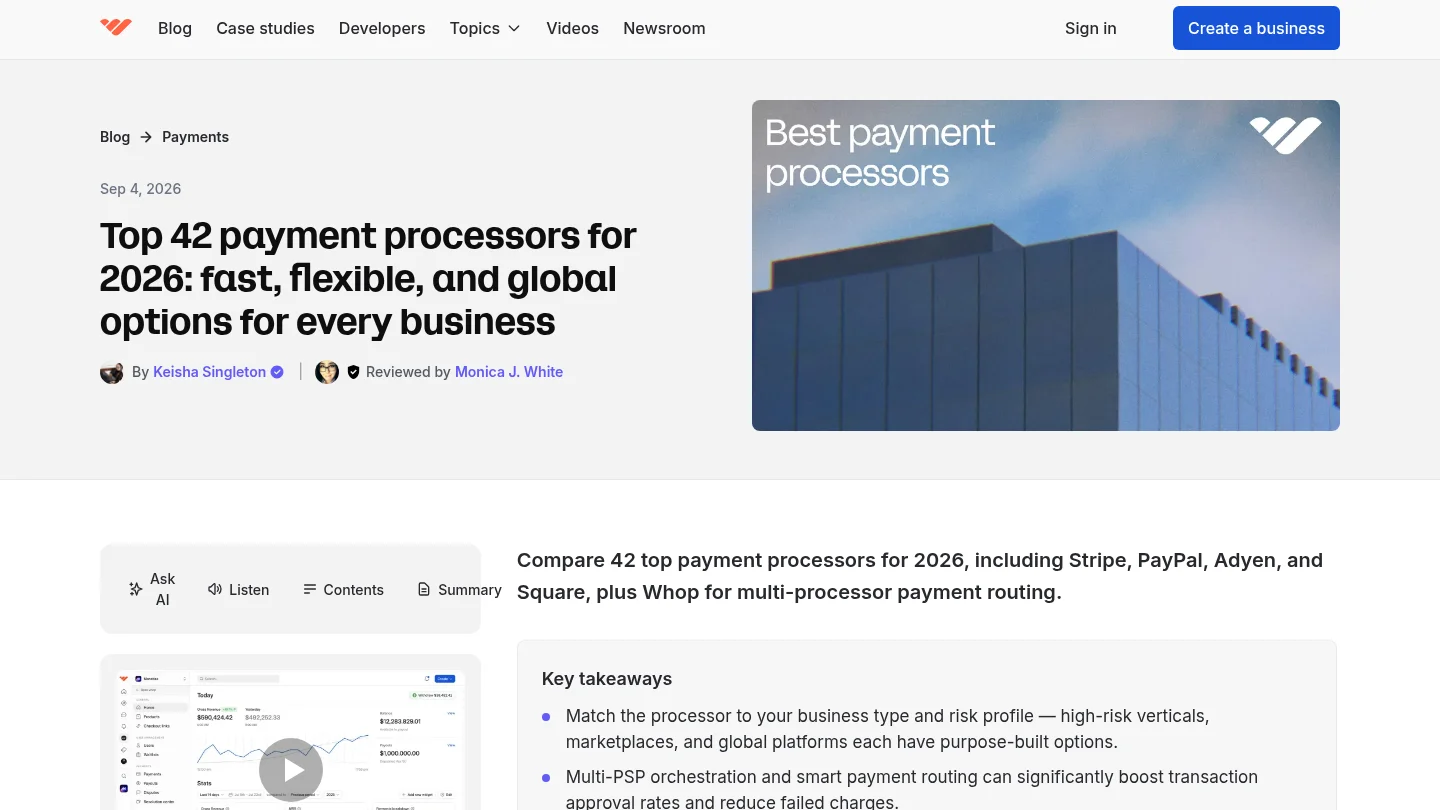
Best for: Coaches selling digital products, memberships, communities, courses, and recurring access.
Whop is not a conventional standalone payment processor. It is a digital commerce platform powered by payment infrastructure, with checkout, digital delivery, community features, and payment routing in the same environment.
Its official pricing page lists 2.7% plus $0.30 for each successful domestic card transaction. International cards add 1.5%, and currency conversion adds 1%. Custom pricing is available for high volume businesses, including volume based rates and dedicated implementation support.
Whop can be efficient when your coaching business needs more than card acceptance. Digital delivery, subscriptions, access management, and community workflows can reduce the number of separate systems you need to connect. The trade off is that you must assess platform dependence, payout terms, tax treatment, and whether its product structure matches your existing funnel.
Pros
- Strong fit for digital products, memberships, and paid communities.
- Published domestic card pricing is 2.7% plus $0.30, roughly 3% before additional charges.
- Offers custom pricing for high volume businesses.
- Combines checkout, access, digital delivery, and payment features.
Cons
- It is a platform rather than a traditional dedicated merchant account.
- International cards and currency conversion increase the effective cost.
- Businesses with highly customized checkout requirements may prefer an API first processor.
3. Adyen
Best for: Established international businesses with complex payment operations and enterprise requirements.
Adyen is a serious option when your coaching business operates across multiple markets and has the resources to manage enterprise payment infrastructure. Its official pricing documentation describes a fixed processing fee combined with payment method pricing. In applicable markets, its model can use interchange plus pricing, with fees passed through alongside a processor markup.
The platform is built for global acceptance, local payment methods, risk management, reporting, and large scale payment operations. That breadth can be valuable for a multi brand education company or a coaching group with substantial international volume.
However, Adyen is not usually the easiest first choice for a creator led coaching business. Its onboarding, commercial negotiations, compliance requirements, and integration work are more demanding. You should also confirm that your coaching category and fulfillment model are accepted before investing in implementation.
Pros
- Designed for enterprise scale and international payment operations.
- Interchange plus pricing can provide greater cost transparency at volume.
- Supports broad payment method and currency coverage.
- Offers advanced reporting and risk management capabilities.
Cons
- Onboarding and integration are more complex than creator focused platforms.
- Pricing varies by market, payment method, and commercial agreement.
- It may be disproportionate for a single coaching brand with a simple funnel.
4. Stripe
Best for: Technical coaching businesses that need custom checkout, subscriptions, automation, or complex integrations.
Stripe remains a flexible option for businesses with development resources. Its official pricing page lists 2.9% plus $0.30 for successful domestic card transactions, with an additional 1.5% for international cards and 1% when currency conversion is required.
Stripe also offers custom pricing for businesses with large payment volumes or unusual business models. That can make the standard rate less relevant once your account is reviewed, but you should request the complete commercial proposal rather than assume that volume discounts will apply.
For recurring coaching programs, Stripe supports billing, payment links, stored payment methods, fraud tools, and a broad range of payment methods. Its flexibility is valuable when your team can manage integration and monitoring. It is less attractive when you need a coaching specialist to handle underwriting, account escalation, and routing.
Pros
- Strong APIs and integration options for customized payment flows.
- Supports recurring billing, subscriptions, payment links, and international payments.
- Offers custom pricing, volume discounts, and country specific rates for eligible businesses.
- Broad ecosystem for billing, fraud prevention, tax tools, and reporting.
Cons
- International cards and currency conversion can materially increase costs.
- Custom implementation usually requires technical resources.
- Standardized payment facilitator underwriting may provide less business specific context than a dedicated merchant account.
5. PayPal Enterprise Payments
Best for: Established online businesses that want card processing alongside PayPal, Venmo, Apple Pay, and Google Pay.
PayPal Enterprise Payments, formerly associated with Braintree, is positioned for businesses that have outgrown a basic hosted wallet button. Its official fee documentation states that established businesses may qualify for custom flat rates, interchange plus pricing, and discounted rates based on their business model and processing volume.
This makes it more relevant to a coaching business above 100k per month than a standard consumer PayPal account. It can support branded checkout, recurring billing, stored payment methods, and multiple wallets through one integration.
The main question is whether the commercial terms and support model match your risk profile. Request clarity on reserves, dispute fees, international pricing, payout timing, and the relationship between the PayPal wallet product and the enterprise processing product.
Pros
- Combines card payments with PayPal and Venmo acceptance.
- Offers custom commercial terms for established businesses.
- Supports recurring billing and stored payment methods.
- Can improve checkout choice for customers who prefer digital wallets.
Cons
- Custom pricing requires a sales and underwriting process.
- Product terminology and account structures can be difficult to compare.
- Wallet, card, dispute, and international fees must be reviewed separately.
6. PayPal
Best for: Fast deployment, buyer familiarity, payment links, invoices, and customers who already use PayPal or Venmo.
PayPal is easy to recognize and widely used by online customers. Its official US fee schedule, updated September 1, 2026, lists 3.49% plus a fixed fee for PayPal Checkout and 2.99% plus a fixed fee for standard credit and debit card payments. International commercial transactions add 1.50%.
That pricing can be acceptable for a secondary payment method or a smaller share of sales. It becomes harder to justify as the primary processor when your customer base is international and your average monthly volume exceeds 100k.
PayPal can still support useful workflows for coaching businesses, including invoices, payment requests, wallet payments, and recurring transactions. Before relying on it for launch revenue, confirm review procedures, reserve terms, payout access, and dispute handling in writing.
Pros
- Strong consumer familiarity at checkout.
- Simple setup for payment links, invoices, and online payments.
- Supports international transactions and multiple payment methods.
- Useful as an additional checkout option alongside a primary processor.
Cons
- Published rates can be expensive for high volume international sales.
- Currency conversion and international charges require close monitoring.
- A standard account may provide less underwriting control than a dedicated merchant arrangement.
How should a displaced creator structure the payment stack?
- Use one primary processor: Choose the provider that best matches your underwriting profile and recurring revenue model.
- Add a deliberate backup: A second approved account can reduce dependence on one funding channel, but it must be disclosed and managed within provider rules.
- Separate payment roles: Use a processor for transactions, a banking platform for treasury, and a Merchant of Record only when its legal and tax responsibilities fit your model.
- Document your geography: Keep your LLC documents, EIN, business address, beneficial ownership details, customer markets, and fulfillment evidence consistent.
- Monitor disputes: Track refunds, cancellation reasons, failed renewals, customer complaints, and chargeback ratios before volume rises further.
Living abroad does not automatically make a US LLC unsuitable for payment processing. It does make consistency more important. The entity, owner residence, bank account, website, fulfillment model, customer geography, and marketing claims should tell the same business story.
For higher risk categories or businesses with previous holds, review our guide to high-risk payment processors before applying. The goal is not to hide risk, but to present the business accurately to a provider that understands it.
Verdict
For most coaching businesses above 100k per month, Easy Pay Direct is the most practical first option because its published coaching offer addresses underwriting, recurring billing, and payment continuity directly. Whop is stronger when digital delivery and community access are central. Stripe suits technical teams, Adyen suits enterprise international operations, and PayPal products work best when wallet familiarity is strategically important. Your final decision should prioritize payment processor stability at high volume, not the lowest headline rate.
Take action with WhatPayment
Choosing a processor for an international coaching business requires more than comparing advertised card rates. You need to understand effective fees, payout behavior, account reviews, tax responsibility, recurring billing, and fit for your delivery model.

We publish independent comparisons and practical research for creators, coaches, course sellers, community operators, and online businesses. Our evaluations use public documentation, testing, fee analysis, and use case criteria. Explore our payment processor research for high-volume coaching businesses to compare infrastructure before you commit to a new account.
Frequently Asked Questions
Is a shared payment facilitator suitable above $100,000 per month?
It can work, especially when your business has a clear history and moderate risk profile. However, a dedicated merchant account may provide more tailored underwriting, clearer escalation, and greater control over reserves and funding.
Can a nonresident owner use a processor with a US LLC?
Possibly, provided the processor accepts your ownership, residence, entity, banking, and operating profile. You should disclose the relevant information consistently and confirm eligibility before directing significant volume through the account.
Is Whop a conventional payment processor?
No. Whop is better understood as a digital commerce platform that includes payment infrastructure, checkout, delivery, and community features. That model can be efficient for digital products, but it differs from a dedicated merchant account.
Does a payment processor handle VAT, sales tax, or GST?
Not automatically. A processor normally moves funds, while the legal seller remains responsible for tax obligations unless a separate Merchant of Record arrangement applies.
What should you request before switching processors?
Request the full fee schedule, reserve policy, payout timetable, dispute fees, contract terms, supported countries, currency rules, and underwriting requirements. Also ask how the provider handles sudden volume increases, failed renewals, refunds, and account reviews.
Keep reading
Browse all guidesBlog
Spectrum Online Payment: Bill Pay or Digital Creator Processor?
Blog
FastSpring vs Paddle for Software Distribution: 2026 Guide
Review
Paddle Review 2026: Best Merchant of Record for SaaS?
Review
Whop Review 2026: Fees, Features, Honest Verdict
Review
Gumroad Review 2026: The 10% Fee, and Who Overpays
Review