What you'll get
Best Payment Processor in 2026 for Global Digital Businesses
best payment processor 2026 compared for fees, global payouts, risk controls, and digital product fit for US LLC owners abroad.

Founder & Editor
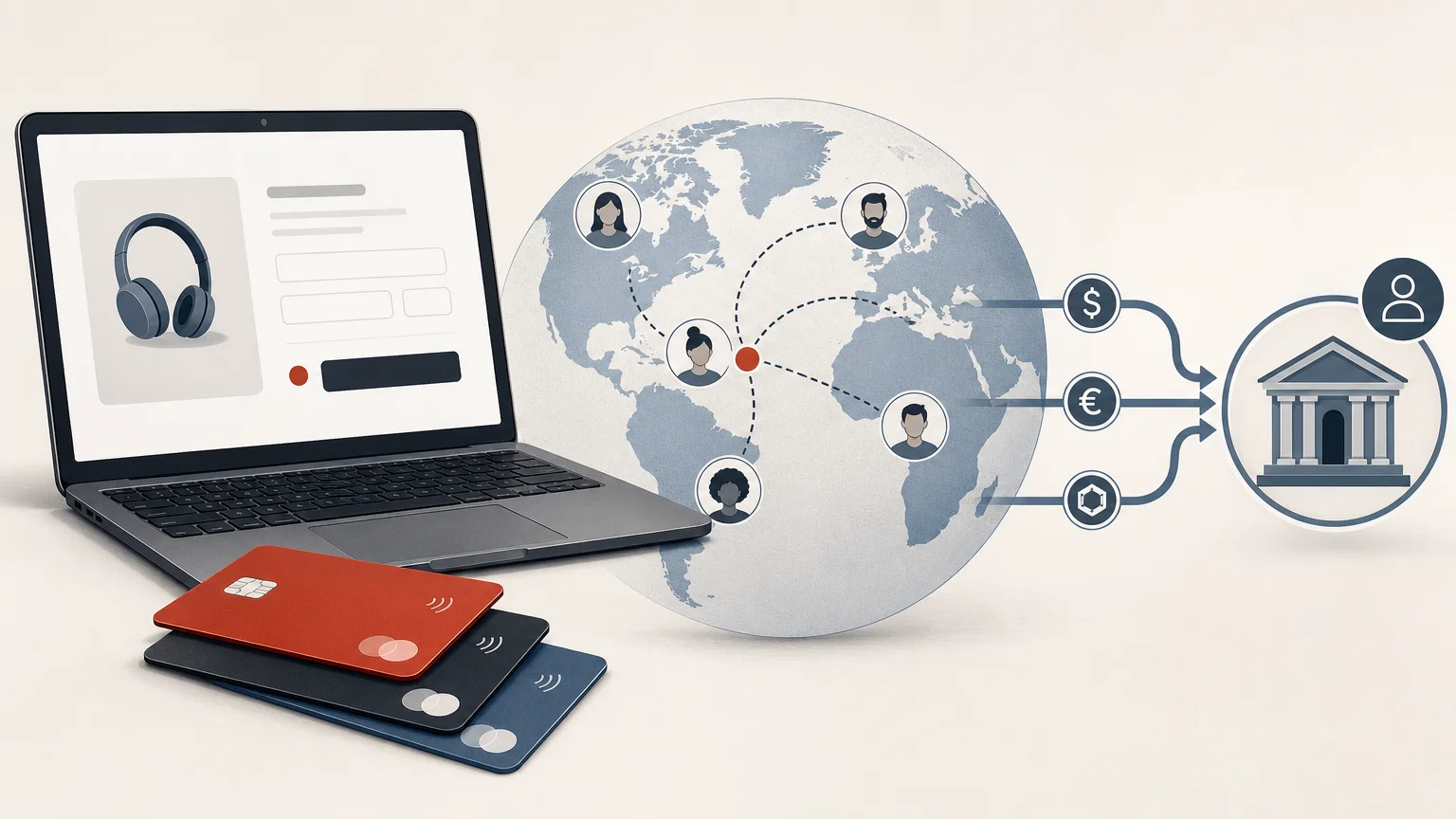
For a creator with a US LLC who lives abroad, the best payment processor is not necessarily the cheapest one. Your ownership structure, residence, customer countries, product category, and payout account can all affect approval and cash flow. Our broader analysis of the top payment processors starts with one practical conclusion, fit matters more than a headline rate.
International digital sales also create costs beyond card processing. Currency conversion, payment method coverage, reserves, refunds, disputes, and tax responsibility can change the real economics. The comparison below focuses on digital products, courses, memberships, communities, software, and creator businesses rather than physical or retail commerce.
Key takeaways for international digital sellers
- Whop charges 2.7% plus $0.30 for domestic card payments, according to its published fee summary. Its broader platform also supports digital products, checkout, payouts, and marketplace distribution.
- Stripe lists 2.9% plus $0.30 for domestic online card transactions in the United States. International cards add 1.5%, and currency conversion adds 1% when required.
- Airwallex lists 2.80% plus $0.30 for domestic cards and 4.30% plus $0.30 for international cards on its US pricing page.
- PayPal provides strong buyer recognition, but its US commercial rates vary by payment type. Standard card payments are listed at 2.99% plus a fixed fee, while PayPal Checkout is listed at 3.49% plus a fixed fee.
- and Adyen are generally more relevant to established businesses with meaningful volume, complex payment flows, and technical resources.
Which payment setup fits your situation?
- Choose a platform built for creators if you need checkout, memberships, digital access, affiliates, and payouts together.
- Choose an API first processor if you need custom subscriptions, usage billing, marketplace flows, or a branded checkout.
- Prioritize multi currency settlement if customers pay from several countries and you regularly move funds internationally.
- Confirm seller eligibility before applying. A US LLC does not automatically make a non US resident eligible for every provider.
- Ask how reviews, reserves, payout delays, refunds, and chargebacks are handled before moving launch revenue.
The ranking below is designed for a displaced creator, not for every business. It gives priority to digital product fit, international operations, payout flexibility, and the ability to grow without rebuilding the entire payment stack.
| Rank | Provider | Best for | Key differentiator |
|---|---|---|---|
| 1 | Whop | Digital creators selling globally | Creator operations, checkout, access, and multi provider routing |
| 2 | Stripe | Technical control and subscriptions | Deep APIs, billing tools, and developer flexibility |
| 3 | Airwallex | Multi currency collections | Global payment methods and currency management |
| 4 | PayPal | Trusted checkout and simple setup | Familiar consumer wallet and payment links |
| 5 | Braintree | Branded checkout with PayPal and Venmo | One integration for cards, wallets, and recurring payments |
| 6 | Helcim | Transparent interchange plus pricing | Cost visibility for eligible North American businesses |
| 7 | High growth international businesses | Enterprise payment optimization and global acquiring | |
| 8 | Adyen | Large global platforms | Unified acquiring, local methods, and enterprise controls |
Why the owner’s residence changes the decision
- Your company location and your personal residence are separate onboarding facts.
- Providers can request formation documents, tax identification, beneficial owner information, proof of address, and bank details.
- Customer geography affects fraud scoring, card fees, local payment availability, and currency conversion.
- A processor can approve the US LLC while still restricting certain payout destinations or business activities.
A foreign owned US LLC should be prepared for enhanced verification. You may need to explain where you live, where the company operates, what you sell, how customers find you, and where fulfillment occurs. A professional website with clear terms, refund rules, product descriptions, and contact details can reduce avoidable uncertainty.
You should also separate three questions. First, can the provider accept your business? Second, can it accept your customers’ preferred payment methods? Third, can it pay you through a bank account or payout rail you can reliably access? A positive answer to only one question is not enough.
Ad intelligence can prevent payment problems later
- Ad spy research can reveal whether an offer is already being promoted across several markets.
- Offer validation can show whether your pricing, promise, and funnel create an unusual risk profile.
- Launch spikes should be communicated clearly when a processor reviews expected volume.
- Payment infrastructure should match the offer, not only the advertising strategy.
Infopreneurs often treat advertising and payments as separate decisions. They are connected. A sudden increase in volume, a new customer geography, aggressive continuity billing, or unclear refund language can affect payment reviews.
Before scaling an offer, review competitor ads, customer expectations, refund timing, and subscription terms. This does not guarantee approval, but it helps you build a clearer operating profile. It also makes it easier to explain your business during onboarding or a later account review.
1. Whop
Best for: Digital creators who want payments, digital access, payouts, and business operations in one platform.
Whop is not a conventional standalone processor. It is a digital business platform powered by payment providers and designed around internet businesses. That distinction matters because you are evaluating more than card acceptance. You are also evaluating checkout, marketplace distribution, communities, courses, affiliates, payment routing, and payouts.
Whop’s published domestic card fee is 2.7% plus $0.30, which is roughly 3% effective for many transactions. This corrects older comparisons that describe the platform as costing around 6%. Whop’s fit is strongest when you sell digital products and want operational tools alongside payment acceptance.
Pros:
- Strong alignment with courses, memberships, communities, software, and digital products.
- Supports checkout links, embedded checkout, marketplace distribution, and creator workflows.
- Can reduce dependence on a single payment provider through multi provider routing.
- Offers international payout options, subject to eligibility and account terms.
Cons:
- It is broader than a pure processor, so the platform model may be unnecessary for a simple custom checkout.
- You should confirm product eligibility, payout availability, and tax responsibilities before launch.
2. Stripe
Best for: SaaS, subscriptions, marketplaces, and digital businesses with technical resources.
Stripe remains the strongest technical option in this comparison. Its APIs, billing tools, payment links, reporting, fraud products, and marketplace capabilities give you control over complex payment flows.
Stripe’s official US pricing page lists 2.9% plus $0.30 for domestic online card transactions. International cards add 1.5%, and currency conversion adds 1% when required. Those additions matter for a creator whose customers are spread across countries.
Stripe supports customer payments across many countries and currencies, but customer coverage is not the same as seller eligibility. You must confirm that your company structure, residence, bank account, and business activity qualify for the account you want.
Pros:
- Excellent API and subscription billing flexibility.
- Strong fit for custom checkout, usage billing, and software products.
- Detailed payment, fraud, dispute, and authorization reporting.
Cons:
- International fees can make the effective rate materially higher than the domestic headline rate.
- Implementation can require engineering time and careful risk configuration.
- Account reviews may interrupt cash flow when business patterns change.
3. Airwallex
Best for: Businesses collecting revenue in several currencies and managing international payouts.
Airwallex is particularly relevant when currency management matters as much as checkout. It combines online payments with multi currency accounts, local payment methods, foreign exchange, transfers, payment links, and subscription features.
Its US pricing page lists 2.80% plus $0.30 for domestic cards and 4.30% plus $0.30 for international cards. Subscription management is listed at 0.50% per successful card transaction. You should model these fees against your customer mix rather than relying on the domestic rate.
Airwallex also supports local payment methods and international transfers. That can help a creator avoid unnecessary conversions, although eligibility, settlement currency, and payout availability depend on the business profile.
Pros:
- Useful multi currency infrastructure for cross border digital businesses.
- Supports payment links, subscriptions, APIs, and local payment methods.
- Can help separate collection currency from payout and operating currency.
Cons:
- International card pricing is higher than domestic pricing.
- Its financial infrastructure may be more extensive than a small creator needs.
- Risk based limits and verification requirements can apply to new accounts.
4. PayPal
Best for: Creators who value familiar checkout, invoices, and payment links.
PayPal’s main advantage is recognition. Customers may already have an account, balance, or preferred payment method, which can reduce hesitation during checkout. It is also practical for invoices and simple payment requests.
PayPal’s official US fee page lists standard credit and debit card payments at 2.99% plus a fixed fee. PayPal Checkout is listed at 3.49% plus a fixed fee. International commercial transactions add 1.50% to the domestic rate, before any applicable currency conversion costs.
PayPal can work well as an additional payment option. It is less attractive as your only payment rail when you need predictable international settlement and full control over your checkout experience.
Pros:
- Strong consumer familiarity in many markets.
- Simple setup, invoices, payment links, and wallet payments.
- Useful as a secondary checkout option alongside another processor.
Cons:
- Fees vary by payment type and international transaction status.
- Currency conversion can increase the effective cost.
- Account reviews and holds can create cash flow uncertainty.
5. Braintree
Best for: Online businesses that want cards, PayPal, Venmo, and wallets through one branded checkout.
Braintree is PayPal’s developer focused payment product. It is more suitable than a standard PayPal button when you need to keep customers on your own checkout and manage recurring payments through an integration.
The exact current fee for your account is Non defini pour le moment without a verified offer from Braintree for your business profile. Public comparisons describe flat rate card, wallet, Venmo, and ACH pricing, but the applicable rate can depend on payment method, customer country, currency, and account terms.
Braintree is worth considering when PayPal and Venmo acceptance are commercially important. It is less compelling if you need a complete creator marketplace, native community access, or multi currency treasury tools.
Pros:
- Branded checkout with cards, PayPal, Venmo, and digital wallets.
- Recurring billing and developer tools for online businesses.
- Useful for mobile products and software with custom payment flows.
Cons:
- International and wallet pricing requires careful account specific review.
- It does not provide the broader creator operating layer available from Whop.
6. Helcim
Best for: Eligible North American businesses prioritizing interchange plus transparency.
Helcim uses an interchange plus model rather than a single blended rate. That structure can provide better visibility into card network costs and processor markup, especially when volume and card mix justify more detailed statement analysis.
The exact current fee for your business is Non defini pour le moment without a direct account specific quote. Interchange plus pricing changes with card type, transaction environment, volume, and applicable services.
Helcim is not the first option I would choose for a displaced creator whose main challenge is international payout access. It can be useful when your business is eligible, your customers are concentrated in supported markets, and cost transparency is more important than creator specific infrastructure.
Pros:
- Interchange plus pricing can expose the true components of processing cost.
- No long term contract is commonly associated with its standard positioning.
- Useful invoicing and online payment tools for eligible businesses.
Cons:
- International seller and payout eligibility requires verification.
- Statements can be more difficult to interpret than a simple flat rate.
- It is less specialized for communities, courses, and digital access workflows.
7.
Best for: Established digital businesses with international volume and technical resources.
is designed for high growth online businesses rather than early stage creators. Its platform supports cards, local payment methods, fraud controls, payment optimization, reporting, and payouts across multiple geographies.
Pricing is custom, and the exact fee is Non defini pour le moment without a merchant specific proposal. states that its platform supports more than 150 processing currencies and local acquiring in over 50 countries.
The main question is scale. If your business has stable volume, international growth, and an internal payments or engineering function, may deserve a sales discussion. If you need a fast creator setup, the onboarding effort may outweigh the benefits.
Pros:
- Strong global infrastructure for established digital businesses.
- Supports local methods, fraud controls, hosted pages, APIs, and payouts.
- Custom pricing may be appropriate for meaningful volume.
Cons:
- Custom onboarding and pricing are less convenient for small creators.
- You need to evaluate minimums, risk requirements, settlement terms, and support before signing.
8. Adyen
Best for: Large digital platforms, marketplaces, and international businesses with complex payment flows.
Adyen combines payment processing, acquiring, local payment methods, risk management, and reporting in one enterprise platform. It is particularly relevant when your business operates across regions and needs consistent data across multiple payment channels.
Adyen uses an interchange plus structure. The fixed processing fee and payment method fee vary by market and method, so the exact cost is Non defini pour le moment without a merchant specific proposal. Its public company information highlights support for more than 150 currencies and more than 200 local payment methods.
Adyen is powerful, but it is not designed around the immediate needs of most course creators or small membership operators. You should consider it after your volume, compliance needs, and technical complexity justify enterprise onboarding.
Pros:
- Strong global acquiring and local payment method coverage.
- Advanced fraud, authorization, reporting, and enterprise controls.
- Suitable for marketplaces and complex international payment flows.
Cons:
- Onboarding and underwriting can be demanding.
- Minimum invoices or commercial requirements may make it unsuitable for smaller businesses.
- Implementation usually requires technical and operational resources.
How to compare fees, payouts, and tax responsibility
- Calculate your effective fee using actual transaction volume, fixed charges, international fees, conversion costs, and payout fees.
- Separate domestic cards from international cards because their economics can differ substantially.
- Review settlement currency, bank destination, payout timing, and reserve policies together.
- Do not assume that a processor is a Merchant of Record.
- Confirm who handles VAT, sales tax, GST, refunds, and chargebacks in the contract.
A payment processor usually provides payment infrastructure, not automatic tax ownership. A Merchant of Record arrangement can change the allocation of selling, tax, refund, and chargeback responsibilities. Before choosing a platform, review our explanation of merchant of record payment solutions and confirm the legal role stated in the provider’s agreement.
Creators selling courses, memberships, communities, or coaching should also check whether the payment flow supports recurring billing, failed payment recovery, trials, upgrades, downgrades, and clear cancellation. You can compare specialized payment processors for online courses when course delivery is the central use case.
If your offer involves regulated, restricted, or unusually sensitive categories, standard onboarding may not be appropriate. Review the criteria in our guide to high-risk payment processors before applying.
Verdict, what is the best payment processor in 2026?
For most displaced creators selling digital products internationally, Whop is the strongest overall fit because it combines creator focused operations with payment access, digital delivery, and payout tools. Stripe is the better choice when technical control and custom billing are your priority. Airwallex is stronger when multi currency collection and international financial operations dominate your needs.
PayPal works well as a trusted secondary payment option. Braintree suits branded checkout and wallet acceptance. Helcim, , and Adyen become more relevant when your eligibility, volume, and operating complexity justify their respective models. The best payment processor 2026 decision is ultimately the one that keeps your checkout reliable, your payouts accessible, and your total cost understandable.
Take action with WhatPayment
If your US LLC is owned by someone living abroad, a generic ranking rarely answers the questions that affect approval. You need to compare customer geography, payout rails, effective fees, account review exposure, product eligibility, and tax responsibility.

We publish independent comparisons and practical payment research for creators, founders, course sellers, community operators, and SaaS businesses. Our work uses public documentation, testing, fee analysis, and use case comparisons. If you are evaluating SaaS payment infrastructure, consult our analysis of the best Stripe alternative for SaaS before committing to a new setup.
Frequently Asked Questions
Can a non US resident use a payment processor through a US LLC?
Possibly, but approval depends on the provider’s seller country rules, ownership verification, business activity, bank account, and payout destination. A US LLC alone does not guarantee eligibility.
Which option is best for selling online courses?
Whop is useful when you need digital access and creator operations together. Stripe may be better when you need custom course billing, subscriptions, or a deeply integrated checkout.
Is Whop a traditional payment processor?
No. Whop is a digital business platform powered by payment providers. It can still be relevant when your priority is combining checkout, digital products, access, payouts, and other creator workflows.
Should you use more than one payment provider?
A secondary provider can reduce dependence on one account and give customers another familiar payment method. You should still verify product eligibility, accounting workflows, refunds, and customer support for every account.
Are payment processors Merchant of Record providers?
Not automatically. You should confirm the contractual role of the provider and identify who is responsible for tax collection, refunds, chargebacks, and customer disputes before selling internationally.
Keep reading
Browse all guidesBlog
Best Payment Processor for Coaching Businesses Over 100k per Month
Blog
Spectrum Online Payment: Bill Pay or Digital Creator Processor?
Comparison
Stripe vs Whop for Creators (2026): Fees, Freezes & Who Wins
Comparison
Slash vs Airwallex: Pick the Right Banking Layer (2026)
Comparison
Stripe vs Paddle 2026: Which Is Better for Global SaaS?
Comparison