What you'll get
How to Compare Merchant Service Providers for Global Sales
Learn how to compare merchant service providers for global digital sales, including fees, onboarding, payouts, tax duties, and offer validation tools.

Founder & Editor

A low headline rate can still leave a cross-border creator with expensive currency conversion, an unsuitable payout route, or an account they cannot properly onboard. Start with the specific business you run, a US LLC owned by someone living abroad, and compare the best payment processors against the same transaction and operating assumptions.
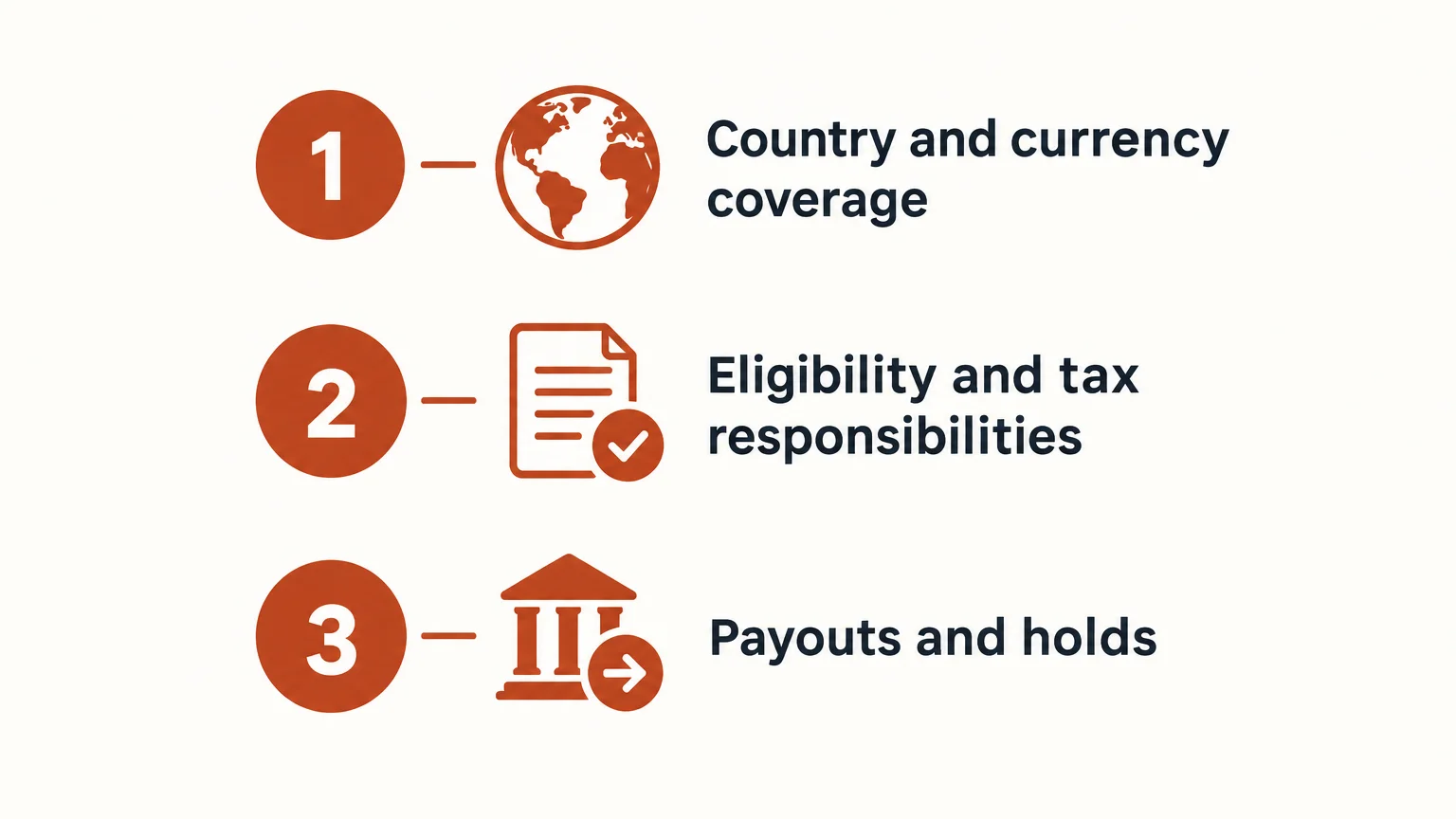
When deciding how to compare merchant service providers, look past the checkout screen. Your customer countries, product type, legal seller, owner residence, and destination bank account all affect whether a provider is workable. Keep tax responsibility in the comparison too, since a payment processor and a Merchant of Record do not necessarily take on the same role.
What should you compare first for a global digital business?
- List where the LLC is registered, where you live, and where customers are located.
- Separate digital products, subscriptions, and one-time services by payment flow.
- Write down your collection currencies, payout currency, and destination account.
- Record the platform integrations and customer payment methods your checkout needs.

This profile matters because a company’s formation country and its owner’s residence are separate details to confirm during onboarding. Do not assume that having a US LLC automatically settles eligibility, identity verification, or payout-account requirements. Ask each provider what it needs from the company and from its owner, then compare the written answers using the same checklist.
Also distinguish a provider’s customer reach from its merchant eligibility. Accepting payments from buyers in many countries does not necessarily mean a business can open an account from any country. Record those as separate criteria rather than treating “global payments” as a complete answer.
There is a practical reason to include settlement and fee issues early. The Federal Reserve Banks’ 2024 report, based on its 2023 Small Business Credit Survey, found that roughly four in five small firms faced payment-related challenges. The report noted that firms paid in full at purchase commonly cited fees, while firms collecting through third parties more often cited delays in settlement or funds availability.
How do you compare the real cost of processing?
- Use a typical order value and a realistic monthly transaction count.
- Add percentage fees, fixed transaction charges, subscriptions, and currency conversion.
- Include refund, dispute, payout, and other applicable charges from the official fee schedule.
A useful comparison calculates the cost of the same sales mix with each provider. For example, a creator selling a low-priced digital download and a higher-priced course should not rely on a single example transaction. The fixed amount per charge weighs more heavily on smaller orders, while percentage fees and currency conversion matter across sales value. If subscriptions are involved, check recurring billing costs and any fees for failed-payment retries or other subscription tools.
Use this simple calculation for a first pass: total processing cost equals transaction fees, fixed per-charge fees, monthly platform or account charges, currency conversion, and other fees that apply to your setup. Divide that total by processed sales to estimate the effective rate. For real decisions, calculate it at more than one sales level and include any extra software or payout costs your workflow requires.
Read the provider’s official pricing and terms for the country and transaction type you will actually use. A headline rate is not a complete quote if cross-border cards, currency conversion, recurring billing, or other features carry separate charges. If the pricing page does not specify a fee, ask for a written fee schedule rather than treating the missing detail as a zero.
Our comparisons assess effective costs at different revenue levels, including processing, currency conversion, subscriptions, payouts, and relevant add-ons. To see how providers are evaluated across additional criteria, compare payment processor rankings, then verify any fee or feature directly against the provider’s current official terms before signing up.
Does the provider accept your LLC and owner profile?
- Confirm the entity’s registration country and business address requirements.
- Ask which owner identity and tax documents are needed.
- Check whether your residence and payout-bank location are accepted together.
- Save the provider’s written response and any relevant onboarding terms.
For a US LLC owner abroad, a mismatch between the company address, the owner’s residential address, and the payout account can complicate an application. Treat these as concrete onboarding questions, not assumptions to resolve after launch. Ask whether the provider needs the LLC’s formation records, an employer identification number, owner identification, proof of address, or specific bank-account details. Requirements differ, so a generic checklist from another seller does not establish your eligibility.
The IRS describes an EIN responsible party as a person who owns, controls, or exercises effective control over a business and its funds. That is relevant when keeping business records consistent, but it does not establish that a payment provider will approve an application. Review the IRS responsible-party guidance, then get onboarding requirements from each payment provider directly.
Keep a copy of the company details, owner identity information, website description, product terms, refund policy, and payout-account information you submit. Use accurate, consistent descriptions of what you sell. If your offer changes, ask the provider whether the change requires an update to the account or its underwriting information.
How should you evaluate payouts, holds, and account reviews?
- Compare the standard payout schedule and supported payout currencies.
- Ask how the provider communicates verification requests and account reviews.
- Check what happens to balances during a review, refund, or dispute.
- Maintain enough working capital to handle a payout delay.
For a business operating from abroad, payout usefulness depends on more than the number of days shown in a marketing page. Confirm which bank accounts and settlement currencies are supported for your specific account country. Ask whether changing a payout account triggers verification, and what documents are required if the provider reviews sales or requests additional information.
Do not compare a promised standard schedule with an optional faster payout as though they were the same service. Faster access can carry a separate fee or eligibility conditions. Likewise, a stated schedule is not an assurance that every payout arrives on that exact day when a transaction, account, or bank transfer is under review.
Cross-border payment infrastructure also involves trade-offs in cost, speed, and transparency. The Bank for International Settlements’ 2026 bulletin describes progress and continuing gaps in cross-border payments. For a small digital business, the practical response is to test the complete route: customer payment, processor balance, conversion, and arrival in the business account.
Before switching, map your active subscriptions, saved payment methods, refund process, and accounting records. A lower effective fee is not useful if migration interrupts renewals or makes reconciliation harder. Ask whether historical transaction data and payment tokens can move, and document what will need to be re-created if they cannot.
Does a processor or Merchant of Record fit your model?
- Determine which business is the legal seller in the customer transaction.
- Identify who handles applicable sales tax, VAT, or GST obligations.
- Compare the service scope, payout terms, and total fee for each arrangement.
A payment service provider generally supplies payment infrastructure while your business remains the seller. A Merchant of Record (MoR) takes the legal selling role and handles stated tax-related responsibilities within its service model. The exact agreement matters, so check the contract and tax documentation rather than relying on a label alone.
An MoR can reduce some administrative work, but its service fee and seller relationship need to make sense for your product and margins. A direct processor may provide more control over the customer relationship, while leaving more operating and tax responsibilities with your business. Compare what each arrangement includes, what remains yours, and how refunds or disputes are handled.
WhatPayment’s editorial comparisons examine processor costs, Merchant of Record status, tax responsibility, payout behavior, and business-model fit. To broaden your shortlist beyond a single type of provider, review this list of payment processors, then check the relevant provider contract for the details that apply to your situation.
Where do ad-intelligence tools fit in the decision?
- Use payment tools to collect, settle, and manage customer transactions.
- Use ad-intelligence tools to research creative patterns and assess market offers.
- Keep the evidence and assumptions for each decision in separate notes.
Ad-intelligence tools serve a different decision. They can help an infopreneur inspect advertising examples or evaluate whether an offer is worth testing, but they do not verify payment-provider eligibility, accept customer funds, or determine tax responsibility. Treat any ad or offer signal as a research input, then test demand within your own budget and comply with the rules of the advertising platforms you use.
Do not mix ad-tool pricing into a processor’s transaction rate. If a research tool is relevant to your workflow, assess it separately for the markets, platforms, and evidence it covers, and verify its current price and terms with its publisher. If you only need to accept sales for a digital product, an ad-spy feature does not replace a checkout or payment service.
Comparison table: which questions belong in your shortlist?
| Comparison area | What to verify | Why it matters |
|---|---|---|
| Eligibility | LLC country, owner residence, identity documents, business address, and payout-account rules. | An account must fit your actual company and owner profile before its rate matters. |
| Effective cost | Percentage and fixed fees, currency conversion, monthly charges, subscriptions, refunds, and payouts. | A full cost model shows how fees change with order value and sales volume. |
| International checkout | Customer countries, currencies, payment methods, and checkout requirements for digital products. | Broad customer reach is useful only when your target buyers can complete payment. |
| Settlement and reviews | Standard payout route, timing, currency, verification process, and balance handling during reviews. | Cash availability and a clear review process affect day-to-day operations. |
| Seller and tax role | Whether you remain the seller or use an MoR, and which tax duties the agreement assigns. | Responsibility follows the contract and business arrangement, not the checkout label. |
| Ad intelligence | For a separate research tool, verify its coverage, evidence, price, and terms with its publisher. | Offer research informs marketing choices, but does not replace payment processing. |
If you cannot fill a cell from a current official source or written provider response, mark it Non defini pour le moment in your own working sheet. That is a reason to follow up, not a reason to assume the feature or fee is absent. Save the date and version of any pricing schedule you rely on because provider terms can change.
Verdict: compare the whole payment route
The right shortlist starts with your real ownership and residence details, not a generic “international” label. Compare written eligibility requirements, calculate effective fees from your actual order mix, test the payout route, and decide who carries seller and tax responsibilities. Keep ad-intelligence research separate from payment acceptance. A merchant service provider comparison is useful only when each option is measured against the same business facts and the same official documentation.
Explore payment options for your SaaS business
Once your LLC profile, customers, currencies, and billing model are clear, narrow the comparison to infrastructure that supports those needs. A SaaS seller should pay particular attention to recurring billing, subscription changes, payment recovery, and the difference between a processor and a Merchant of Record.

Our editorial comparisons use platform testing, test accounts, public documentation, fine-print research, and fee analysis across different revenue levels. We disclose affiliate relationships, do not sell vendor placement, and do not send reviews to vendors for prepublication approval. Explore a Stripe alternative for SaaS as one input to your own provider review.
Frequently Asked Questions
What is the first thing to compare between payment providers?
Start with whether the provider will onboard your LLC and owner profile, and confirm the payout account requirements. Then compare costs and payment features using the same business assumptions.
Does a US LLC guarantee that I can open a processor account?
No. The LLC’s formation details and the owner’s residence are separate facts to confirm with each provider. Ask for the exact onboarding documents and eligibility rules that apply to your setup.
How can I calculate an effective processing rate?
Add applicable transaction percentages, fixed charges, monthly costs, currency conversion, and other relevant fees, then divide by the processed sales amount. Run the calculation using your own order values and sales mix.
What is the difference between a processor and a Merchant of Record?
A processor provides payment infrastructure, while an MoR takes the legal selling role and handles stated tax-related responsibilities within its service model. Check the agreement to determine the exact responsibilities each party retains.
Can an ad-intelligence tool help me choose a payment processor?
Not directly. Ad-intelligence tools inform offer or advertising research, while a payment provider handles checkout and payment operations. Assess them separately and verify each tool’s current coverage and terms with its publisher.
Keep reading
Browse all guidesBlog
Top 10 Payment Processors for Digital Products in 2026
Blog
The Night Stripe Froze My $35,000 MRR Business
Alternatives
Best Kajabi Alternatives in 2026: The Only Unbiased Ranking
Alternatives
Best Stan Store Alternatives in 2026 (Fee Math Included)
Alternatives
Best Patreon Alternatives in 2026 (Before Apple Takes 30%)
Alternatives