What you'll get
Coach Payments for Global Digital Businesses: A Practical Guide
Coach payments for a US LLC abroad depend on payout access, tax responsibility, subscription needs, and evidence from offer research.

Founder & Editor

A client in another country can be ready to buy while your business is still unsure whether its payment setup can accept the sale and send the proceeds where they need to go. Start by comparing the payment processor for coaching businesses against your real business details, not against a generic checklist for US-based sellers.
For a US LLC owner living abroad, the key questions are connected: whose identity and address the provider verifies, what bank details it accepts for payouts, which party is responsible for tax obligations, and how refunds or disputed charges affect cash flow. Ad-intelligence tools belong in a separate part of the decision. They can help you examine visible advertising and competing offers, but they do not process payments or prove customer demand.
- A US LLC does not, by itself, establish that every payment provider will accept its owner, address, or payout account.
- A payment service provider and a Merchant of Record place legal selling and tax responsibilities in different hands.
- Compare processing, currency conversion, payout, subscription, and other applicable charges, not just a headline transaction rate.
- Ad-intelligence tools are for researching visible ads and offers, not for collecting customer payments or proving that an offer is profitable.
- Check the current eligibility and payout requirements with each provider before routing sales through it.
What makes coach payments work across borders?
- Confirm that the provider accepts your actual company and owner details.
- Check that its payout method works with the account you can maintain from abroad.
- Decide whether you or a service provider will carry the legal seller and tax responsibilities.

A US LLC is one part of a payment provider’s onboarding picture, not a substitute for checking the other parts. Review the information requested for the company, its beneficial owners, business location, and bank account. Make sure each detail is accurate and consistent across your application and supporting documents. A mismatch between where you live, where the company is registered, and where money is paid can prompt additional verification.
Next, trace the money in both directions. Ask which payment methods customers in your main markets can use, which currencies you can present or settle in, and how payouts reach your account. If you need to convert USD into another currency to pay your expenses, include that conversion in your cost estimate. Do not assume that a provider’s list of customer payment methods also describes its payout options.
Tax handling deserves a separate check. A payment provider is not automatically the legal seller of your digital coaching product. Digital-product tax treatment can depend on the customer’s location and the product; Avalara’s state guide describes differing state approaches to digital-product sales tax. A provider may supply payment processing while leaving tax decisions and obligations with your business, or the arrangement may make the provider the Merchant of Record. Confirm the applicable terms and your own obligations rather than inferring them from a checkout feature.
Should you choose a payment provider, Merchant of Record, or platform?
- A payment service provider is one approach to accepting and processing customer payments.
- A Merchant of Record arrangement changes who is the legal seller and who handles specified tax-related responsibilities.
- A coaching platform can bundle business tools, but its payment and legal setup still needs checking.
Start by identifying the role you actually need. A payment service provider, or PSP, supplies payment infrastructure while your business remains the seller under the comparison framework used here. A Merchant of Record, or MoR, takes the legal seller role and stated tax-related responsibilities. An all-in-one coaching or course platform may include checkout, subscriptions, or content delivery, but those features do not by themselves tell you whether it acts as an MoR or depends on a separate processor.
| Setup | Seller and tax responsibility | What to verify | Current fee detail |
|---|---|---|---|
| Payment service provider | Your business remains the seller and is responsible for its obligations. | Company and owner eligibility, accepted customer payment methods, payout routes, and dispute terms. | Non defini pour le moment. |
| Merchant of Record | The MoR is the legal seller and takes on stated tax-related responsibilities. | Countries and products supported, tax scope, payout timing, reserves, refunds, and dispute allocation. | Non defini pour le moment. |
| Coaching or course platform | Depends on the platform’s legal and payment arrangement. | Whether it processes payments itself or relies on another provider, plus access delivery and recurring-billing terms. | Non defini pour le moment. |
| Ad-intelligence tool | It is not a payment collection arrangement. | Ad coverage, search filters, data limits, and whether its evidence matches your target market. | Non defini pour le moment. |
The table is a starting point, not a substitute for the provider’s contract. Read the parts that define the legal seller, tax scope, supported countries, payout conditions, and what happens to funds during a review. For a course or membership, separately confirm whether customers receive access automatically after a successful payment and what happens when a renewal fails.
Our comparisons are designed to help with that distinction. We assess platforms using test accounts, public documentation, and fine print, and compare factors such as effective fees, MoR status, payout behavior, and fit for the business model. When your program is sold as a group offer or mastermind, our guide to payment processing for high-ticket mastermind groups focuses on that specific use case.
How should you check eligibility and tax responsibilities?
- Check requirements for both the LLC and its owners.
- Ask which payout accounts and methods are supported for your circumstances.
- Keep payment processing and tax advice as separate questions.
Before you connect a sales page, write down the facts that a provider will need to assess: the LLC’s registered details, the owner’s residence, the type of coaching or digital product, the countries where customers are located, and the intended payout account. Then compare that list with the provider’s application and terms. If a requirement is unclear, ask the provider whether it applies to the company, the beneficial owner, or both.
Tax should not be reduced to the question, “Does checkout calculate a tax amount?” You also need to know who is responsible for deciding whether tax applies, registering where required, reporting it, and handling corrections or refunds. A digital-product tax overview distinguishes sales tax on a sale from income tax on business profit. Those are different questions, and outsourcing a transaction workflow does not settle every tax obligation related to your company.
Keep the paperwork trail usable. Store provider terms, invoices, payout statements, refunds, and customer records in a form that your accountant can reconcile. This matters when one provider processes the charge, another service hosts the course, and the funds arrive in a different currency. The more tools in the path, the more important it is to know which record is authoritative for each step.
How do you compare fees, payouts, and payment plans?
- Calculate the cost at your own average sale size and revenue level.
- Check payout timing, conversion, dispute, and refund terms before launch.
- Test recurring charges and installments with realistic customer journeys.
Do not select a provider from a single percentage. Effective cost can include transaction charges, fixed per-payment amounts, currency conversion, subscriptions, payout charges, and other applicable items. Calculate a representative low-ticket sale and a higher-ticket program sale, then compare the result at your expected monthly volume. If a fee or surcharge is not confirmed in an official current source, record it as Non defini pour le moment rather than treating it as zero.
Payout design matters as much as the checkout. Check the ordinary payout schedule, the currencies and accounts supported, and the terms that apply during account reviews or reserves. Ask how the provider handles refunds and chargebacks, who supplies evidence in a dispute, and whether a refund or reversal can reduce a later payout. Keep enough operating cash to deal with the timing difference between delivering coaching and receiving or retaining funds.
For recurring coaching, verify what happens when a card expires or a payment fails. For a payment plan, find out whether installments are scheduled charges, a subscription, or a third-party credit product. These options can create different customer obligations and different operational tasks for you. Our guide to BNPL options for high-ticket coaching addresses the distinction between payment options and the underlying payment setup.
Higher-volume businesses should also model the full cost at their own scale, since fixed per-transaction charges and currency conversion can have different effects at different sale sizes. Our comparison of payment processors for high-volume coaching businesses is relevant when monthly processing volume is a key constraint. Treat every rate as something to verify against the provider’s current official pricing and your account terms.
What can ad-intelligence tools tell you about an offer?
- Use ad research to generate questions about positioning, audience, and creative.
- Check whether the observed ads relate to your intended market and offer.
- Validate interest with your own customer evidence before committing to a payment stack.
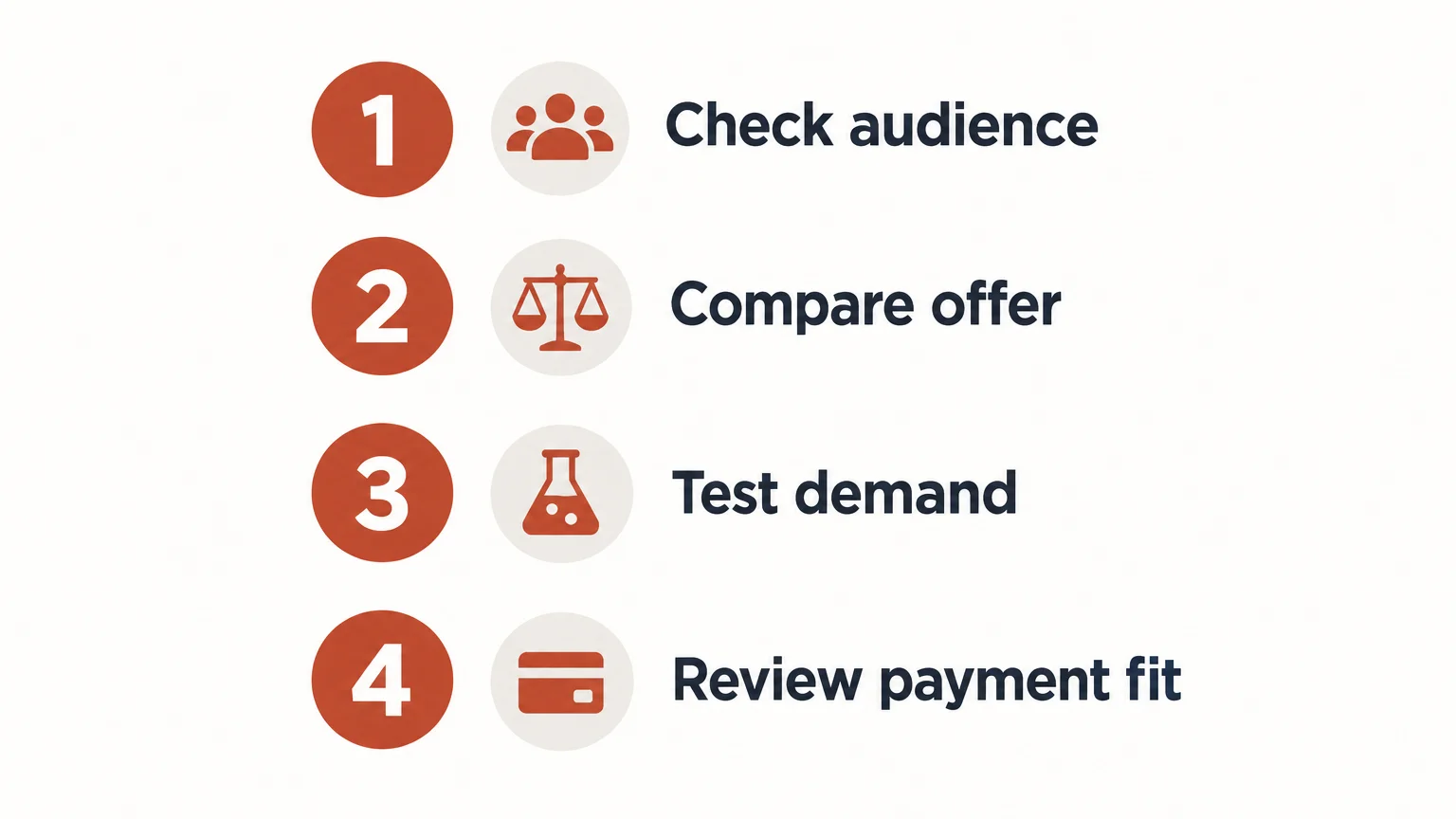
An ad-intelligence tool can help you inspect visible advertising activity and compare how offers are presented. Use it to note the customer problem addressed, the promise being made, the format, and the audience cues. Then ask whether those observations apply to your own coaching niche, geography, price point, and delivery model. A frequently visible creative is something to investigate, not proof of revenue, conversion rate, or profitability.
Validate the offer with evidence closer to your own customers. Speak with prospective buyers, review questions that arise during sales conversations, and test a small version of the offer before building a complex delivery stack. If people show interest but abandon checkout, investigate payment method, currency, and installment friction. If they do not recognize the offer’s value, changing processors is unlikely to solve the underlying problem.
Only after you have a credible offer should you choose payment infrastructure around its delivery. A one-time coaching package, recurring membership, cohort course, and high-ticket program can require different combinations of billing, access control, refunds, and customer communication. Ad research helps inform the offer; the processor or MoR handles the transaction mechanics. Keeping those jobs distinct makes it easier to see which tool is necessary and which cost is avoidable.
Verdict
For a coach operating a US LLC from abroad, choose payment infrastructure by checking entity and owner eligibility, payout access, tax responsibility, effective all-in cost, and fit with the way clients buy and receive your digital offer. Verify the current terms directly before launch, and keep ad-intelligence findings separate from evidence of actual demand. The clearest payment setup for global coaches is the one whose legal role, money movement, and customer workflow you can explain and reconcile.
Read the Whop platform review
If Whop is part of your shortlist, assess it against your business model rather than assuming that marketplace discovery, checkout, payouts, and tax responsibility are interchangeable. The right questions are whether the platform’s current terms fit your offer and whether its operating model suits a US LLC whose owner lives abroad.

We publish editorial reviews and comparisons that examine payment infrastructure, fees, payout behavior, Merchant of Record status, and business-model fit. Our publication is affiliate-funded, so a qualifying action after a disclosed affiliate link may generate a commission, while the reader pays the same vendor price. Vendors do not pay for placement or review content before publication. Read our Whop platform review as one source for evaluating that option.
Frequently Asked Questions
Can a US LLC owner living abroad use a US payment provider?
Do not assume that LLC registration alone determines eligibility. Confirm the provider’s requirements for the company, beneficial owners, residence, address, and payout account before opening the account.
Should a coach choose a payment service provider or a Merchant of Record?
A PSP processes payments while your business remains the seller under the applicable arrangement. An MoR takes the legal seller role and stated tax-related responsibilities, so compare the contract and tax scope with your actual obligations.
Can a payment platform handle subscriptions and installments?
Some platforms support recurring billing or scheduled payments, but the terms and handling of failed charges differ. Confirm whether an installment is a scheduled payment, a subscription, or a third-party financing product, and check how access changes after a failed payment.
Do ad-intelligence tools prove that a coaching offer will sell?
No. They can provide clues about visible advertising and offer positioning, but they do not establish sales, profitability, or demand among your own audience. Validate those points with customer research and real offer tests.
How can WhatPayment help compare options?
We publish comparisons and reviews that examine effective fees, MoR responsibilities, payout behavior, international coverage, and fit for coaching and digital products. Our editorial process includes platform testing, official documentation and fine-print research, and periodic article reviews; relevant affiliate relationships are disclosed.
Keep reading
Browse all guidesBlog
Global Payment Gateways for Subscription Businesses
Blog
Payment Processors Like Stripe for Global Digital Creators
Guide
Spy on Competitor Ads Before Building Your Digital Product
Guide
Whop Merchant of Record: Tax and Chargeback Rules (2026)
Guide
Sell Digital Products Without Stripe (2026): 5 Freeze-Safe Picks
Guide