What you'll get
Payment Processing for High Ticket Mastermind Groups
Payment processing for high ticket mastermind groups: compare fees, payment plans, chargeback controls, and global payout options.

Founder & Editor
A single high-ticket enrollment can create meaningful revenue, but it can also create concentrated payment risk. When the buyer is purchasing access to a mastermind, community, coaching program, or digital transformation service, the transaction depends on trust, clear terms, and reliable future installments. For a displaced creator, the challenge is greater because your US LLC, residence, customer locations, and payout destinations may all sit in different countries. To compare suitable routes, begin with our high-risk payment processors.
Choosing payment processing for high ticket mastermind groups therefore means evaluating the full payment operation. Approval is only the first step. You must also examine authorization, settlement timing, refund handling, recurring billing, chargeback evidence, currency conversion, and whether the provider treats coaching and paid communities as an acceptable business model.
What should your payment setup solve first?
- Your processor should support the exact sales model, including one-time tuition, installments, subscriptions, or deposits followed by scheduled balances.
- Your checkout should explain what the buyer receives, when access begins, how cancellation works, and which refund terms apply.
- Your payment records should help demonstrate delivery through agreements, attendance records, onboarding messages, recordings, and access logs.
- Your payout arrangement should reflect your US entity, your country of residence, your customer countries, and your preferred settlement currency.
Mastermind operators commonly use three billing structures: a one-time payment, a recurring monthly plan, or an annual payment. The 2023 SSI report found that surveyed mastermind operators used one-time payments most often, followed by monthly and yearly billing. That distribution matters because each structure creates a different operational burden. One-time tuition concentrates dispute exposure, while recurring plans create failed-payment and cancellation obligations.
A payment processor should not be judged only by the advertised transaction rate. Review its rules for average ticket size, payment-plan storage, retry logic, refunds, reserves, account reviews, and international settlement. A low headline fee can become expensive if a launch triggers a reserve, a payout delay, or a sudden account termination.
Why does a displaced creator face additional risk?
- A US LLC with an overseas owner can require more documentation than a domestic business with matching entity and residence details.
- International customer activity can make your transaction pattern appear more complex, especially when currencies and customer countries change quickly.
- Large digital transactions can generate disputes based on dissatisfaction, misunderstanding, nonattendance, or alleged promises about future results.
- Your processor may evaluate your sales page, webinar, call scripts, refund policy, and payment-plan language as part of underwriting.

The entity and residence mismatch does not automatically make processing impossible. It does mean that your application should be transparent and consistent. Prepare incorporation documents, beneficial-owner information, bank statements, processing history, refund terms, customer agreements, and a clear explanation of your delivery model.
Consistency is particularly important when your customers are spread across countries. Your sales page, invoices, payment descriptor, legal terms, onboarding workflow, and actual delivery should describe the same product. If your checkout presents a mastermind as education, but your sales call promises a guaranteed financial outcome, the inconsistency can increase review and dispute risk.
You should also separate payment acceptance from tax responsibility. A payment service provider usually processes the transaction, but it may leave you responsible for sales tax, VAT, GST, reporting, and customer documentation. A Merchant of Record model may allocate more of those obligations to the platform, but it can impose different restrictions, fees, and payout rules. Our guide to our merchant of record services explains the distinction before you commit to a structure.
Which billing structure fits a high-ticket mastermind?
- A one-time payment is operationally simple, but the entire customer relationship is financially concentrated in one transaction.
- A payment plan can reduce the initial barrier, but it creates future collection risk and requires clear installment terms.
- A recurring membership supports ongoing access, but it requires transparent renewal notices, cancellation controls, and reliable failed-payment recovery.
- A deposit followed by scheduled balances can suit premium programs, but the customer agreement must define every amount and due date.
Payment plans should be evaluated by collected revenue, not only by initial conversion. A buyer may accept a multi-payment schedule and later miss installments, request a refund, or dispute future charges. Your system should record authorization, payment dates, reminders, failed-payment attempts, and access status.
The 2026 MRC report shows that payment success rate, revenue, payment cost, loss rates, authentication, and authorization remain important payment metrics for payment professionals. For a mastermind operator, this means that conversion is only one part of the evaluation. You should also measure how much contracted revenue is ultimately collected and how much is lost to refunds, failed installments, and disputes.
For buyers who need financing or staged affordability, BNPL may appear attractive. However, availability for coaching, education, memberships, and high-ticket digital services can vary by provider, buyer location, offer category, and underwriting policy. Review the restrictions carefully through our BNPL for high-ticket coaching before presenting it as a checkout option.
How do ad intelligence tools affect payment decisions?
- Ad spy tools can help you study how comparable infopreneurs present offers, objections, guarantees, and calls to action.
- Offer-validation research can reveal whether the promise is understandable before you invest in a high-ticket sales funnel.
- Creative research should inform positioning, but it should not encourage unsupported income, health, or transformation claims.
- Your payment setup should be selected after the offer, sales process, and delivery obligations are defined.
Ad intelligence belongs before payment infrastructure, not after it. If you use an ad spy or offer-validation tool to study competing infoproduct campaigns, focus on structure rather than imitation. Review the audience, promise, proof, qualification process, payment schedule, and delivery format.
High-touch offers behave differently from self-serve digital products. Spiffy's 2026 report describes masterminds, cohorts, live events, and one-to-one services as high-touch formats with fewer checkouts but greater sales concentration. That pattern reinforces an important point: a payment failure or dispute has more impact when every sale represents a substantial share of monthly revenue.
Use ad research to improve qualification and expectation setting. If the offer attracts customers who expect guaranteed results, instant access, or unlimited personal support, the problem is not only marketing. It affects refund requests, chargebacks, customer service workload, and the evidence you will need if a dispute occurs.
Which payment route fits your operating model?
- Independent editorial research is useful when you need to compare providers, fees, tax responsibility, payout behavior, and use-case fit before applying.
- A creator platform may simplify checkout, community access, and digital delivery, but you should review its payment terms and account policies.
- A conventional payment service provider may work for an established, clearly documented business, but acceptance is never guaranteed for every coaching model.
- A dedicated high-risk merchant account may suit a business with elevated ticket size or dispute exposure, but it can involve underwriting, reserves, and additional documentation.
| Route | Public fee detail | Payment-plan fit | Key question for an international creator |
|---|---|---|---|
| WhatPayment editorial research | Not a payment processor, so processing fees are not applicable. | We compare one-time payments, subscriptions, installments, and Merchant of Record models. | This is the strongest starting point for comparing effective cost, payout behavior, tax responsibility, and account-review exposure. |
| Whop | 2.7% plus $0.30, roughly 3% effective, based on the supplied 2026 comparison figure. | Review the current product, subscription, community-access, and payout terms for your offer. | Confirm how your entity, residence, customer countries, currencies, and product category are handled. |
| Conventional payment service provider | Non defini pour le moment. | Confirm whether stored payment methods, retries, installment schedules, and recurring billing are supported for your account. | Ask how the provider handles high average ticket size, international activity, reserves, and coaching disputes. |
| Dedicated high-risk merchant account | Non defini pour le moment. | Ask whether the account supports installments, deposits, scheduled balances, and recurring memberships. | Confirm underwriting documents, reserve conditions, settlement timing, gateway compatibility, and dispute procedures. |
| Merchant of Record | Non defini pour le moment. | Review supported plans, refunds, renewals, currencies, and product restrictions. | Confirm which party handles tax obligations, chargebacks, customer receipts, and payout limitations. |
The table is a decision framework, not an approval guarantee. Your final choice should come from written terms that match your actual offer. For a broader starting point, compare the criteria in our best payment processors, then verify every current fee and restriction with the provider.
How should you test a processor before launch?
- You should request written confirmation that your business model, ticket size, billing cadence, and customer geography are acceptable.
- You should test checkout, payment confirmation, refunds, failed-payment notifications, and customer-access changes before taking live payments.
- You should document delivery from enrollment through completion, including agreements, onboarding, attendance, recordings, and support interactions.
- You should monitor authorization, successful settlement, payout timing, refunds, disputes, failed installments, and reserve movements after launch.
Run a controlled launch rather than moving your entire payment volume immediately. Confirm that the payment descriptor is recognizable, the receipt explains the purchase, and the customer receives the promised access without manual confusion.
Review your payment data at the offer level. A launch can show a healthy overall approval rate while one payment plan, country, currency, or traffic source produces failed payments. The 2026 MRC research also identifies settlement time, refund rate, checkout abandonment, and retry performance as relevant payment metrics. Those measures are especially useful when your business collects revenue over several months.
Keep a written incident plan. If a provider pauses payouts, requests additional documents, or reviews a sudden increase in volume, you should know which records to supply and how to communicate with enrolled customers. A secondary provider may be useful, but only if it is approved for your model and configured lawfully. Do not open backup accounts by concealing your business activity or misrepresenting your entity.
Verdict: choose payment stability over headline rates
The right payment processing setup for high-ticket masterminds combines appropriate underwriting, transparent terms, payment-plan controls, useful dispute evidence, reliable payouts, and a clear answer on tax responsibility. For a US LLC owner living abroad, entity and residence alignment should be treated as a central selection criterion, not an administrative detail.
Use ad intelligence to validate the offer, then select payment infrastructure that matches how you sell and deliver it. Compare effective cost rather than advertised rates, test the full customer journey, and verify current terms before every major launch or pricing change.
Take action with WhatPayment
High-ticket mastermind payments involve more than checkout conversion. You need a practical comparison of processing costs, payout behavior, Merchant of Record responsibility, international considerations, and account-review exposure before you choose a platform.
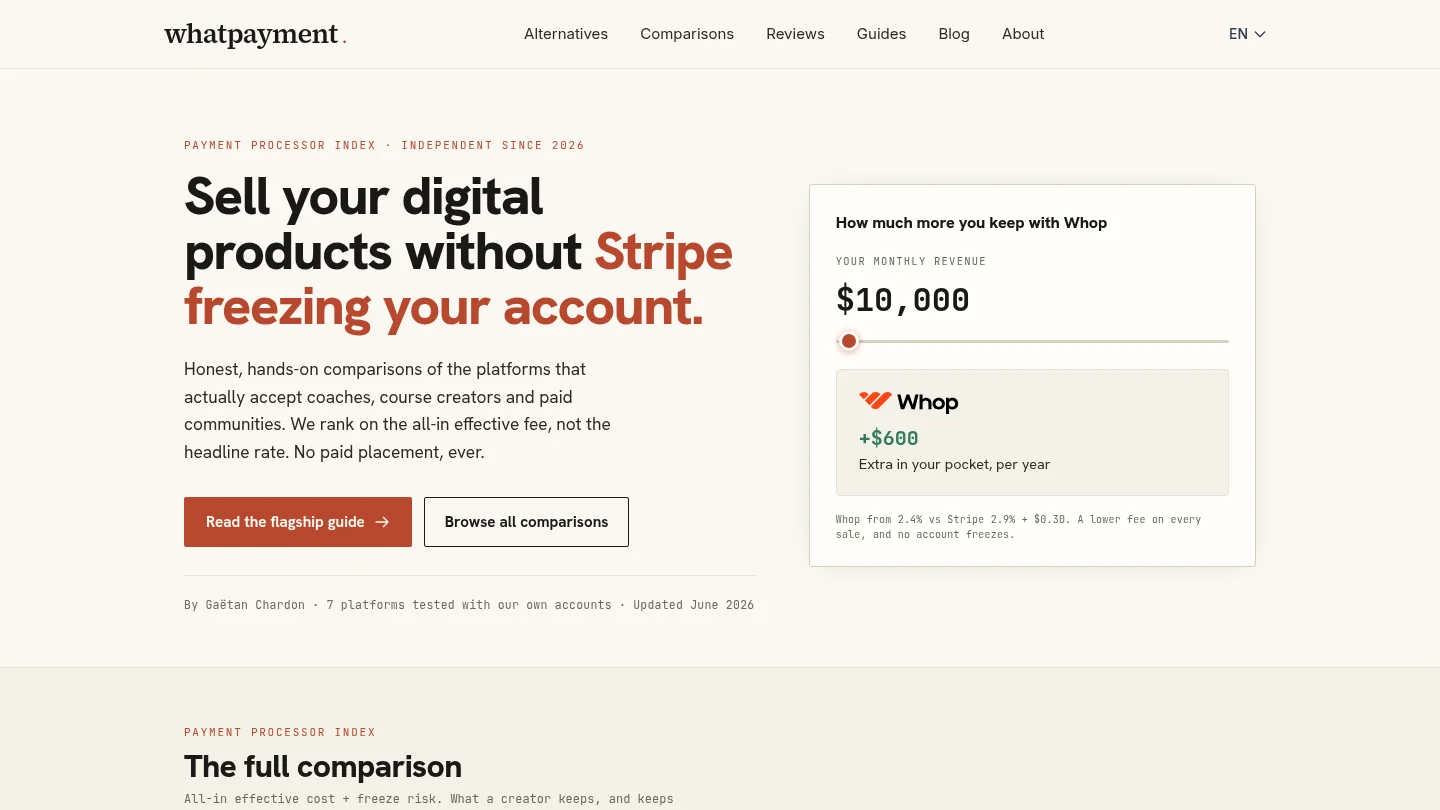
We publish independent comparisons and reviews based on public documentation, testing, creator feedback, and use-case analysis. If you are assessing a creator platform for digital products, communities, or memberships, read our review of Whop payment processing and verify the provider terms against your own business model.
Frequently Asked Questions
What is the most important payment feature for a high-ticket mastermind?
Payment-plan control is often central because it affects authorization, future collection, failed-payment recovery, refunds, and disputes. The processor should also support clear customer records and reliable payouts for your specific business model.
Can a US LLC owner living abroad use a payment processor?
It may be possible, but approval depends on the provider, your residence, your beneficial-owner information, your banking setup, your customer geography, and your product category. You should disclose the structure accurately and prepare documentation explaining the relationship between the entity and the operator.
Should a mastermind use one-time payments or installments?
One-time payments simplify collection but concentrate the financial commitment. Installments can make a high-ticket offer more accessible, but they require stronger authorization records, reminders, failed-payment handling, cancellation terms, and delivery evidence.
Is a Merchant of Record always better for international masterminds?
No. A Merchant of Record can simplify certain tax and transaction responsibilities, but it may impose product restrictions, payout rules, or different economics. Compare its legal role, customer-support duties, refund process, and effective cost with a conventional payment service provider.
How can WhatPayment help me compare payment options?
WhatPayment provides independent editorial research on payment processors, creator platforms, Merchant of Record models, fees, payouts, risk handling, and use-case fit. Its comparisons help you build a shortlist, but you should confirm current terms directly with the provider before processing live payments.
Keep reading
Browse all guidesBlog
Payment Processors for Global Digital Product Sellers
Blog
High-Risk Merchant Accounts for Global Digital Sellers
Review
Lemon Squeezy Review 2026: Still Worth It After Stripe?
Review
Payhip Review 2026: When It Beats the Giants
Review
Sellfy Review 2026: Niche, But Genuinely Defensible
Review