What you'll get
Payment Processors Like Stripe for Global Digital Creators
Need a stripe like payment processor? Compare global digital product options by eligibility, fees, tax roles, payouts, and creator fit.

Founder & Editor
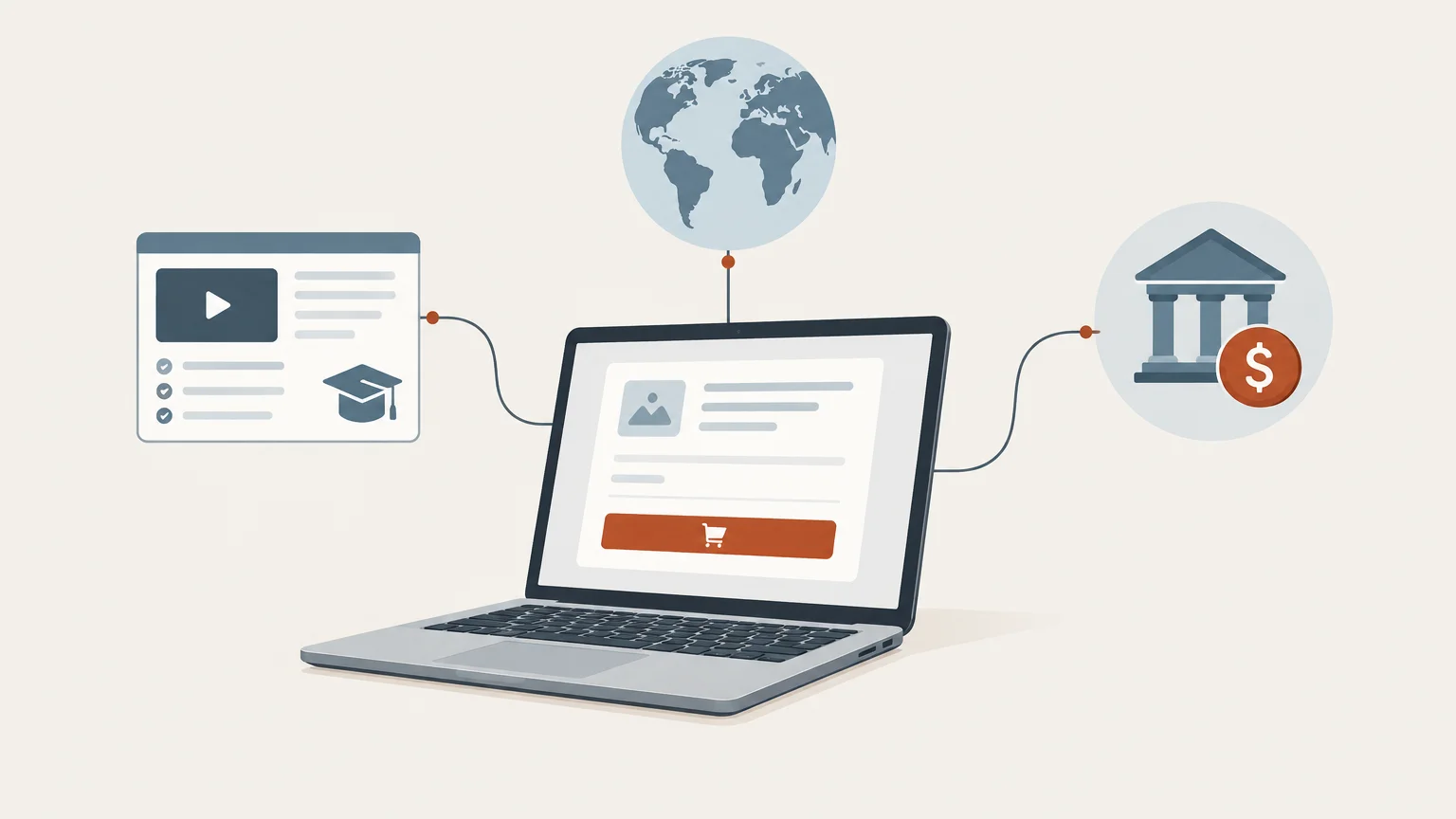
Does a US LLC make it simple to use a payment processor like Stripe while living abroad? Not by itself. The relevant questions include where your business is registered, where its activity takes place, which payment methods your customers use, and which bank account receives payouts. Our Stripe alternatives coverage compares providers for online sellers, including digital product businesses and creators.
International sales can also introduce tax responsibilities that payment acceptance alone does not resolve. The OECD’s digital sales tax guidance describes how jurisdictions approach VAT on cross-border sales of digital products and services. Your residence, entity structure, customer locations, and provider’s legal role all matter, so treat processor selection and tax planning as separate decisions.
Shortlist by the payment job you need done
- Need digital product tax handling? Compare a Merchant of Record, such as Paddle, with a payment processor. Their legal roles and fee structures differ.
- Need creator checkout and community sales? Consider Whop, but check its tax settings and seller responsibilities rather than assuming it takes on every liability.
- Need international payment infrastructure? Assess Airwallex or Adyen against your actual business location, customers, payout currencies, and volume.
- Need bank debit for recurring payments? GoCardless can complement a card processor, but it is a different payment method, not a like-for-like card replacement.
The table is a screening tool, not a universal ranking. “Non defini pour le moment” means an exact fee or eligibility outcome is not established here for your specific account and setup. Confirm current terms with the provider before moving payments.
| Provider | Relevant role | Tax responsibility | Fee or eligibility check |
|---|---|---|---|
| Whop | Creator-focused digital sales and checkout | Tax handling depends on the selected mode. Sellers retain other responsibilities. | Domestic cards: 2.7% + $0.30 per successful transaction. International card and currency fees can add to this. |
| Paddle | Merchant of Record for digital products | Handles transaction tax collection and remittance within its Merchant of Record service. | Check current pricing and seller approval. Exact fee: Non defini pour le moment. |
| Airwallex | International payments and multi-currency financial infrastructure | Not a Merchant of Record by default; the seller must assess its tax duties. | Check acceptance by business location and account terms. Exact fee: Non defini pour le moment. |
| GoCardless | Bank debit and recurring bank payments | The seller remains responsible for its own tax obligations. | Confirm business eligibility, customer bank schemes, and fees. Exact fee: Non defini pour le moment. |
| Stripe | Card processor and payment infrastructure | The seller remains responsible for its own tax obligations. | Confirm account location and physical business details. Exact fee: Non defini pour le moment. |
| Braintree | Payment gateway and processor with PayPal-related payment options | The seller remains responsible for its own tax obligations. | Confirm merchant-country eligibility and terms. Exact fee: Non defini pour le moment. |
| PayPal | Wallet and online payment option | Using PayPal does not, by itself, transfer the seller’s tax duties. | Confirm account availability and fees for your country. Exact fee: Non defini pour le moment. |
| Adyen | Global payment infrastructure | The seller remains responsible unless a separate legal arrangement states otherwise. | Verify business fit, onboarding, and pricing directly. Exact fee: Non defini pour le moment. |
What an owner living abroad should check first
- Match entity and activity. Make sure your application accurately describes the LLC, its operating location, and the address where business activity takes place.
- Check payout access. Confirm which bank accounts, currencies, and payout countries the provider accepts for your business profile.
- Separate processor from MoR. A processor takes payments; a Merchant of Record may take on specified transaction-related obligations under its terms.
- Review tax requirements separately. A provider’s tax service does not settle every US or local filing obligation.
A US LLC owner living abroad should not assume that a US registration alone answers account eligibility. For example, Stripe’s US account requirements include a registered US business and a physical address reflecting where the majority of business activity occurs. That makes it important to represent your real operating situation, not simply reuse a formation address.
Residence abroad is also not the same thing as foreign ownership for US tax purposes. A foreign-owned US disregarded entity can have reporting requirements, including Form 5472 and a pro forma Form 1120 in specified circumstances. The IRS Form 5472 instructions explain those rules; an accountant should assess your actual ownership and transactions.
For international digital sales, compare the whole checkout and settlement path. The card currency, customer location, payout currency, conversion rate, and bank fees can all affect net receipts. If you sell courses, downloads, or memberships, start with the product and customer journey, then test whether the provider supports the payment methods your buyers actually use.
Whop
Best for: Creators selling digital products, memberships, or community access who want a creator-oriented checkout and selling environment.
Whop’s stated domestic card fee is 2.7% + $0.30 per successful transaction, roughly 3% as a shorthand. The fixed charge means the effective percentage changes with ticket size. International card and currency conversion charges can add to the base fee, so do not treat the domestic rate as the worldwide all-in cost. Older “around 6%” estimates do not describe the stated base domestic card rate.
Its seller terms distinguish payment processing from taking on all seller obligations. Tax handling is subject to the selected mode, while sellers remain responsible for refunds, chargebacks, and taxes beyond the specified transaction-tax service. For a closer comparison with Stripe, see our Stripe vs. Whop analysis.
Pros
- The base domestic card rate is clearly stated, making it easier to begin a fee calculation.
- Its creator-focused setup can suit digital products and paid communities better than a processor-only workflow.
Cons
- International card and currency charges change the total cost for a global audience.
- Sellers still need to understand their own refund, dispute, and tax responsibilities.
Paddle
Best for: Digital product businesses that prioritize a Merchant of Record model and want transaction tax handling within that service.
Paddle is built for digital products, including courses, e-books, software, and downloadable files. As a Merchant of Record, it says it calculates and remits transaction taxes on sales it processes under its model. That can reduce the seller’s transaction-tax workload, but does not erase entity-level tax or other obligations that sit outside the agreement. Compare the full service price and payout terms with the value of the tax and billing work it includes.
Pros
- The Merchant of Record model puts specified transaction-tax tasks with the provider.
- Its product focus includes digital downloads and recurring billing.
Cons
- A Merchant of Record is a different legal and commercial arrangement from using a processor directly.
- Review its pricing, approval requirements, payout terms, and contract scope before switching.
Airwallex
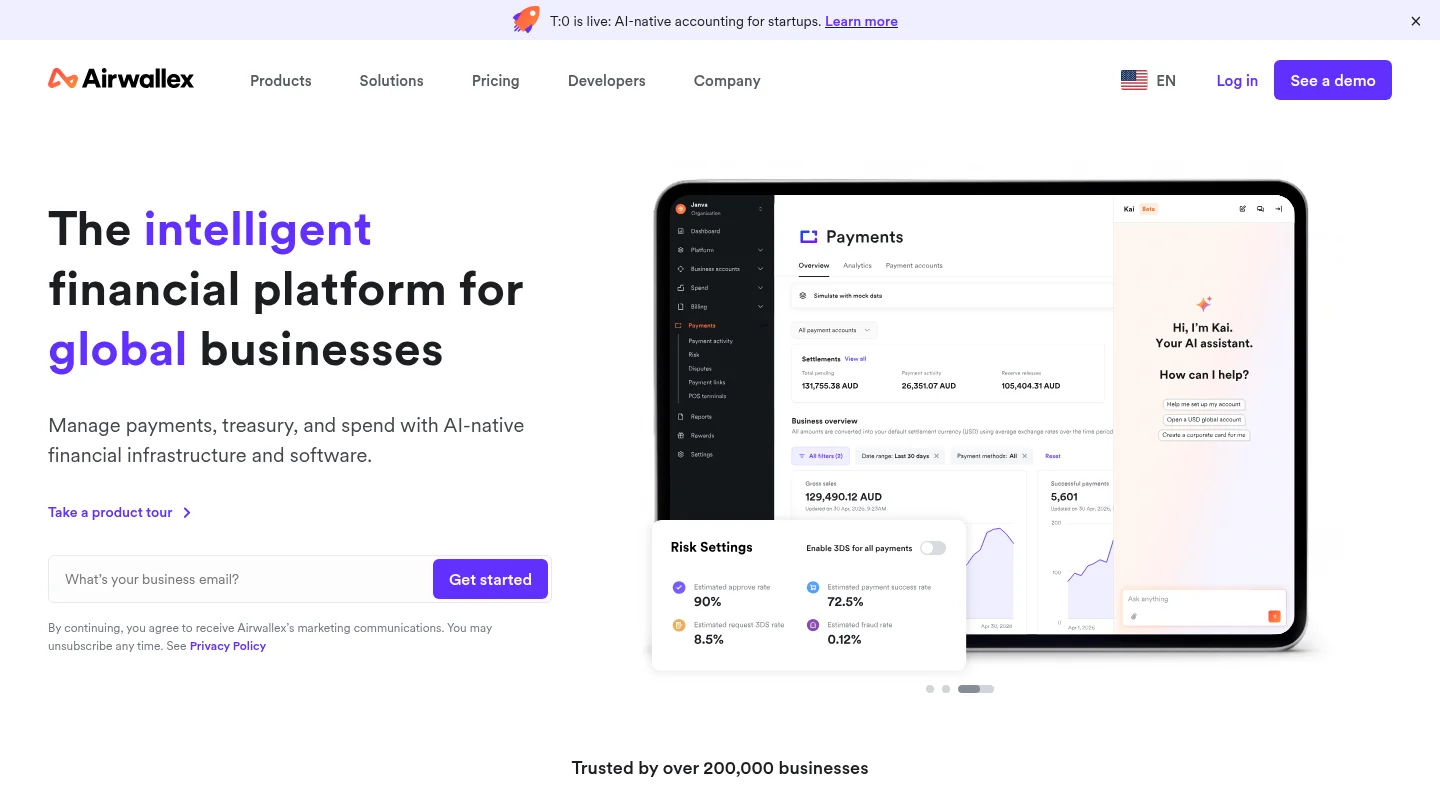
Best for: Operators who need international payment acceptance alongside multi-currency business accounts or transfers.
Airwallex combines payments with financial infrastructure, including multi-currency accounts and international transfers. Its documentation lists payment methods with separate business-location, customer-region, currency, and settlement conditions. For an owner living abroad, that detail matters: broad international coverage does not prove that a particular US LLC, operating address, and owner profile qualify for every feature.
Evaluate it as a payment stack rather than assuming it automatically replaces Stripe in every digital-product workflow. Confirm whether subscriptions, payment links, settlement currencies, and your target countries fit your checkout needs.
Pros
- Its multi-currency and cross-border features suit businesses with international operations.
- Its payment-method documentation makes location and settlement conditions visible for review.
Cons
- Eligibility and feature availability depend on the business and payment method’s relevant locations.
- It is not a Merchant of Record by default, so sellers still need to assess tax duties.
GoCardless
Best for: Businesses collecting recurring bank payments, such as membership or invoice payments, where supported schemes match their customers.
GoCardless focuses on bank payments, including direct debit and ACH. Its merchant information lists the United States among the countries where businesses can sign up, and describes customer collection through supported bank debit networks. This makes it a possible addition for recurring payments, not a universal replacement for card acceptance across global digital sales.
Pros
- Bank debit can be relevant for recurring billing when customers have access to a supported scheme.
- Its published country and currency information gives sellers concrete eligibility checks.
Cons
- It serves a different payment method from a general card processor.
- Check whether your customers’ locations and preferred payment methods are supported before relying on it.
Stripe, the reference point
Best for: Digital businesses that want a flexible processor with developer tools, recurring billing options, and a broad payments stack.
Stripe remains a useful baseline for comparing checkout control and integrations. For a US LLC owner abroad, the key question is whether the account information, business activity address, and verification documents fit the provider’s requirements. Its global customer reach does not mean every seller can open an account from any place of residence.
Pros
- It offers configurable payment tools and recurring billing options for online businesses.
- It can serve as a familiar starting point for comparing processors and Merchant of Record services.
Cons
- The seller must account for its own tax responsibilities and any additional tools or processes needed for compliance.
- Eligibility depends on the business profile and verification details, not just having a US LLC.
Braintree
Best for: Digital businesses looking for a developer-oriented processor that includes PayPal-related payment options.
Braintree is a processor and gateway within the PayPal ecosystem. It can be relevant if your checkout needs cards and wallet options through a developer-led integration. Before shortlisting it, check whether the merchant account is available for your actual business location and whether the integration supports your subscription or one-time payment model.
Pros
- It offers a technical integration route for businesses that need more control over payment flows.
- Its connection to the PayPal ecosystem makes it worth assessing when those payment options matter to customers.
Cons
- It requires a closer review of onboarding and technical fit than simply adding a wallet button.
- Do not assume that the owner’s residence and the LLC’s registration can be treated interchangeably during approval.
PayPal
Best for: Sellers who want to offer a recognizable wallet as a payment option to international customers.
PayPal can add a familiar checkout choice, but it is not automatically a like-for-like replacement for a full processor setup. Check which business services are available for your account country, how payouts work, and how currency conversion affects receipts. For many sellers, the practical comparison is whether to add PayPal alongside a processor rather than move every payment flow.
Pros
- A separate wallet option can give customers another way to pay.
- It may complement a card processor rather than requiring a complete migration.
Cons
- Availability, terms, and withdrawal options depend on the account’s country and setup.
- It does not transfer the seller’s wider tax responsibilities.
Adyen
Best for: Established businesses evaluating global payment infrastructure and a broad set of local payment methods.
Adyen is oriented toward businesses managing international payments at scale. Its official materials describe a platform for payments across regions and local methods, but that does not establish approval for a specific LLC owned by someone living abroad. Ask about business-country acceptance, underwriting, implementation, and pricing before investing in a migration plan.
Pros
- Its global payment infrastructure makes it a candidate for complex multi-market operations.
- It is relevant when a business needs to assess local payment methods beyond cards.
Cons
- Its practical fit depends on onboarding and integration needs, not only geographic reach.
- Do not assume it is the simplest choice for a small creator business without checking requirements.
Where ad intelligence fits for infopreneurs
- Use ad intelligence to investigate offers. Ad-spy and offer-validation tools address questions about ads, positioning, and market signals.
- Use payment infrastructure to collect money. A payment provider determines acceptance, checkout, payout, and some operational responsibilities.
- Do not confuse validation with approval. An ad performing well does not establish that a processor will approve your business model or account.
For an infopreneur, offer research and payment selection belong in separate checks. An ad-intelligence tool can inform whether to test an offer; it does not confirm account eligibility, international payout access, tax treatment, or dispute handling. Select the payment setup after you have defined the product, billing model, customer countries, and expected payout currencies.
Compare effective cost, responsibility, and risk
- Model the full charge. Include percentage and fixed fees, cross-border charges, conversion, subscription add-ons, and withdrawal costs.
- Read the legal role. Determine whether the provider processes a payment or acts as Merchant of Record for specified obligations.
- Test the payout route. Confirm the settlement currency, receiving bank, timing, and review process for your account profile.
- Keep card security in scope. Outsourcing checkout does not necessarily remove every merchant responsibility.
Compare the same transaction scenarios across providers, such as a domestic card sale, an international card sale, and a recurring subscription. Use your own average transaction amount because fixed fees change the effective rate, and keep separate rows for foreign-card and currency-conversion charges. If a provider’s offer is quote-based or your exact conditions are not clear, record “Non defini pour le moment” rather than treating a missing figure as zero.
For card payments, the PCI Security Standards Council explains that merchants can retain responsibilities even when parts of payment processing are outsourced. Its e-commerce security guidance is a useful reminder to check who protects each part of the checkout and how responsibilities are documented.
Our comparisons focus on the details that matter to operators: effective fees, Merchant of Record status, tax allocation, payout behavior, account reviews, and fit for digital products. We use test accounts and public documentation, disclose affiliate relationships, and do not accept vendor-paid placement or vendor review before publication. Because we are affiliate-funded, readers should consider that relationship alongside the stated methodology and disclosures.
Frequently asked decision points
Before migrating, write down the LLC’s registration country, operating address, owner’s residence, customer countries, payment methods, and payout account. Then ask each provider to confirm its requirements against those facts in writing.
Verdict: choose for the business you actually operate
The strongest Stripe alternative for global digital sales depends on whether your priority is creator checkout, transaction-tax handling, multi-currency operations, wallet choice, or recurring bank payments. A US LLC and customers across countries do not guarantee account approval or a low effective cost. Verify the business profile, price the full payment path, and map tax responsibilities before moving a live checkout.
Compare Stripe alternatives for SaaS
Payment processors are not interchangeable, especially when the owner lives abroad and customers pay from several countries. A useful comparison should weigh fees, tax responsibility, payout behavior, and account eligibility against the actual digital business model.

We publish payment processor indexes, comparisons, and guides for digital businesses. Our Stripe alternatives for SaaS page is focused on software businesses, while our broader editorial coverage addresses creators and other online sellers. We disclose affiliate relationships, do not sell payment processing or implementation services, and revisit articles as terms and features change.
Frequently Asked Questions
Can a US LLC owner living abroad use Stripe?
Possibly, but the LLC alone does not establish eligibility. Check that the business location, operating address, owner information, and verification documents match the provider’s current requirements.
Is a Merchant of Record always better than a payment processor?
No. A Merchant of Record can take on specified transaction-related responsibilities, while a processor may give the seller more direct control. Compare the legal scope, total price, payout terms, and remaining tax duties.
Does Whop cost around 6% on every sale?
That is not a reliable description of its stated base domestic card fee. International card and currency conversion charges can increase the cost, so calculate the rate for your buyer and payout currencies.
Can GoCardless replace a card processor for digital products?
It is a bank payment option, not a general substitute for card acceptance. It fits best when the customer’s bank scheme and your recurring payment workflow are supported.
Does a Merchant of Record handle every tax obligation for a US LLC?
No. Its service may cover specified transaction taxes, but it does not automatically remove entity-level, income-tax, or other local reporting responsibilities. Review the contract and consult a tax professional about your own circumstances.
Keep reading
Browse all guidesBlog
ProcessorFit vs Payment Review: Which Research Fits You?
Blog
Payment Processing for High Ticket Mastermind Groups
Review
ClickFunnels Review 2026: Buy or Skip for Infopreneurs?
Review
Kartra Review 2026: Pricing, Fees, and Who Overpays
Review
Polar.sh Review 2026: Pricing, Fees, and Who It Fits
Alternatives