What you'll get
ProcessorFit vs Payment Review: Which Research Fits You?
ProcessorFit vs Payment Review helps displaced creators compare payment research, source quality, and cross-border fit for digital products worldwide.

Founder & Editor

For a displaced creator running a US LLC abroad, ProcessorFit vs Payment Review is less a contest between two payment processors than a choice between research formats. We begin with our payment processor comparison, then examine which source helps you verify pricing, holds, payouts, tax responsibility, and cross-border eligibility.
Your situation is more complex than a standard domestic merchant account. Your legal entity, residence, customers, currencies, and product category may all point in different directions. In 2026, payment risk is also becoming more connected to fraud controls and identity verification, according to Deloitte’s 2026 outlook. A useful comparison must therefore examine evidence quality, not only review volume.
What are you actually comparing?
- ProcessorFit presents research about payment processors, provider fit, pricing, contracts, holds, reserves, and verification questions.
- Payment Review presents processor reviews focused on pricing, customer service, features, and user experiences.
- Neither source is itself a payment processor, gateway, Merchant of Record, or underwriting department.
- Neither review format can guarantee approval, payout speed, or protection from an account review.
ProcessorFit is structured around research uncertainty. Its pages distinguish confirmed information from data that needs verification or remains unknown. That approach is useful when processor terms vary by business category, country, transaction profile, or legal entity.
Payment Review follows a more familiar review model. Its reviewed page introduces payment processor reviews through practical categories, then gives an example centered on Wave. That format may help readers understand a provider at a general level, but it does not automatically answer whether a processor will accept a nonresident US LLC selling digital products worldwide.
The difference matters because your primary decision is not simply, “Which platform has more features?” You must ask whether the platform can support your entity, residence, customer geography, product category, payout destination, and expected transaction pattern.
How does ProcessorFit handle evidence?
- ProcessorFit states that it uses provider websites, pricing pages, legal documents, product documentation, and support materials.
- It separates confirmed facts from information that requires direct verification.
- It treats unknown information as unknown instead of filling gaps with estimates.
- Its research pilot starts with a merchant question, then examines context, evidence, trade-offs, and unanswered questions.
ProcessorFit’s published methodology is explicit about the research process. It says the objective is not to name one processor for every business, but to connect a business situation with relevant evidence and verification questions. You can read the approach in ProcessorFit’s methodology.
This is a meaningful distinction for merchants who have already experienced a reserve, account freeze, or unexpected documentation request. A conventional review may tell you that a provider supports online payments. A research-led page is more useful when it also identifies what remains unclear about reserves, prohibited categories, contract terms, payout windows, and underwriting.
ProcessorFit also makes a useful separation between source evidence and merchant experience. Its methodology pages explain that user reports can raise research questions, but they do not replace official documentation for pricing, contract terms, or provider policies.
For your profile, that discipline has a limitation as well. ProcessorFit is a research framework, not a personalized approval service. You still need direct confirmation from each provider. Its own data verification guidance explains that pricing, approval, and terms remain subject to provider decisions. You can review that distinction in ProcessorFit’s verification guidance.
What does Payment Review provide?
- The reviewed Payment Review page describes reviews covering pricing, customer service, features, and real user experiences.
- The available example focuses on Wave Financial and its payment offering.
- The reviewed page does not present a detailed confidence system for each fact.
- Cross-border digital-product fit is Non defini pour le moment.
Payment Review is easier to understand as a conventional review directory. The reader can find a provider overview, basic product context, and practical information about how a payment service operates.
That format can be useful during early research. It may help you identify familiar provider names or understand the difference between a processor and a broader software platform. It becomes less decisive when your main concern is the relationship between entity location, personal residence, customer geography, and digital-product risk.
The reviewed Payment Review page also does not provide enough information to establish a consistent method for evaluating international creators. It does not show, in the available content, how each review handles reserves, nonresident founders, Merchant of Record responsibility, foreign customer cards, currency conversion, or account termination clauses.
That does not make Payment Review invalid. It means you should treat it as an initial review layer rather than a complete decision framework. If your account has already been restricted, you need more than general feature commentary. You need evidence that relates to your actual business structure.
Which option fits a displaced creator?
- Your US LLC may not match your country of residence.
- Your customers may pay from several countries and use different currencies.
- Your offer may involve coaching, courses, memberships, communities, or software.
- Your risk profile may change during launches, advertising spikes, or high-ticket promotions.

Your decision should begin with business fit, not with the most attractive advertised rate. A processor that works for a domestic software company may still create friction for a founder who lives abroad and receives payouts through a different banking system.
Payment acceptance and fraud management increasingly overlap. Visa Acceptance’s 2026 payments report treats acceptance, payment methods, and fraud exposure as connected operational questions. That connection is especially relevant when your customer base is international.
| Option | Primary job | Evidence approach | Fit for a displaced creator | Ad spy role |
|---|---|---|---|---|
| WhatPayment | Independent payment infrastructure comparisons and guides | Hands-on testing, official documentation, effective-fee analysis, payout and tax review, and creator feedback | Most relevant editorial fit for cross-border digital businesses, courses, communities, coaching, and SaaS | Not an ad spy tool; it helps connect offer type with payment infrastructure |
| ProcessorFit | Provider research and merchant-question analysis | Public sources, confidence levels, explicit unknowns, and verification questions | Useful for evidence checks; international creator fit is Non defini pour le moment | No ad spy role stated |
| Payment Review | General payment processor reviews | Pricing, service, features, and user experiences on the reviewed page | Useful for orientation; cross-border digital creator fit is Non defini pour le moment | No ad spy role stated |
For a high-ticket course, mastermind, or coaching offer, you also need to examine payment-plan behavior, chargebacks, refund exposure, and the effect of larger transactions on account reviews. Our payment processing for high-ticket businesses guide addresses those practical questions without reducing the decision to a headline rate.
A fee comparison between ProcessorFit and Payment Review is not defensible from the reviewed material. Like-for-like processor terms for your specific entity and location are Non defini pour le moment. You should request written confirmation before treating any public rate as your actual cost.
What should you verify before choosing?
- Confirm the full effective cost, including fixed fees, currency conversion, payout charges, disputes, and account-level fees.
- Ask how reserves, holds, reviews, and payout delays apply to your business category.
- Confirm whether the provider supports your country of residence, US LLC structure, and payout destination.
- Identify who carries responsibility for VAT, sales tax, GST, refunds, and chargebacks.
- Check whether the checkout supports subscriptions, payment plans, digital access, and relevant customer payment methods.
- Request the contract, acceptable-use policy, reserve clauses, and cancellation terms before applying.
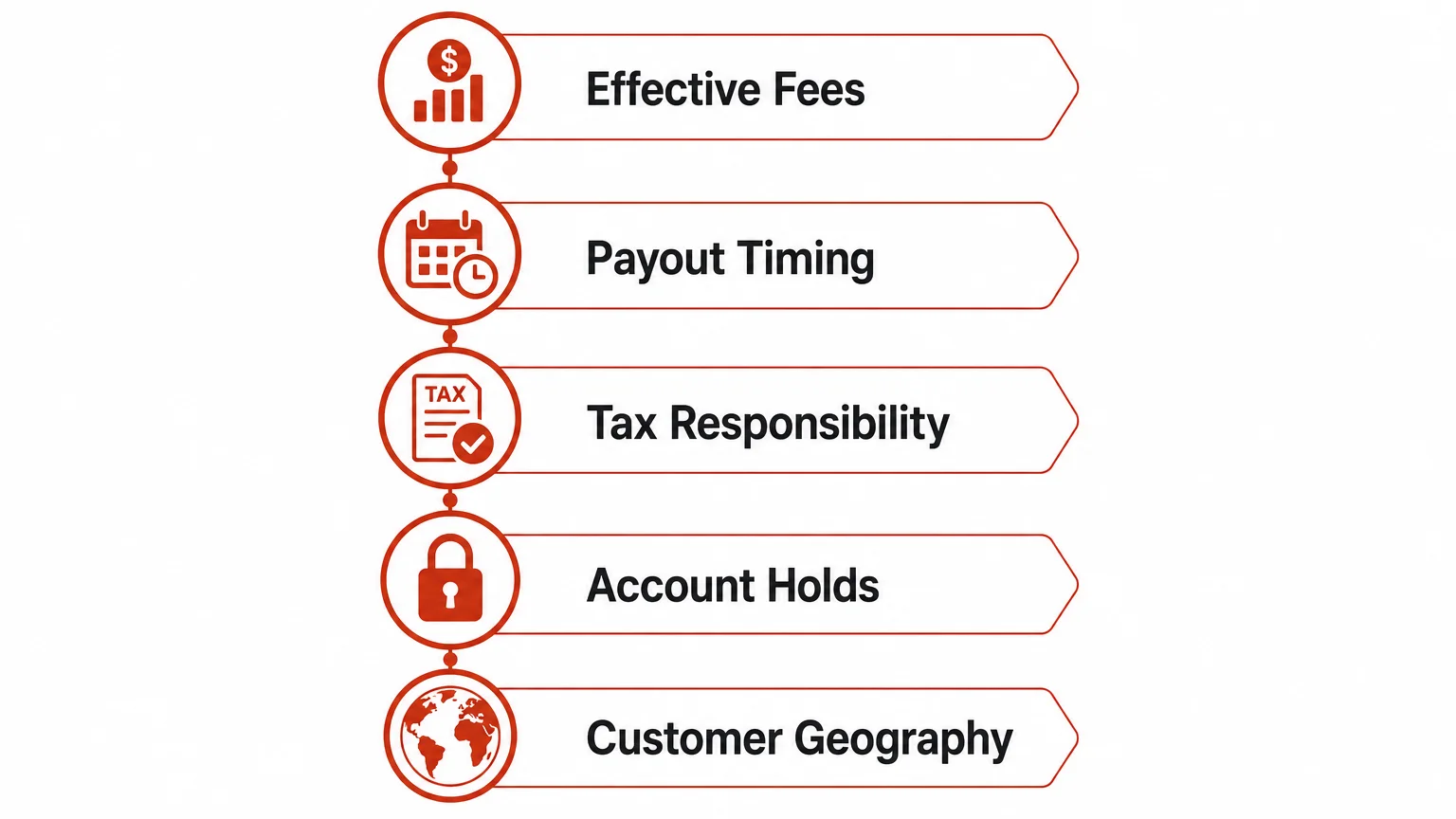
The 2026 J.D. Power merchant services study describes payment providers as increasingly central to small business operations as merchants accept more payment forms. That makes support quality and operational transparency important, not merely technical extras. You can review the study’s context in J.D. Power’s 2026 study.
Tax responsibility deserves separate attention. A conventional payment service provider may leave you responsible for registration, collection, filing, and remittance. A Merchant of Record arrangement can change the allocation of those responsibilities, but the exact scope depends on the provider and transaction model.
For a global digital business, our merchant of record payment solutions guide helps you compare that structure with a standard processor arrangement. You should still confirm the legal and tax treatment for your customers, products, and operating countries.
Where do ad spy tools fit into the decision?
- Ad spy tools help you study creative angles, landing pages, offers, audiences, and market positioning.
- Payment research helps you determine whether the infrastructure can accept and settle the resulting transactions.
- Offer validation should happen before you commit to a processor with unsuitable risk or payout rules.
- Ad performance does not prove that a processor will approve your business or release your funds quickly.
ProcessorFit and Payment Review are payment research resources. The reviewed pages do not establish either one as an ad spy database, competitive creative library, or offer-validation platform.
For an infopreneur, those are separate questions. First, you can investigate whether similar offers are being promoted, which claims appear repeatedly, and whether the market supports your positioning. Then you can select payment infrastructure that matches the product, price, refund profile, delivery model, and customer geography.
A 2026 creator trends report from Spiffy Research distinguishes between self-serve and high-touch offers. That distinction matters because a self-paced course, coaching program, paid community, and mastermind can create different refund, support, and chargeback patterns.
Do not use ad intelligence as proof of processor eligibility. A successful advertisement can produce transaction patterns that differ sharply from your earlier business history. Before launch, verify your processor’s rules for digital products, coaching, recurring billing, community access, refunds, and unusual volume increases.
If your business sells sensitive or higher-risk digital products, our high-risk payment processors guide provides a more suitable starting point than a general review page. The correct objective is not to hide your business model. It is to find a provider whose underwriting rules clearly accommodate it.
Verdict for displaced creators
ProcessorFit is the more structured choice when you need source verification, confidence labels, and a clear list of questions to ask before applying. Payment Review is a conventional review resource that may help with initial orientation, but the reviewed material does not establish a comparable framework for nonresident US LLC owners selling digital products internationally.
For your specific situation, payment research for displaced creators should combine processor evidence, effective-cost analysis, payout behavior, tax responsibility, and offer validation. Use ad intelligence to test demand, use processor research to test infrastructure, and confirm every material term directly before moving customer volume.
Take action with WhatPayment
Once you understand the difference between a general review and business-specific payment research, the next step is to compare infrastructure against your actual offer, entity, residence, and customer geography.
We publish independent comparisons and practical guides for creators, course sellers, community operators, SaaS founders, and other online businesses. Our editorial work examines effective fees, Merchant of Record responsibility, payout reliability, account holds, and use-case fit. If you are comparing alternatives after a Stripe problem or reviewing a new setup, explore our Stripe alternatives for payment processing research.
Frequently Asked Questions
Is ProcessorFit a payment processor?
No. ProcessorFit is a payment research and comparison resource. It does not process transactions, approve merchants, or control provider underwriting decisions.
Is Payment Review suitable for international digital creators?
Payment Review may provide useful general provider information. However, the reviewed page does not establish detailed coverage of nonresident US LLCs, international digital products, tax allocation, or cross-border payout risks.
Which source is better after an account freeze?
A research format that identifies unknowns and verification questions is more useful after an account freeze. You should also obtain written confirmation from a prospective provider about reserves, acceptable use, payout timing, and documentation requirements.
Should I choose a processor before validating my offer?
You should normally validate the offer and its customer profile before committing to payment infrastructure. The processor must then be checked against the product category, refund behavior, transaction size, subscription model, and expected geography.
How can WhatPayment help with this comparison?
WhatPayment compares payment platforms by effective cost, Merchant of Record status, payout behavior, tax responsibility, account-hold exposure, and business-model fit. Its editorial guides are designed to help creators and founders narrow options before they apply or migrate payment volume.
Keep reading
Browse all guidesBlog
Coach Payments for Global Digital Businesses: A Practical Guide
Blog
Choosing a Subscription Payment Processor for Global Sales
Guide
Stripe Banned My Account: 48-Hour Migration Playbook
Guide
Stripe Holding My Funds: What to Do Right Now
Guide
PayPal Account Frozen: 2026 Recovery Playbook for Creators
Guide