What you'll get
Stripe Alternatives for Global Digital Creators With a US LLC
Compare Stripe alternatives for a US LLC owner abroad, weighing payment costs, tax responsibility, payout fit, and global digital product sales.

Founder & Editor

Where should you take payments when your US LLC is run from abroad and your buyers live in several countries? The right Stripe alternatives depend on whether you want a payment processor and will handle tax obligations yourself, or a Merchant of Record that assumes more of the sales and tax work. Start with our payment processors that can replace Stripe, then compare options against your actual buyer locations and payout needs.
Living abroad does not automatically make an account eligible just because the company is registered in the United States. If you are a foreign person who wholly owns a US disregarded entity, IRS instructions describe a possible Form 5472 filing with a pro forma Form 1120 when the reporting requirements apply. The IRS Form 5472 instructions are a useful reminder that payment setup and company compliance are separate decisions.
Key takeaways
- Stripe’s published US card rate is 2.9% plus $0.30 for domestic cards, with listed surcharges for international cards and currency conversion.
- Whop lists 2.7% plus $0.30 for domestic card transactions. International card, currency conversion, and selected optional service fees add to that base.
- Paddle lists 5% plus $0.50 per checkout transaction, with payments, subscriptions, and tax compliance included in its Merchant of Record service.
- Lemon Squeezy lists a 5% plus $0.50 base fee, with additional charges for some international, subscription, and PayPal payments.
- A Merchant of Record does not take over every tax obligation of a business or its owner. Check the exact transaction scope and responsibility in the provider’s terms.
Compare the payment models before comparing rates
- Choose a payment service provider if you want direct control over your payment flow and are prepared to manage seller obligations.
- Consider a Merchant of Record if you want the provider to handle specified customer transactions and related indirect tax tasks.
- Compare the entire cost, including international card fees, conversion, payout charges, and optional services, rather than only the domestic rate.
| Platform | Published fee structure | Tax role | Key consideration for an owner abroad |
|---|---|---|---|
| Stripe | 2.9% + $0.30 for domestic cards; listed international card and currency conversion surcharges apply. | Payment service provider, not a Merchant of Record. | Confirm the company country, owner verification, currencies, and settlement arrangement. |
| Whop | 2.7% + $0.30 for domestic cards; international card and currency conversion charges may apply. | Optional tax services have separate fees. The seller remains responsible for correct inputs and obligations outside the selected service. | Check seller eligibility, payout availability, and fees for each customer and withdrawal currency. |
| Paddle | 5% + $0.50 per checkout transaction under its published standard pricing. | Merchant of Record, with tax and payment operations included in its offer. | Confirm onboarding eligibility for your LLC and your residence before migrating. |
| Lemon Squeezy | 5% + $0.50 base fee, with additional fees for some transaction types. | Merchant of Record for qualifying digital product sales. | Review international payout costs and note that Lemon Squeezy is owned by Stripe. |
These are platform published fee structures, not a promise that every payment will receive the same rate. Stripe’s official pricing lists the domestic card rate plus additional charges for international cards and currency conversion. Whop’s official pricing separates its domestic card base from additional international, conversion, and optional service fees. Paddle and Lemon Squeezy publish their own checkout pricing and terms. Compare actual transactions from your markets before choosing.
Stripe, the baseline for a custom payment stack
Best for: A technically capable team that wants payment infrastructure and is prepared to manage its own seller and tax responsibilities.
Stripe combines online payment processing with developer tools, recurring billing, and international payment methods. Its published US pricing sets a useful reference point: 2.9% plus $0.30 for domestic cards, with listed surcharges for international cards and currency conversion. Those charges are not the whole cost of operating across borders, but they make clear why comparing only a domestic card rate can mislead.
Pros:
- Its APIs and billing tools suit businesses that need a tailored checkout or complex software subscription flow.
- The published rate structure is a clear starting point for calculating domestic card costs.
Cons:
- As a payment service provider, Stripe does not become the seller of record for your digital product. You retain seller responsibilities that a Merchant of Record may handle for qualifying sales.
- Cross-border charges can increase the processing cost, and a US LLC registration alone does not establish that an owner living abroad meets onboarding requirements.
Whop, a creator focused storefront and payments option
Best for: Digital creators who want to combine a storefront with payment and community oriented features.
Whop’s published standard rate is 2.7% plus $0.30 per domestic card transaction. That is roughly 3% on a $100 domestic card sale, before any additional service or payment type fees. Its pricing also lists an extra 1.5% for international cards and 1% for currency conversion. Optional services, including tax and remittance when enabled and tax is collected, carry their own charges. The comparison Stripe vs. Whop is relevant if you are weighing its creator oriented setup against Stripe’s more developer centered approach.
Whop is not simply a full Merchant of Record replacement by default. Its seller terms describe tax modes and specify that sellers remain responsible for the accuracy of their inputs and for obligations outside the selected service. That distinction matters if you expect the platform to absorb every tax risk. Before migrating, check whether your LLC and actual country of residence are eligible, and identify the payout methods, currencies, and added charges available to your account.
Pros:
- The domestic card base rate is below Stripe’s published domestic card rate.
- A creator oriented storefront may suit digital products and paid communities without requiring a fully custom checkout build.
Cons:
- International card and currency conversion fees raise the base cost for a globally distributed audience.
- Tax handling is an optional service with defined limits, not a blanket transfer of the seller’s responsibilities.
Paddle, a Merchant of Record for digital businesses
Best for: Digital product and SaaS sellers who prioritize bundled payment, subscription, and tax operations.
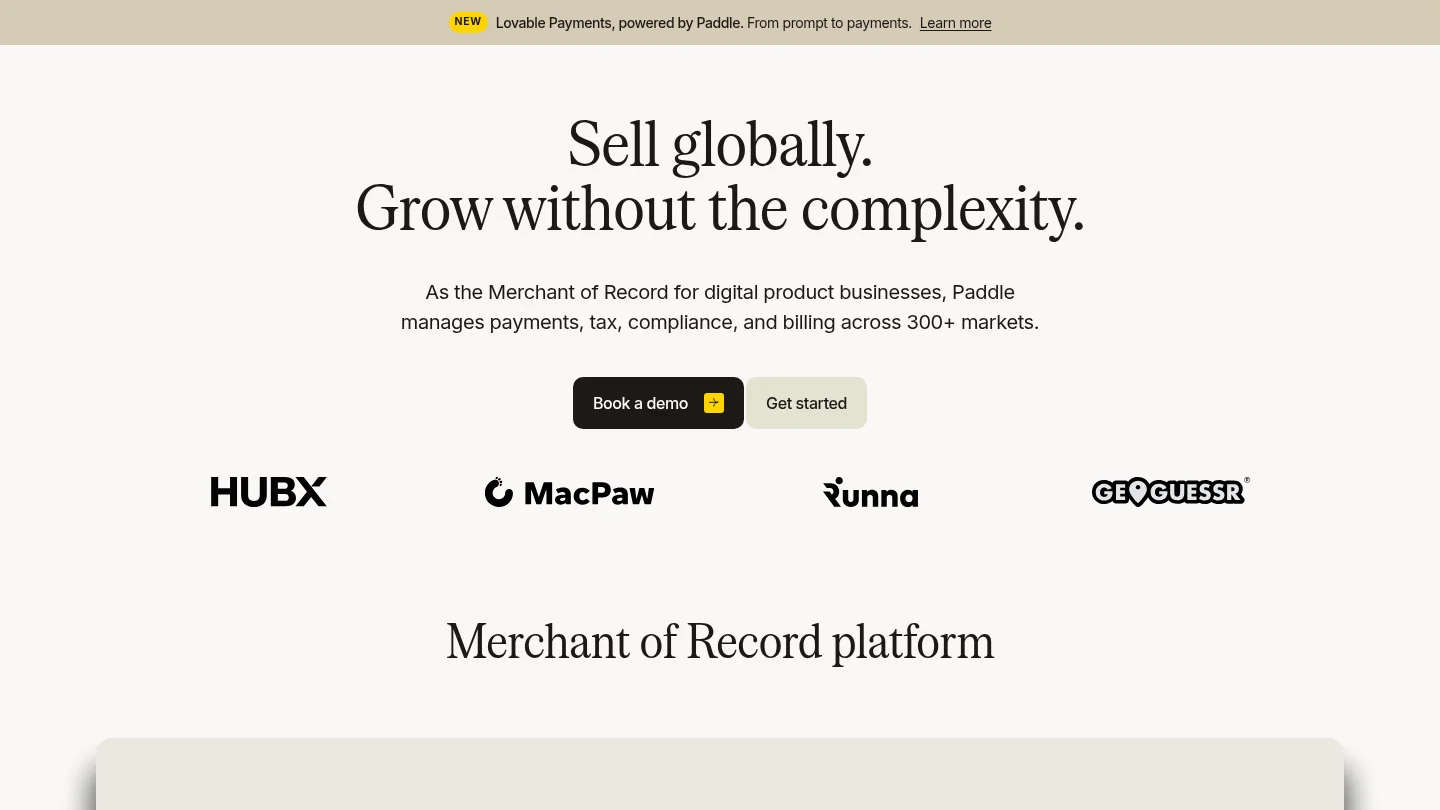
Paddle publishes a standard fee of 5% plus $0.50 per checkout transaction, with no monthly fee under its pay as you go pricing. Its offer includes payments, subscription billing, tax compliance, fraud protection, chargeback handling, and payment related buyer support. Paddle describes its Merchant of Record service as covering digital product businesses across more than 300 markets. For a global SaaS seller, bundling these tasks can make the higher transaction rate easier to compare with the cost and work of managing them separately.
The trade off is that a headline rate does not establish that Paddle will accept every business model, entity, or founder residence. Ask about your specific US LLC and where you live before moving subscriptions or relying on a particular payout path. A useful comparison is Stripe vs. Paddle, especially when your decision is about tax responsibility as much as processing.
Pros:
- One transaction fee includes several payment and compliance functions that a seller might otherwise arrange separately.
- The Merchant of Record model is a strong fit when handling indirect tax across customer markets is a major operational concern.
Cons:
- The published 5% plus $0.50 rate is higher than a basic domestic card processing rate. Compare it with the full cost of the alternatives, not with one fee line alone.
- Confirm product and seller eligibility directly before treating the advertised market coverage as approval for your particular business.
Lemon Squeezy, digital product tools with a Merchant of Record model
Best for: Software and digital product sellers who want hosted checkout, subscriptions, and a Merchant of Record.
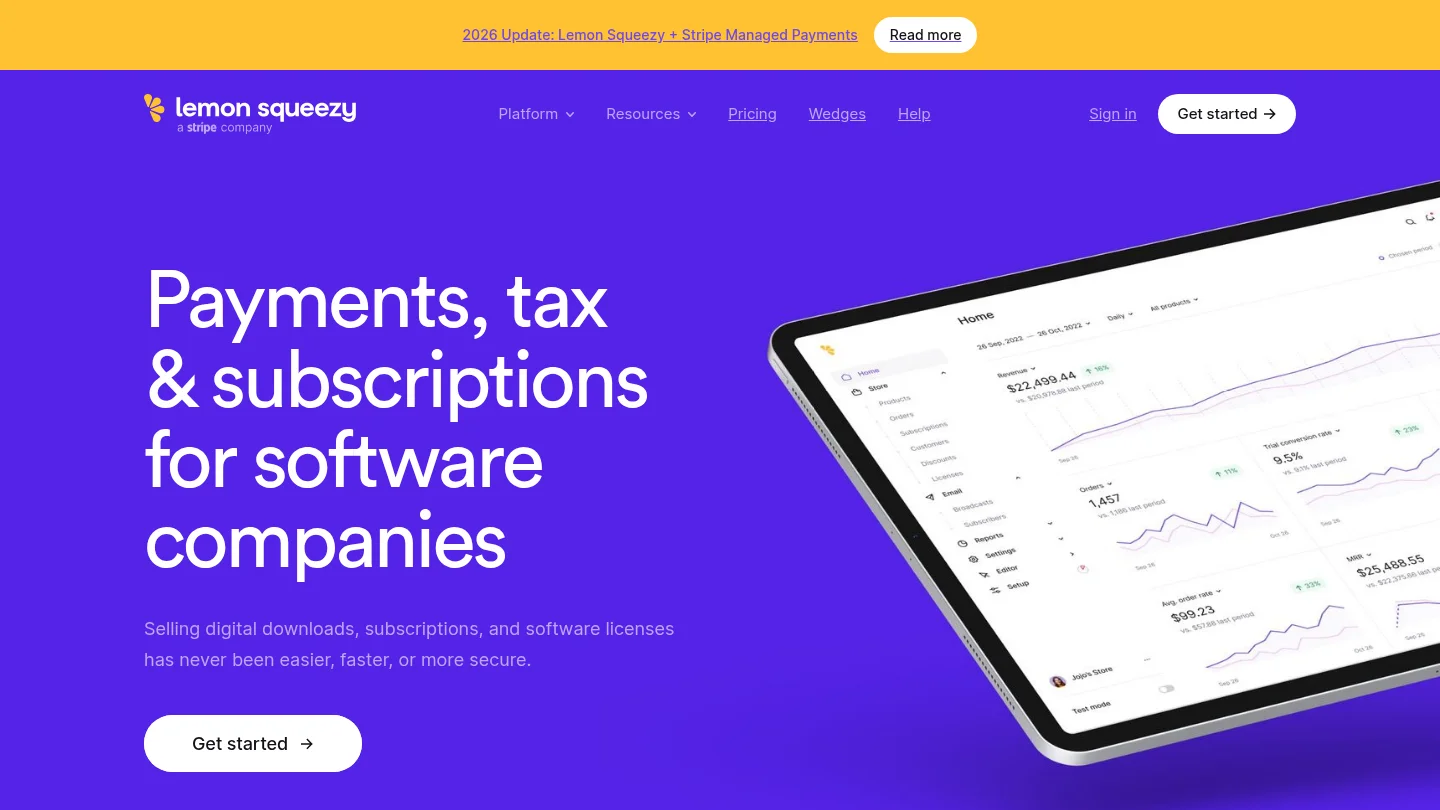
Lemon Squeezy supports digital downloads, subscriptions, software licenses, and hosted checkout. Its published base fee is 5% plus $0.50. Its fee documentation lists additional charges for some international card payments, subscriptions, PayPal transactions, and payouts, so calculate the rate for your actual customer mix and withdrawal method. The platform states that it acts as Merchant of Record for digital sales, handling specified sales tax responsibilities.
There is an important distinction for someone seeking an alternative to Stripe: Stripe acquired Lemon Squeezy in 2024. The two products have different models, but Lemon Squeezy is not an independent corporate alternative. In a January 2026 update, Lemon Squeezy described Stripe Managed Payments as a related Merchant of Record initiative and discussed migration options for its customers. Verify the current product direction, payout eligibility, and fees before moving a business because the corporate relationship and product roadmap matter to a long term choice.
Pros:
- Its tools are tailored to software and digital products, including recurring billing and software license handling.
- The Merchant of Record approach can reduce the seller’s direct work on specified indirect tax tasks.
Cons:
- The base fee has additional charges for some international, subscription, and PayPal payments, as well as certain payouts.
- Its ownership by Stripe means it does not meet the needs of every seller looking for a separate corporate provider.
What changes when the US LLC owner lives abroad?
- Payment acceptance country and owner residence are separate checks.
- The customer’s country can affect payment method, currency conversion, and indirect tax treatment.
- A Merchant of Record arrangement does not replace the LLC’s other tax or reporting duties.
For a practical example, a US LLC may sell an online course to a buyer in the EU while its owner works from another country. The processor’s account country, the owner’s identity and residence documents, the buyer’s payment method, and the tax treatment are separate details. Ask each provider to confirm that it will onboard your actual setup, not just a US registered entity in the abstract.
EU rules provide a route for eligible businesses outside the EU to report VAT on certain consumer services through the Non Union One Stop Shop. The EU One Stop Shop guidance explains the scheme for services supplied to EU consumers. A provider’s tax service may simplify collection and remittance for covered transactions, but it does not settle your income tax, entity reporting, or obligations in your country of residence.
For migrating subscriptions, check which customer records and payment credentials transfer, what reauthorization is required, and how cancellations, refunds, disputes, and failed payments are handled. If a platform cannot confirm these points for your account, stage the move with a small product or new subscription cohort first. Our guide to selling digital products without Stripe offers another way to frame the transition.
Use ad intelligence to test offers, not to choose a processor
Could competitor ads tell you whether a course or membership will sell? They can show creative patterns, audience language, and offer framing, but an ad library cannot establish another seller’s profit or prove that the same promise will work for your audience. TikTok’s Creative Center Top Ads filters selected advertisements, and TikTok notes that the displayed ads are limited to those authorized for the feature. It is a source of creative examples, not a complete record of every successful campaign.
Paid ad spy tools, including products such as Minea and Pipiads, can help infopreneurs scan visible advertisements and compare hooks, formats, and landing page offers. Use that research to form a hypothesis, then test a small audience with an offer you can fulfill and measure purchases, refunds, and customer questions. In the United States, the FTC states that advertising claims must be truthful and supported by evidence. Its advertising guidance is a useful standard when adapting testimonials or performance claims from ads you have studied.
How to make the final choice
- Estimate fees using your typical transaction amount and the share of customers paying internationally.
- Decide whether you want a payment processor or a Merchant of Record, then check exactly which tax and support duties transfer.
- Confirm the seller’s country, owner’s residence, payout method, and payout currency before migrating.
- Test the checkout, renewal, refund, and dispute process before moving every customer.
For a creator selling a simple digital download, a lower base rate may be attractive if the seller can manage tax and cross border operations. For a subscription software business seeking a bundled Merchant of Record service, Paddle or Lemon Squeezy may justify a higher fee, while Whop suits sellers who value its creator oriented ecosystem and understand the limits of its optional tax service. None should be selected on rate alone.
Verdict: match the platform to your real operating setup
The best Stripe alternatives for a US LLC owner abroad are the ones that approve the real entity and residence arrangement, pay out through a usable route, and assign tax responsibilities clearly. Whop has a lower published domestic card base rate, while Paddle and Lemon Squeezy bundle more Merchant of Record operations at higher listed transaction fees. Confirm terms for your seller profile and customer mix before transferring subscriptions or relying on tax coverage.
Compare payment options for your business model
Choosing a provider from headline rates alone can miss international card charges, currency conversion, payout costs, and tax responsibility. We compare payment platforms by effective fees, Merchant of Record status, payout behavior, and use case, so you can focus your shortlist on the setup your business actually needs.

Our editorial work uses test accounts, official documentation, fine print, and fee calculations. Gaetan Chardon, our founder and editor, brings Big Four consulting and digital marketing agency experience, along with hands on work on payment volume, chargebacks, account reviews, and multi currency payouts. We do not accept vendor paid placement or vendor prepublication approval. WhatPayment is affiliate funded, and a qualifying action after a disclosed affiliate click may generate a commission while you pay the same vendor price. Read our Stripe alternatives for SaaS analysis to compare options against a software business model.
Frequently Asked Questions
Which Stripe alternative is best for a digital creator abroad?
It depends on whether you need a payment processor or a Merchant of Record, and whether the provider accepts your company and residence setup. Compare total fees, tax responsibilities, and payout access before choosing.
Does a US LLC guarantee that I can open a payment account?
No. A provider may consider the company’s registration, the owner’s identity and residence, and its supported account countries. Confirm eligibility for your exact situation before migrating.
Does a Merchant of Record handle every tax obligation?
No. A Merchant of Record handles specified payment and indirect tax responsibilities for covered transactions. The LLC and its owner may still have separate income tax, filing, and reporting duties.
Is Lemon Squeezy independent from Stripe?
No. Stripe acquired Lemon Squeezy, though the products have distinct offerings and payment models. Review current product direction and terms before choosing it as a replacement.
Can ad spy tools validate a course or coaching offer?
They can help you study visible creative, messaging, and offer formats, but they do not prove another advertiser’s profitability or validate your own offer. Use the research to develop a test, then judge the offer by your own buyer and sales data.
Keep reading
Browse all guidesBlog
Coach Payments for Global Digital Businesses: A Practical Guide
Blog
Choosing a Subscription Payment Processor for Global Sales
Guide
Best Coaching Payment Processor 2026: Whop vs Stripe
Guide
Whop Finance Review: 6% APY Treasury Plus Debit Card
Guide
Info Product Launch Processor (2026): Survive a $100K Spike
Guide