What you'll get
How to Find the Lowest-Fee Payment Processor for Global Sales
Compare fees, FX, payouts and tax roles to find the lowest fee payment processor for global digital products, beyond advertised rates.

Founder & Editor
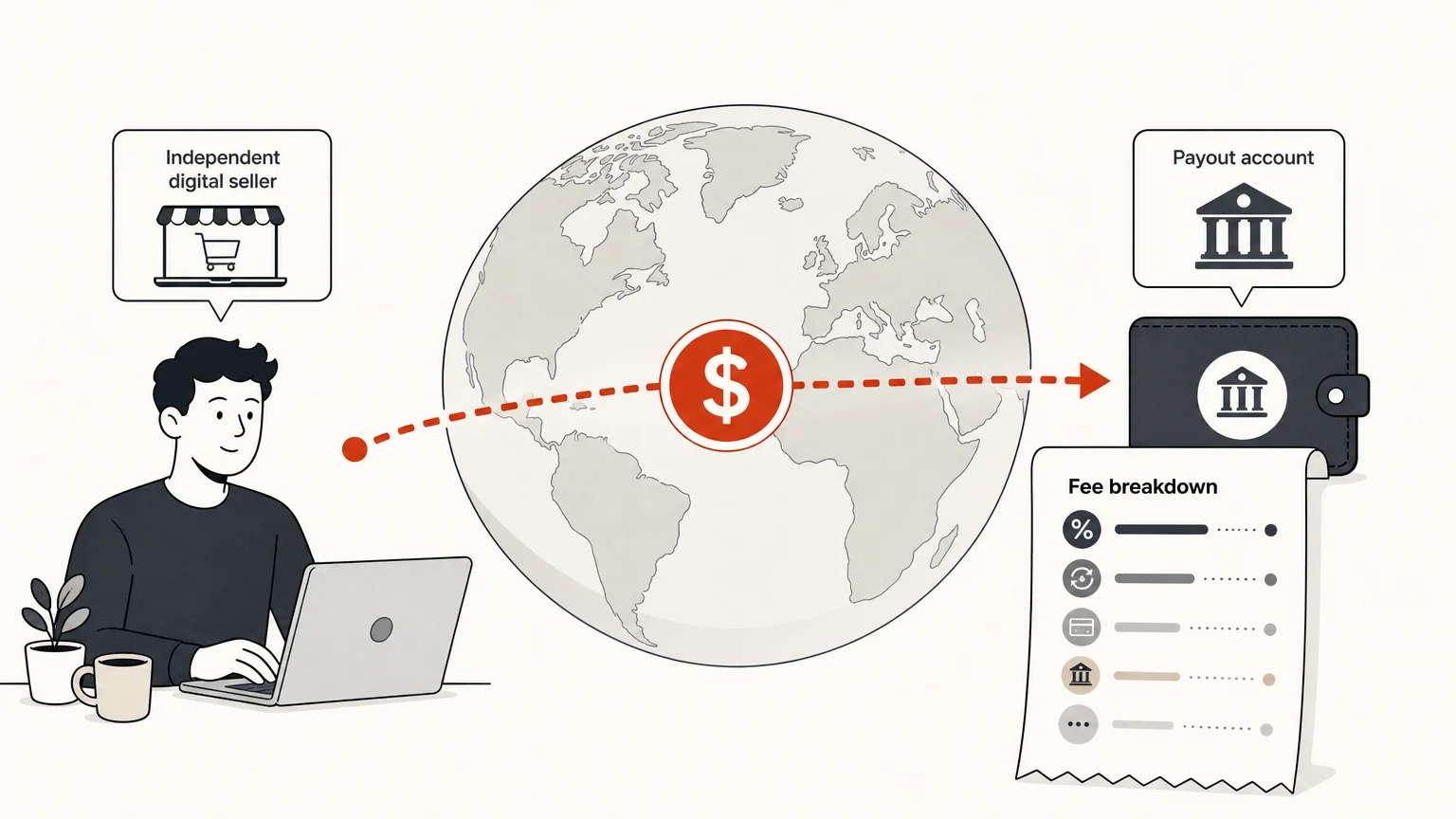
A processor’s advertised rate is only one line in the cost of selling internationally. A US LLC owner living abroad may face different charges depending on where customers pay from, which currency they use and how proceeds reach the owner. Our best payment processors coverage treats those differences as part of the comparison, rather than assuming one rate answers every seller’s question.
The useful question is not simply, “Which provider charges the smallest percentage?” It is, “Which setup leaves my business with the best net result after processing, currency conversion, payout costs and tax obligations?” For digital products, that answer can change with the price of the product, the proportion of international customers, and whether you choose a direct processor or a Merchant of Record.
What does “lowest fee” mean for global digital sales?
Compare the effective processing cost, including percentage-based and fixed transaction charges.
Include any international-card, currency-conversion and payout fees that apply to your actual transactions.
Account for whether you remain responsible for tax registration and remittance, or use a Merchant of Record.

Card networks, issuing banks and processors contribute different parts of a card transaction’s cost. The Kansas City Fed’s 2026 interchange update compares interchange fees across countries, but interchange is only one part of a merchant’s full processing bill. It does not establish which provider will be cheapest for your account, sales mix or buyer locations.
Fixed charges matter most when your average order value is low, because the same fixed amount consumes a larger share of a small sale. Percentage charges matter more as the order value rises. For example, Whop’s published standard card fee is 2.7% plus $0.30 per successful transaction. On a $100 sale, that is $3, or 3% before any separately applicable international-card or currency-conversion charges. The standard rate is not a universal all-in rate for every cross-border sale.
That is why the phrase lowest fee payment processor needs context. A provider can have a lower domestic headline price but become more expensive for a business whose buyers pay in other currencies, or whose payouts require costly conversion. In our payment processor rankings, we compare effective costs and operational fit, rather than treating a single advertised percentage as a complete answer.
Which payment model fits a creator selling across borders?
A direct processor can suit a business prepared to manage its own tax and compliance responsibilities.
A creator commerce platform can combine payment collection with digital-product or membership features, while charging its own listed fees.
A Merchant of Record can take on specified legal-seller and tax responsibilities, but its transaction pricing must be compared against the value of that service.
| Setup | Fee comparison | Tax responsibility | Possible fit |
|---|---|---|---|
| Direct payment processor | Non defini pour le moment. Obtain the applicable quote and include card, international, conversion and payout charges. | The business generally remains responsible for its own tax obligations. | Operators who want control over the payment stack and can manage tax compliance. |
| Creator commerce platform | Whop lists a standard card fee of 2.7% plus $0.30. Its published schedule separately lists charges for international cards and currency conversion. | Confirm the specific seller arrangement and tax services. Do not assume a platform is the Merchant of Record. | Creators comparing payment costs alongside digital-product, membership or community needs. |
| Merchant of Record | Non defini pour le moment. Compare the provider’s full transaction price with any separate processing and payout charges. | The Merchant of Record takes on legal-selling and stated tax-related responsibilities under its arrangement. | Sellers deciding whether reduced tax administration justifies a different fee structure. |
These are different business models, not interchangeable rate cards. A Merchant of Record may cost more per transaction than a direct processor, but the quoted fee alone does not measure the seller’s administrative burden or tax exposure. Conversely, paying for tax services does not make a platform a good fit if its checkout, payout methods or supported countries do not meet your needs.
For Whop, separate the domestic card rate from cross-border charges instead of repeating a blended estimate without its conditions. Its published pricing lists 2.7% plus $0.30 for standard successful card transactions, with additional fees listed for international cards and currency conversion. You can see the line items discussed in our Whop fees explained page, then confirm the current pricing schedule for your account before relying on a calculation.
How do international cards, FX and payouts change the total?
Map where customers are located and which currencies they use to pay.
Check whether the processor converts at collection, at payout, or both.
Compare the amount charged with the amount that arrives in the bank account you actually use.
In 2026, Federal Reserve staff noted that average foreign-exchange margins for North America are generally higher than global costs, even though average payment fees in the region are generally lower. This is a useful caution for a US LLC owner abroad: a competitive processing percentage does not, by itself, tell you the cost of converting proceeds into your working currency. The Federal Reserve’s cross-border payments note discusses broad payment-cost patterns, not a quote for any particular seller or processor.
For a practical comparison, use recent transactions or a representative forecast and separate the cost categories. Record the sale amount, customer country, card or payment method, charge currency, payout currency, conversion applied and any payout charge. Then calculate net proceeds for each setup. If fees vary by country, avoid applying a single international rate to every buyer unless the provider’s terms confirm that it applies uniformly.
Payout timing is a separate consideration from payout price. A transfer that arrives sooner may be useful for cash flow, but its fee should be weighed against the value of faster access to funds. Check whether the provider supports a payout route you can use from your country of residence, and whether your business entity, owner identity and bank details meet its verification requirements. A US LLC alone does not establish that every owner, residence or payout combination is supported.
Published fee information can also leave unanswered questions about how domestic payment costs compare across markets. A World Bank report published in 2025 examined domestic payment costs in six markets and noted that online business-to-person payment costs and fee disclosures can be complex. It is not a cross-border processor price survey, but it reinforces why a seller should check the precise payment route and market rather than assume fee structures are uniform.
What should you calculate before switching providers?
Use your average order value and typical order count, not only your largest sale.
Include the currencies and countries that make up your actual customer mix.
Subtract processing, conversion and payout costs from each modeled sale.
Compare tax-administration responsibilities as well as the cash fee.
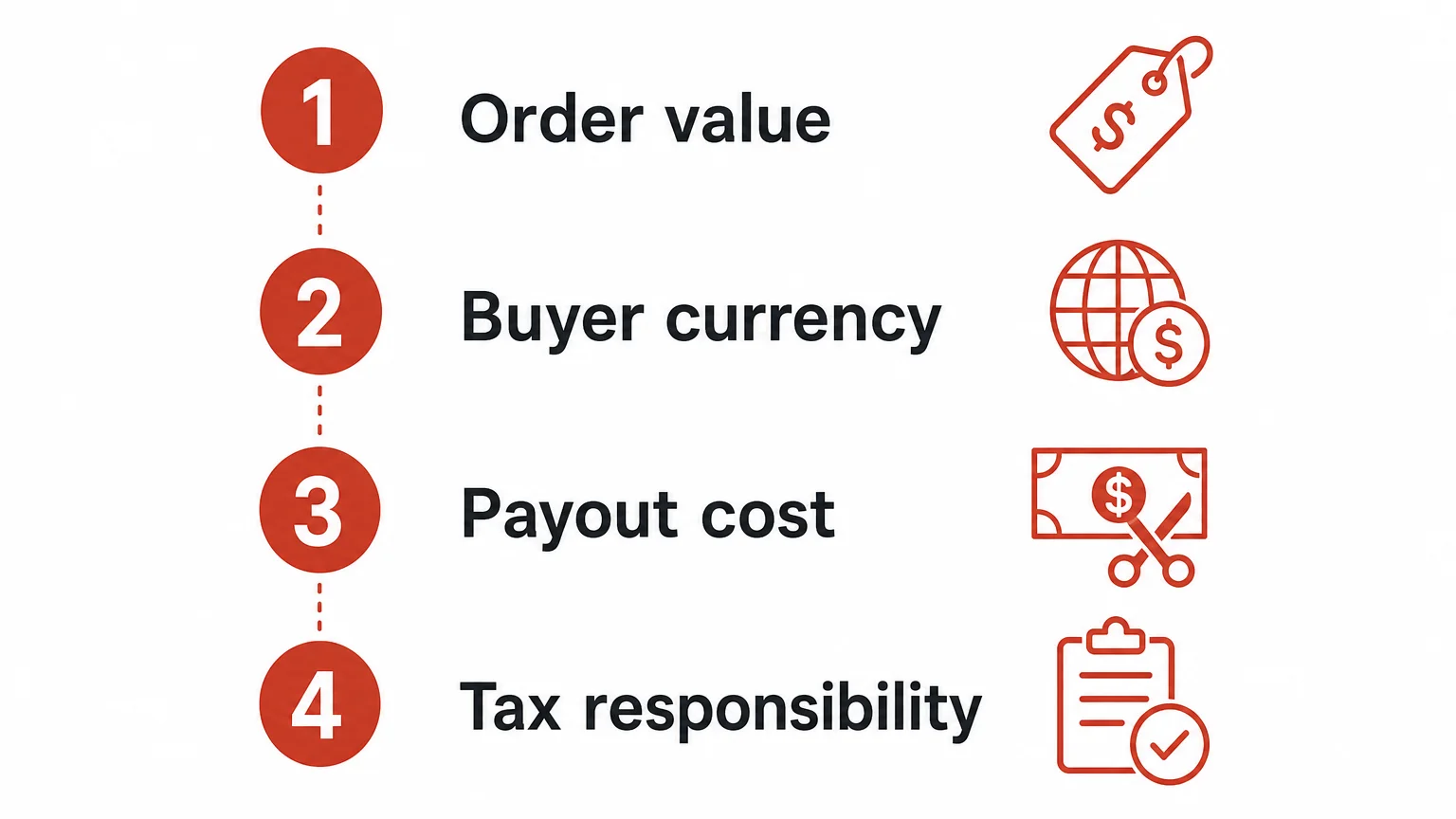
For each setup, estimate total cost across a realistic sales period, then divide by gross sales to get an effective rate. Keep tax and operational costs visible rather than hiding them inside an assumed percentage. If the provider gives a custom quote, label it as a quote for your business, not a generally available rate. Where the processor’s public information does not establish a value, record “Non defini pour le moment” and request clarification rather than filling the gap with a competitor’s advertised figure.
Also test the whole path from checkout to usable funds. Confirm that buyers can pay through suitable methods, that your account can accept the relevant currencies, and that payouts can reach your banking or payout destination. For subscription products, include any billing-related charges and consider how failed renewals, refunds and disputes affect your net revenue. A lower transaction fee does not help if the service lacks a required payment route or business-model feature.
Ad-intelligence tools belong in a separate part of the calculation. Ad-spy and offer-validation products may help an infopreneur assess a marketing idea, but they do not reduce the processor’s charge on each completed sale. Treat their subscriptions as customer-acquisition or research expenses, not payment-processing fees. The cost for a specific ad-intelligence product is Non defini pour le moment here because no vendor or plan has been selected.
Our editorial comparisons use test accounts, hands-on platform work, official documentation and fee analysis where the information is available. We also revisit articles quarterly and correct stale information. Because WhatPayment is affiliate-funded, a qualifying action after a reader clicks a disclosed vendor link may generate a commission; vendors do not pay for placement or review articles before publication.
Frequently asked questions
Is there one lowest-fee processor for every international creator?
No, the lowest-cost setup depends on order size, payment method, customer location, conversion and payout route. Compare those costs using your own sales mix rather than selecting from a domestic headline rate alone.
Is Whop’s standard fee around 6%?
Whop’s published standard card price is 2.7% plus $0.30 per successful transaction, which is roughly 3% on a $100 sale before separately applicable charges. Its pricing schedule lists international-card and currency-conversion charges separately, so confirm which apply to your sales instead of using an unsupported blended figure.
Does a Merchant of Record always cost less overall?
Not necessarily, because a Merchant of Record may charge a different transaction price while taking on specified legal-selling and tax responsibilities. Compare the full fee with the tax work and obligations that would otherwise remain with your business.
Should I include currency conversion and payouts in my fee comparison?
Yes, include them whenever your customer charges, processor balance and usable payout currency differ or a payout route carries a charge. Compare what reaches your account, not only what the checkout deducts.
How can WhatPayment help me evaluate payment costs?
Our processor rankings and reviews compare effective fees alongside tax responsibility, payout behavior, geographic coverage and business-model fit. They are editorial research resources, not payment-processing or implementation services.
Verdict: compare the net cost, not the headline rate
The lowest-fee payment processor for a cross-border digital business is the one that leaves the best net result for its actual customer mix, after payment, currency-conversion and payout charges. Compare the tax responsibilities and supported payout routes too, because those can change the real operational cost. Start with your order values and buyer countries, model the complete path to funds, and treat unconfirmed prices as unknown until the provider verifies them.
Use a fee breakdown before choosing
When a platform’s headline percentage does not explain international cards, currency conversion or payout costs, you need a source that separates those charges and places them in context. Our editorial reviews examine platform terms and fit for digital businesses, while distinguishing confirmed pricing from costs that still need checking.

Read our Whop review for an editorial assessment of the platform and its pricing. WhatPayment is affiliate-funded, and a qualifying action through a disclosed vendor link may generate a commission without changing the reader’s vendor price; vendors do not pay for placement or review our articles before publication.
Frequently Asked Questions
How often should I recheck payment processor fees?
Recheck the provider’s official pricing and account terms before you make a decision and whenever your business, customer geography or payment mix changes. Treat any dated comparison as a snapshot, not a permanent price guarantee.
Can a low card rate still lead to a high effective cost?
Yes, because fixed transaction charges, international-card pricing, currency conversion and payout fees can add to the base rate. Calculate costs for representative transactions and compare the final amount received.
Should I use an ad-spy tool to choose a processor?
No, ad-intelligence tools support offer research or advertising decisions, while processors handle payment acceptance and settlement. Keep their subscription costs separate from transaction-fee comparisons.
Does a US LLC guarantee that I can use a US processor account while abroad?
No, the provider may assess the business entity, owner identity, residence, bank details and other account requirements. Confirm your exact setup and payout route with the provider before moving sales.
What should I do when a provider does not publish a fee?
Mark it as unknown and ask for a written, use-case-specific quote before comparing totals. Do not infer that a missing fee is zero or substitute another seller’s pricing.
Keep reading
Browse all guidesBlog
Best Payment Processor for Coaching Businesses Selling Globally
Blog
Best Payment Processor for SaaS: 8 Options for Global Sales
Guide
Whop Finance Review: 6% APY Treasury Plus Debit Card
Guide
Info Product Launch Processor (2026): Survive a $100K Spike
Guide
Where to Sell Digital Products in 2026: Match Surface to Product
Guide