What you'll get
Helcim vs PaymentCloud for Scaling Startups: A Comparison
helcim vs paymentcloud for scaling startups: compare fees, risk fit, international payments, billing, and integrations before you switch.

Founder & Editor

For a startup selling software, coaching, courses, or memberships from a US LLC while living abroad, the wrong processor can create more than a payment problem. It can disrupt subscriptions, delay payouts, and make a growing acquisition funnel impossible to monetize. That is why helcim vs paymentcloud for scaling startups is not simply a rate comparison. It is a choice between transparent volume pricing and specialized underwriting. Our research on high-risk payment processors is relevant when your business model falls outside standard risk policies.
Helcim is generally better suited to a conventional SaaS or digital product company that wants interchange plus pricing, recurring payments, APIs, and predictable operating rules. PaymentCloud is more relevant when the business needs a high-risk merchant account, customized approval, or additional support around chargebacks and underwriting. The decisive question is whether your startup is primarily optimizing payment economics or trying to secure stable processing for a risk profile that mainstream providers may reject.
The short answer for a scaling startup
- Choose Helcim when your business can pass standard underwriting and you want transparent pricing that automatically improves with processing volume.
- Choose PaymentCloud when your digital product, offer, customer acquisition model, or chargeback profile requires specialized high-risk underwriting.
- For SaaS subscriptions, Helcim has the stronger documented fit because it supports recurring payments, APIs, webhooks, integrations, and automated volume discounts.
- For international customers, Helcim documents additional international card fees and supports deposits through US payment rails, but it does not provide every local settlement currency.
- For a displaced founder, neither platform removes the need to prove the relationship between your US LLC, operating location, product, customers, and expected transaction volume.
The best option depends on whether the primary constraint is cost, product integration, or approval risk. A low headline rate is not useful if the account cannot support your customer acquisition model or recurring payment volume.
Helcim and PaymentCloud at a glance
- The two processors serve different operating profiles, so the comparison should not treat them as interchangeable.
- Helcim publishes a detailed pricing structure, while PaymentCloud requires a customized quote for the merchant account.
- Helcim is easier to model financially before applying, while PaymentCloud may be more practical for businesses that need specialized underwriting.
| Criterion | Helcim | PaymentCloud |
|---|---|---|
| Core positioning | General payment processing with interchange plus pricing and volume discounts | Payment processing focused on high-risk merchant accounts and customized solutions |
| Online card pricing | Interchange plus 0.50% plus $0.25 at the $0 to $50,000 monthly volume tier, with lower markup tiers at higher volumes | Non defini pour le moment |
| Recurring payments | Supported, with a disclosed 0.4% fee per applicable recurring transaction | Non defini pour le moment |
| Monthly account fee | $0 according to Helcim’s official pricing and fee disclosure pages | Non defini pour le moment |
| Risk profile | Better suited to businesses that fit standard underwriting policies | Designed for high-risk businesses and specialized underwriting needs |
| International operations | International card fees and USD or CAD acceptance conditions apply | Non defini pour le moment |
| Contract terms | No contracts or cancellation fees are disclosed by Helcim | Request the complete agreement before approval, as third-party comparisons identify contract terms as a point to verify |
Helcim

- Best for: SaaS startups, digital product businesses, coaches, and membership operators with standard risk profiles that want transparent pricing and tools for recurring revenue.
Helcim uses an interchange plus pricing model. At the first published monthly volume tier, its online and keyed transaction markup is interchange plus 0.50% plus $0.25. The published markup falls as monthly card volume increases, reaching interchange plus 0.15% plus $0.15 at the highest listed tier above $1 million in monthly volume. The interchange component still varies by card, network, transaction method, and customer location, so these figures are markups rather than complete all-in rates.
For online businesses, Helcim also lists ACH pricing at 0.5% plus $0.25 per approved transaction below $25,000, with a $6 cap under that threshold. Recurring payments carry an additional 0.4% per applicable transaction. Helcim lists no monthly account fee, no setup fee, and no cancellation fee. Its published chargeback fee is $15, or $0 when the dispute is resolved in the merchant’s favor.
The operating toolset is a strong match for a growing digital business. Helcim supports online checkout, payment pages, invoicing, virtual terminal payments, recurring billing, APIs, webhooks, reporting, and accounting integrations. That makes it possible to start with hosted payment tools and move toward a more customized checkout without immediately replacing the processor.
Helcim also documents automatic volume discounts based on a three month rolling average. This is valuable for a startup whose revenue is increasing but uneven, because one unusually slow month does not immediately remove the benefit of a higher processing tier. The model is easier to forecast than a completely bespoke quote, although the final effective fee still depends on card mix and transaction geography.
Pros
- Transparent interchange plus pricing with automatic volume discounts.
- No monthly account fee or cancellation fee in the published US fee disclosure.
- Recurring payments, ACH, payment pages, APIs, webhooks, reporting, and accounting integrations.
- Next business day deposits may be available when the receiving US bank supports the relevant payment rails.
Cons
- The processor is not positioned as a general solution for high-risk businesses.
- International card fees and currency conditions require careful modeling for a globally distributed customer base.
- Interchange plus statements are more detailed than flat-rate pricing, so finance teams must understand card and network costs.
PaymentCloud
- Best for: Digital product sellers and other online businesses that need high-risk underwriting or a customized merchant account.
PaymentCloud positions itself around high-risk payment processing, including merchant accounts for digital downloads. That focus matters for businesses selling offers that may attract higher dispute rates, operate in restricted categories, or receive more scrutiny during underwriting. For those companies, approval and account continuity can be more important than choosing the processor with the lowest publicly listed markup.
PaymentCloud’s public materials emphasize customized payment solutions, payment gateways, fraud prevention, fast approvals, and live support. A third-party side by side comparison also describes customized pricing and a dedicated account manager as part of the high-risk merchant experience. These points make PaymentCloud worth investigating when conventional processors have already rejected the business or imposed restrictive conditions.
The limitation is cost visibility. PaymentCloud does not provide a comparable public rate card in the supplied evidence, so the percentage markup, per-transaction fee, monthly fee, gateway cost, equipment cost, reserve terms, and chargeback fee are Non defini pour le moment. A startup should request every component in writing before comparing the quote with Helcim’s published pricing.
PaymentCloud may also require more underwriting work. That is not automatically a disadvantage for a high-risk business, because specialized review can create an approval path that a general processor cannot provide. However, the founder should be prepared to explain the product, refund policy, fulfillment process, expected chargeback rate, traffic sources, customer geography, and relationship between the US LLC and the founder’s country of residence.
Pros
- Specialized focus on high-risk merchant accounts.
- Customized payment solutions for businesses that may not fit standard processor rules.
- Fraud prevention and live support are part of the stated positioning.
- Potentially more suitable when underwriting is the main obstacle to payment acceptance.
Cons
- Public pricing is not sufficiently detailed for a direct cost calculation.
- Approval, contract, reserve, gateway, and payout conditions must be confirmed in the merchant agreement.
- A customized quote can make financial planning harder before the underwriting process is complete.
International customers change the calculation
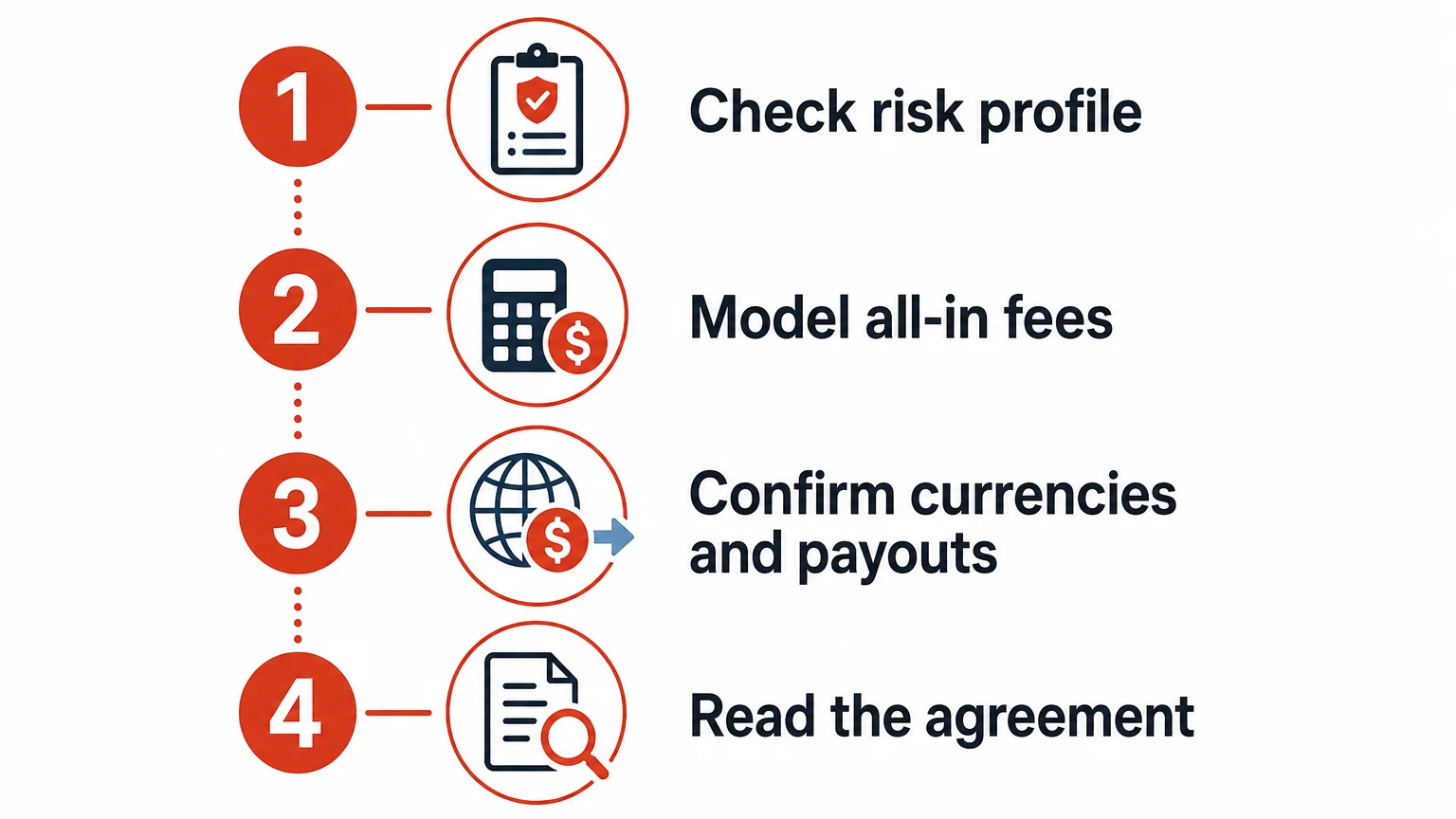
- Confirm the acceptance currency before assuming that customers can pay in their local currency.
- Separate card location from payout location, because a foreign-issued card can create additional network charges even when the merchant settles in USD.
- Review payout timing against payroll, advertising, contractor, and refund obligations.
A displaced creator may operate from Europe, Latin America, or Asia while selling through a US LLC. That structure can be workable, but it creates more questions during underwriting. The processor may assess the legal entity, beneficial owner, operating address, customer locations, product category, and source of traffic together.
Helcim’s US fee disclosure lists additional international transaction charges by card network. For example, the published schedule includes an additional 1.45% plus $0.04 for certain international Visa transactions, 1.45% for international Mastercard transactions, 1.30% for Discover, and 1.00% for American Express. These charges apply to defined international conditions, so they should not be added blindly to every foreign customer transaction.
Helcim also documents USD and CAD conditions for customers outside the United States and Canada. This may be sufficient for a startup whose customers are comfortable paying in one of those currencies, but it is not the same as supporting settlement in every local currency. PaymentCloud’s international acceptance and payout details are Non defini pour le moment in the available evidence, so they should be confirmed before approval.
Risk and underwriting matter more than the headline rate
- Standard risk businesses should focus on total cost, billing reliability, integrations, and account support.
- High-risk businesses should focus first on approval criteria, reserves, dispute handling, prohibited activities, and termination procedures.
- Global founders should document why the company is US registered, where it is operated, and where customers are located.
Payment risk is not limited to the processor’s advertised industry list. A fast launch, aggressive advertising, recurring billing, unclear refund terms, or a sudden increase in volume can create review pressure. If an account is placed on hold, the resulting cash flow problem can be larger than the difference between two processing rates.
PaymentCloud’s specialization is therefore most valuable when it addresses a real underwriting problem. It should not be selected only because the business owner assumes that a high-risk provider will accept every model. Approval remains conditional, and the merchant agreement should explain reserves, dispute fees, payout timing, prohibited products, and what happens after account termination.
Helcim is a stronger fit when the business can meet standard requirements and wants to keep payment operations simple. Its public pricing and product documentation make it easier to compare costs before the application. However, a startup with a restricted product, elevated chargebacks, or an unusual customer acquisition model should not assume that the lower visible markup makes Helcim the safer operational choice.
What changes as you scale from creator sales to SaaS
- At early revenue levels, speed, checkout simplicity, and approval may matter more than a small difference in markup.
- At higher volume, interchange plus pricing, recurring billing costs, ACH acceptance, and card mix become more important.
- When subscriptions grow, tokenized payment data, retry workflows, refunds, failed payment handling, and customer communication become operational requirements.
- When paid acquisition accelerates, payment stability becomes part of the marketing model because a successful campaign can create a sudden volume spike.
Ad intelligence and offer validation tools can help an infopreneur evaluate creative angles, competitors, and demand before increasing spend. They cannot determine whether a processor will approve the business, accept its product category, or release funds during a review. Payment infrastructure should therefore be evaluated before a major launch, not after an advertising campaign starts converting.
For SaaS operators, Helcim has the more documented path from simple payment collection to a connected billing stack. Its APIs, webhooks, recurring payments, reporting, and integrations are relevant when the product needs more than a payment link. The business should still test subscription failures, refunds, plan changes, and customer record synchronization before migrating a large active base.
PaymentCloud may be the better operational choice when the SaaS or digital product has a risk profile that standard processors cannot support. The trade-off is that the founder must obtain a detailed quote and agreement before calculating the true cost of scale. Our methodology focuses on this kind of use-case fit, rather than ranking processors only by advertised rates. For broader planning, our analysis of the best payment processor for scaling businesses applies the same attention to volume, payout behavior, and payment risk.
How to decide before you sign
- Ask Helcim how your expected card mix, international customers, recurring billing, and transaction volume will affect the effective rate.
- Ask PaymentCloud for every fee, reserve condition, contract term, gateway charge, payout rule, and chargeback cost in writing.
- Prepare underwriting documents that explain the US LLC, founder residence, product, fulfillment, refund process, traffic sources, and customer geography.
- Run a failure scenario for a sudden advertising spike, a chargeback cluster, a payout delay, or a temporary account review.
- Keep a backup plan for customer communication and cash flow, without violating processor rules or opening undisclosed duplicate accounts.
A useful comparison should calculate the effective all-in fee, not just the percentage markup. Include the per-transaction charge, recurring billing surcharge, ACH cost, international card charges, gateway or software fees, chargeback fees, reserves, and any equipment or contract obligations.
Verdict
For a conventional scaling SaaS startup or digital product business, Helcim is the more transparent option because its pricing, volume discounts, recurring payment fee, integrations, and contract position are documented clearly. PaymentCloud deserves consideration when high-risk approval and specialized account support are the primary constraints. The practical answer to Helcim versus PaymentCloud for scaling startups is therefore conditional: choose Helcim for predictable scaling economics, and choose PaymentCloud only after confirming that its underwriting and written terms solve a problem Helcim cannot.
Compare Payment Infrastructure Before You Scale
Processor selection becomes harder when your customers are international, your company is operated from abroad, or your revenue depends on subscriptions and launch spikes. Our editorial comparisons examine effective fees, payout behavior, Merchant of Record responsibilities, risk handling, and use-case fit rather than relying on headline rates alone.

If you are evaluating a different checkout or billing route for a SaaS business, review our Stripe alternatives for SaaS startups to compare the trade-offs before committing your payment stack.
Frequently Asked Questions
Is Helcim cheaper than PaymentCloud?
Helcim is easier to model because it publishes interchange plus markups, volume tiers, recurring payment fees, and several other charges. PaymentCloud pricing is customized, so the cheaper option depends on the written quote, risk category, reserve terms, and transaction profile.
Which processor is better for a high-risk digital product?
PaymentCloud is more directly aligned with high-risk underwriting and digital download merchant accounts. Helcim may be more suitable when the product fits standard underwriting and the business prioritizes transparent pricing and integrations.
Can a US LLC owner living abroad use Helcim?
Potentially, but approval depends on the business, owner, operating location, product, customer base, and supporting documents. A founder should explain the cross-border structure clearly instead of assuming that a US registration alone determines eligibility.
Which option is better for recurring SaaS billing?
Helcim has the stronger documented fit because it supports recurring payments, APIs, webhooks, reporting, and integrations. PaymentCloud’s recurring billing capabilities are Non defini pour le moment in the available comparison evidence and should be confirmed before migration.
What should I request from PaymentCloud before signing?
Request the complete pricing schedule, gateway and software fees, chargeback policy, reserve rules, payout timing, contract duration, termination terms, acceptable use rules, and underwriting conditions. Ask how the provider handles sudden volume increases and account reviews before launching a major campaign.
Keep reading
Browse all guidesBlog
FastSpring vs Paddle for Software Distribution: 2026 Guide
Blog
Best Payment Processor for Online Courses in 2026 for Creators
Review
iClosed Review: Is It Worth It for High-Ticket Sales?
Review
WhoScale Review (2026): Pricing and Founder Interview
Review
Whop Review 2026: Is It Legit? Honest Take After 6 Weeks
Review