What you'll get
Best Payment Processors for Selling Digital Products Globally
Compare the best payment processor digital products sellers need, with fees, tax roles, payouts, and global fit for a US LLC abroad.

Founder & Editor
For a cross-border creator, the best payment processor for digital products is not always a card processor. Seller eligibility, tax responsibilities, payout access, and how customers receive a download or course can matter just as much as the headline rate. Our payment gateways for digital assets overview is relevant if you sell templates, downloads, or other files through a US LLC while living abroad.
Does forming a US LLC automatically make you eligible for every payment platform? Do not assume so. Your company’s country, your residence, your payout destination, and your product type may all matter during onboarding. Tax rules also depend on the transaction and jurisdiction. The OECD’s VAT/GST platform guidance describes how digital platforms may participate in tax collection, but that does not mean every platform takes on every tax or filing duty.
Key takeaways for a cross-border digital business
- Whop’s current official pricing lists domestic card processing at 2.7% plus $0.30, roughly 3% effective, with additional charges for international cards and currency conversion.
- Stripe’s official US pricing lists 2.9% plus $0.30 for domestic cards, with additional fees for international cards and currency conversion.
- A Merchant of Record and a payment service provider have different contractual roles. Check which entity is the seller for each transaction.
- A foreign owner’s US LLC may have federal reporting duties separate from payment processing. The exact requirements depend on the LLC’s tax classification and activity.
- Ad-intelligence tools can help review advertisements and creative approaches, but they cannot establish that a digital product will sell profitably.
Compare payment options by seller model, fees, and tax role
Use this shortlist as a fit comparison, not a promise of account approval. The ranking prioritizes sellers who want to reach customers across countries, with the first two options representing Merchant of Record services, not ordinary processors.
- A direct processor handles payment transactions, but the seller generally remains responsible for its own tax and compliance obligations.
- A Merchant of Record sells covered products as the legal seller under its agreement and may take on specified payment and indirect tax responsibilities.
- A commerce platform can bundle storefront or creator tools with payment routing, so confirm which company processes each charge and which terms apply to your account.
| Rank and option | Seller model and tax role | Published US card fee | Key check for an owner abroad |
|---|---|---|---|
| 1. Paddle | Merchant of Record for digital product businesses. | Non defini pour le moment. | Confirm residence and US LLC eligibility, plus the contract’s tax scope. |
| 2. FastSpring | Merchant of Record that sells digital products on the seller’s behalf. | Non defini pour le moment. | Request terms for your specific business and payout destination. |
| 3. Stripe | Direct payment processor, not a Merchant of Record. | 2.9% + $0.30 domestic cards, plus international card and conversion fees. | Check owner verification, bank payout options, and added cross-border costs. |
| 4. Whop | Business platform that uses payment processors and offers creator commerce features. | 2.7% + $0.30 for domestic cards, with additional international card and conversion fees. | Confirm account eligibility and the tax service scope for your transaction flow. |
| 5. Lemon Squeezy | Digital commerce platform with payment, subscription, and tax features. | Non defini pour le moment. | Verify the legal seller role, owner eligibility, and payout route in the agreement. |
Whop and Stripe fee figures above reflect the rates on their official pricing pages checked October 5, 2026. Other fees, including any payout charges, custom rates, or plan-specific costs, can change the total. Where a public fee was not established for this comparison, the table does not treat it as zero.
1. Paddle
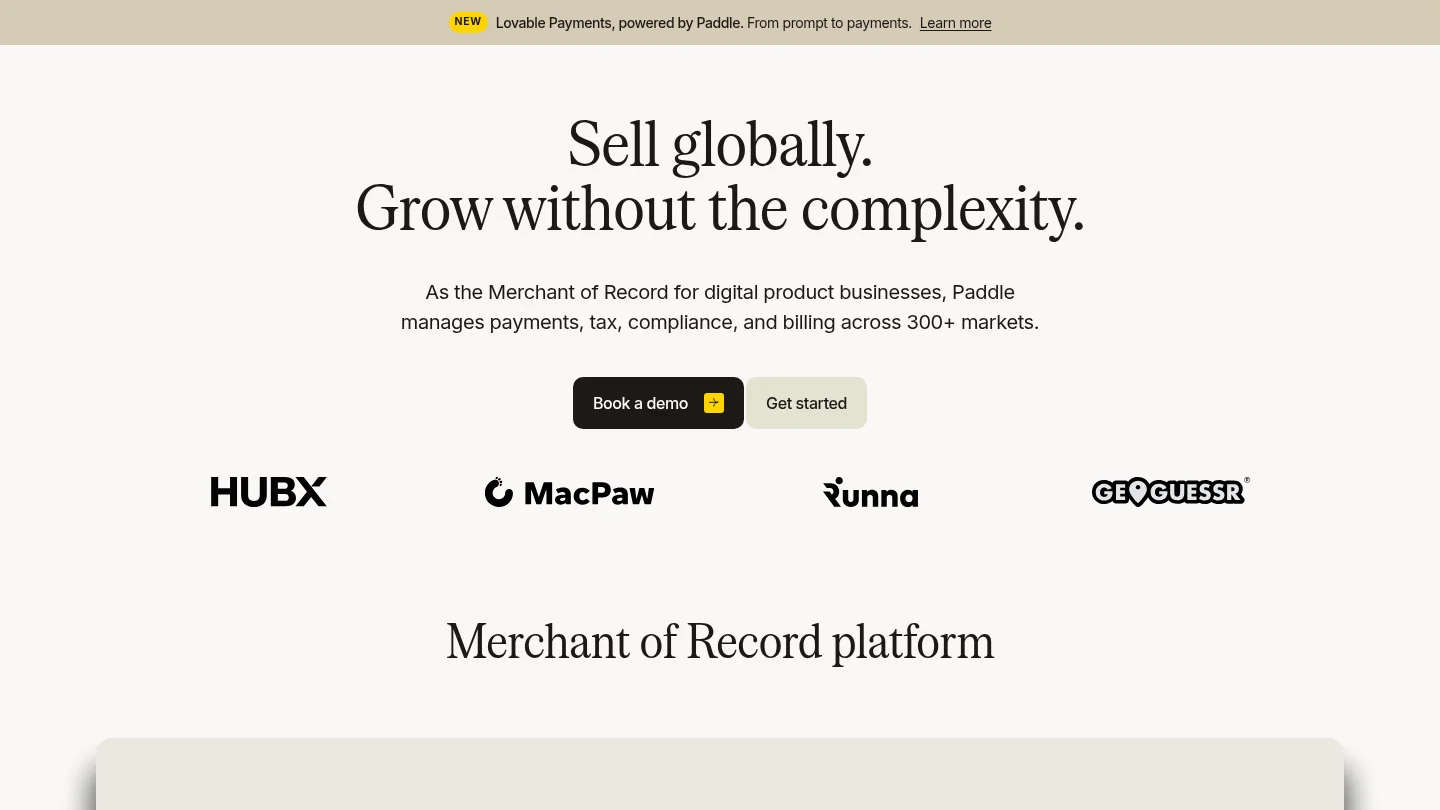
Best for: Digital product businesses that want a Merchant of Record arrangement and a managed billing setup, provided Paddle accepts the owner and business structure.
Paddle describes its platform as a Merchant of Record service for digital product businesses, combining payments, billing, and tax compliance. That model may reduce the seller’s operational burden for covered transactions, but it does not remove the need to understand the contract, account eligibility, or your separate business and income tax duties. Its publicly available fee was not established here, so obtain a complete quote before comparing it with direct processing.
Pros
- The Merchant of Record model can put specified payment and indirect tax responsibilities with the platform for covered transactions.
- Its stated focus on digital products and billing is relevant to downloads and recurring products.
Cons
- The price and acceptance criteria for a US LLC owner living abroad require direct confirmation.
- A Merchant of Record contract changes the selling relationship, so review the contract’s scope before moving an established customer base.
2. FastSpring
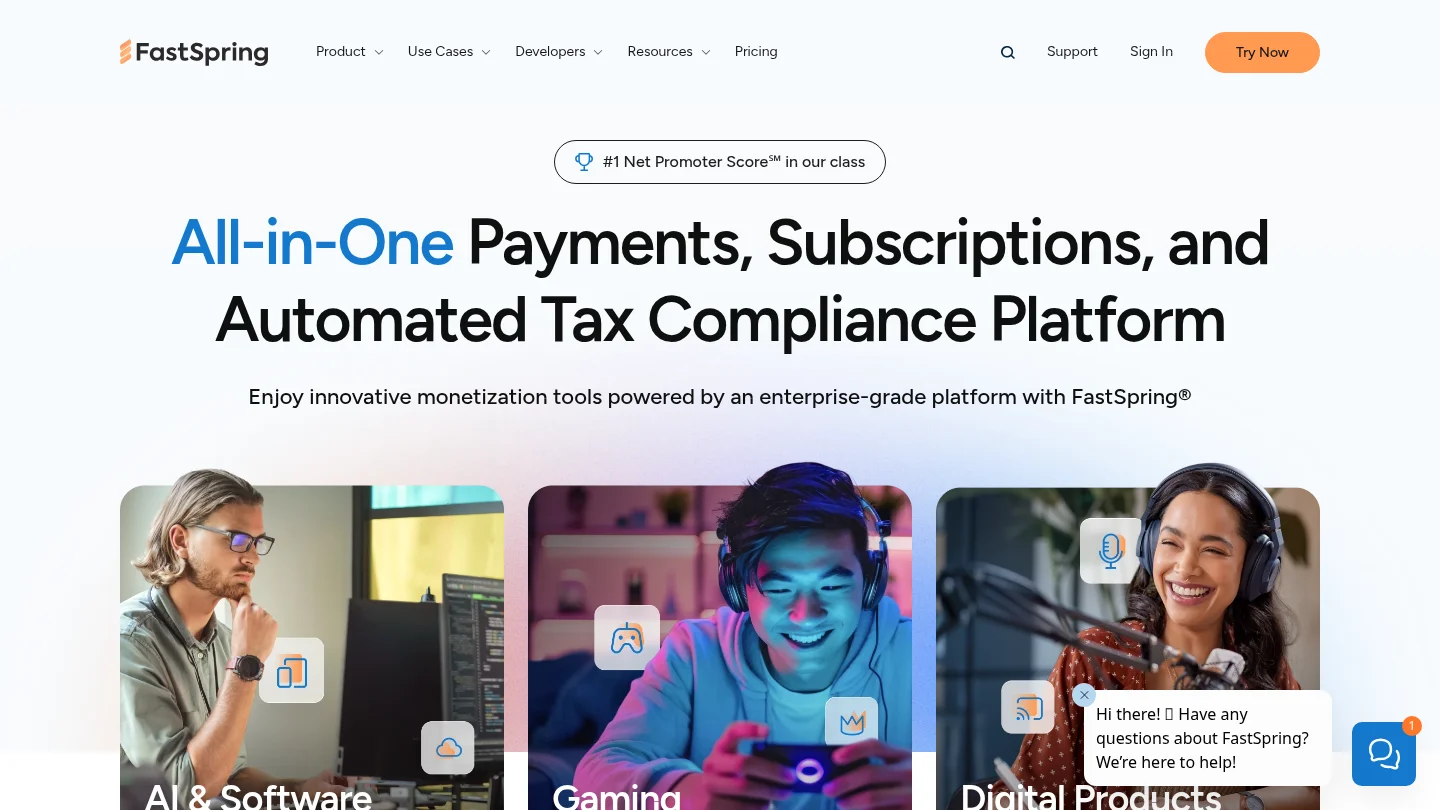
Best for: Software and digital product sellers who want a Merchant of Record rather than managing every part of international checkout themselves.
FastSpring presents itself as a Merchant of Record for digital businesses and says it sells on the seller’s behalf. Its published product information describes support for digital products, subscriptions, localized checkout, and tax handling. A quote is needed to assess total cost, and the platform’s stated global coverage does not itself confirm that a particular nonresident owner or LLC will be approved.
Pros
- The Merchant of Record model can simplify indirect tax collection and remittance for sales covered by the agreement.
- Subscription and checkout tools may suit software, courses, and other digital products with recurring billing.
Cons
- Pricing and eligibility for your particular residence, entity, and payout arrangement need confirmation.
- The model gives the platform a larger role in the transaction than a direct processor does.
3. Stripe
Best for: Sellers who value control over checkout and billing and can manage the additional tax and compliance work themselves.
Stripe provides payment processing and subscription tools, but it is not a Merchant of Record. Its official US pricing lists 2.9% plus $0.30 for domestic cards, an additional 1.5% for international cards, and an additional 1% when currency conversion is required. Calculate the effective cost against your own order values, card mix, and settlement currencies rather than comparing only the domestic headline rate. If Stripe is not a fit, our guide to selling digital products without Stripe covers other options.
Pros
- Published standard card fees make a starting cost comparison possible for US accounts.
- Its developer tools and subscription features offer flexibility for businesses that want to control their own checkout setup.
Cons
- You remain responsible for tax obligations that are not separately handled under your setup.
- International card and conversion fees can raise costs beyond the domestic rate.
- A US LLC alone does not establish that an owner living abroad meets account or payout requirements.
4. Whop
Best for: Creators who want commerce and creator-focused tools alongside payment processing, and who have confirmed their account and payout eligibility.
Whop is not a conventional standalone card processor. Its platform describes payment routing through payment providers and includes creator commerce features such as checkout and products for communities or courses. Whop’s official pricing lists a domestic card fee of 2.7% plus $0.30, roughly 3% effective, with an additional 1.5% for international cards and 1% for currency conversion. It also describes a tax service, so check whether the service covers your transaction and whether it calculates tax, collects it, or handles remittance.
Pros
- The base domestic card rate is clearly stated on its official pricing page.
- Its commerce tools may suit sellers who want to combine checkout with creator products and community-related features.
Cons
- Because it is a platform using payment processors, identify the processor and contractual seller for your particular transaction.
- International card and conversion fees add to the domestic rate.
- Confirm that the platform accepts your ownership and residence details and supports your desired payout destination.
5. Lemon Squeezy
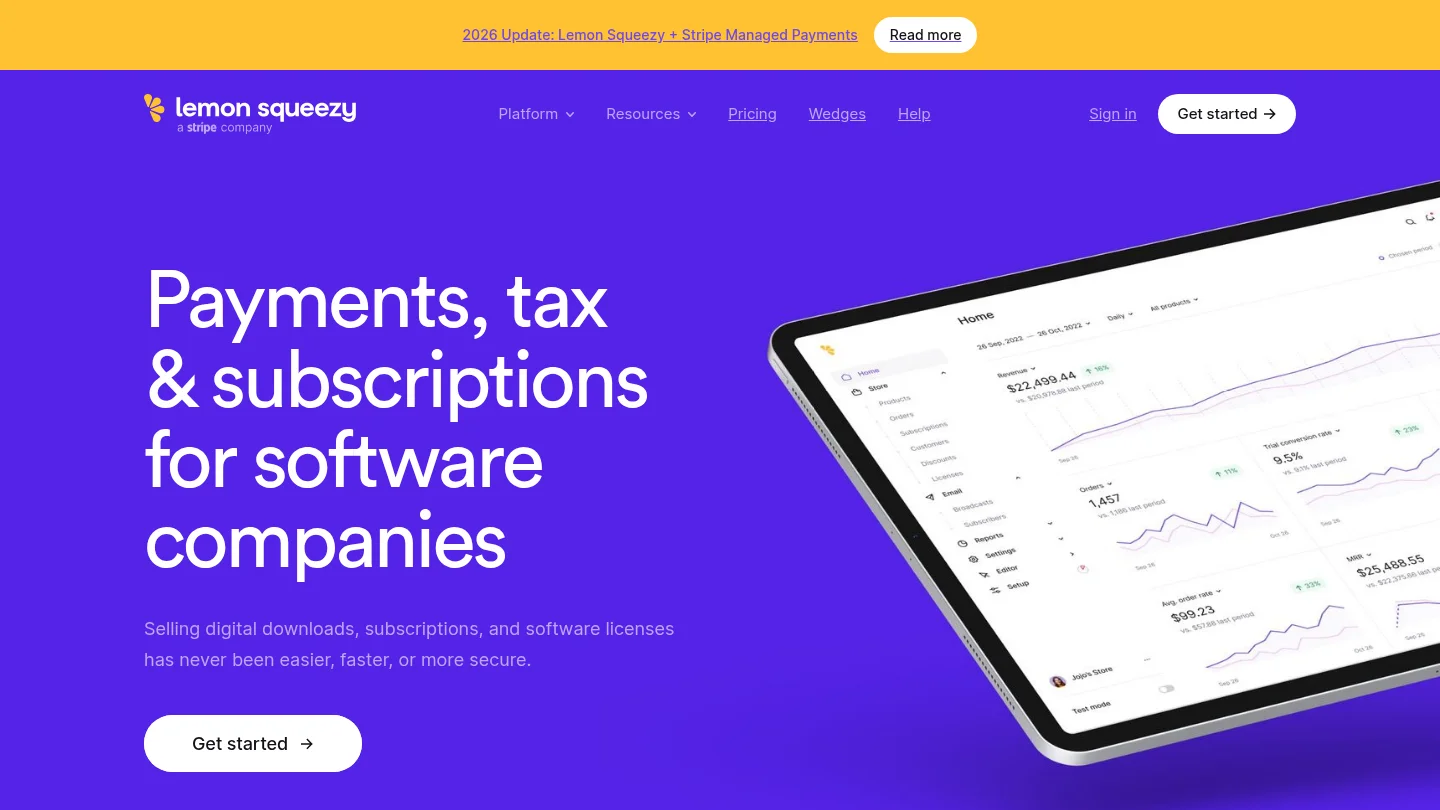
Best for: Sellers of software, subscriptions, and digital downloads looking for a platform with built-in checkout and product management.
Lemon Squeezy’s product information describes payments, subscriptions, digital downloads, and tax features for software businesses. Those functions can make it relevant to a creator selling files or recurring access, but do not assume that the tax feature means every tax obligation has moved to the platform. Confirm the legal seller role, exactly which taxes it handles, account eligibility for a nonresident owner, and payout terms before comparing its total cost. Its fee was not established for this comparison.
Pros
- Its described features address digital downloads and subscription billing rather than physical retail inventory.
- Checkout and product tools may reduce the number of separate services a small digital business needs to coordinate.
Cons
- Confirm the contract’s tax allocation rather than relying only on a general tax feature description.
- Seller eligibility and full pricing for your cross-border setup require verification.
Which model fits a US LLC owner living abroad?
Before applying, compare these four details across the same providers:
- Owner eligibility: Ask whether the platform evaluates the US entity, the beneficial owner’s foreign residence, or both.
- Payout access: Confirm supported payout destinations, currencies, conversion costs, and any payout schedule that matters to your cash flow.
- Tax responsibility: Separate transaction taxes from your company’s income tax and reporting duties.
- Account risk: Read the review, reserve, hold, dispute, and termination terms before a launch or major sales campaign.
For example, a US LLC owned by a foreign person may be a foreign-owned US disregarded entity for federal reporting purposes. IRS guidance says such entities can have Form 5472 information reporting requirements, with the form attached to a pro forma Form 1120 when applicable. Eligibility for a payment service does not settle those filing questions. Review the IRS guidance for foreign-owned disregarded entities and consult a tax professional familiar with your facts.
Indirect tax collection is a separate issue. EU rules provide a One Stop Shop for declaring and remitting VAT on qualifying cross-border sales, including services. The European Commission’s OSS overview explains the scheme, but a processor’s involvement does not automatically establish that it handles every filing for every seller. Our best payment processors comparison is a useful next step when you want to compare more provider models and fees.
If you sell courses or recurring access, also compare how checkout connects to delivery or access control. A payment approval does not automatically prove that a particular processor includes course hosting or membership gating. Our comparison of payment processors for online courses focuses on that business model.
Where ad-intelligence tools fit for infopreneurs
An ad spy or ad-library tool is a research aid, not payment infrastructure. It can help you observe public creative patterns, hooks, formats, and apparent competitor messaging, but an advertisement’s presence does not establish actual sales, customer satisfaction, or profitable acquisition costs.
- Use observed ads to develop hypotheses about audience language and offer positioning.
- Check the underlying product, landing page, price, and buyer journey rather than assuming an active ad is profitable.
- Test your own offer with measured visits, sales, refunds, and support requests before scaling spend.
For infopreneurs, “offer validation” needs evidence from the actual audience and buying process, not just a tool’s ad count or creative library. The FTC says advertising claims must be truthful and supported by evidence; its advertising guidance is relevant when turning competitor observations into claims about your own course, coaching, or digital product.
Verdict: choose the seller model before the processor
The best payment processor for digital products depends on how much control and compliance work you want to keep. Start by confirming that a provider accepts both your US LLC and your foreign residence, then compare its payout route, contract, account review terms, and full international fee stack. Choose a Merchant of Record only when its covered responsibilities and price make sense for your business. Choose direct processing when you are prepared to manage the separate tax and operational work.
Compare digital product platforms with clearer criteria
Choosing payment infrastructure from headline rates alone can leave important questions unanswered, especially when the owner, company, and customers are in different countries. WhatPayment is an independent editorial publication, not a payment processor or Merchant of Record. We compare provider fees, tax roles, payout behavior, account reviews, and fit for digital businesses.

Our reviews use hands-on testing, test accounts, public documentation, and fine print, and articles are revisited quarterly. WhatPayment has affiliate relationships, so a qualifying action after a disclosed vendor link may generate a commission, while you pay the same vendor price. Vendors do not pay for placement or approve articles before publication. Explore our editorial comparison of best platforms to sell digital products.
Frequently Asked Questions
How should I compare payment costs for international customers?
Add the standard processing rate, international card fees, conversion charges, payout costs, and any recurring platform or tax service fees. Compare them against your actual order sizes and expected payment mix.
Does a US LLC guarantee processor approval if I live abroad?
No. Ask each provider how it evaluates the business entity, beneficial owner residence, documentation, and payout destination. Do this before building your checkout around the service.
Does a Merchant of Record take care of every tax obligation?
No. A Merchant of Record may take on specified payment and indirect tax duties for covered transactions under its contract. That does not automatically resolve your company’s income tax, reporting, or personal filing responsibilities.
Is Whop itself a payment processor?
Whop is better described as a business platform that uses payment providers, rather than a standalone card processor. Check the specific payment, tax, and payout terms that apply to your account.
Can an ad spy tool prove that my course offer will sell?
No. Ad libraries can help you study visible creative and messaging, but they do not establish another advertiser’s profitability or your own product demand. Validate your offer with evidence from your own audience and sales process.
Keep reading
Browse all guidesBlog
Best ecommerce payment processors for digital creators abroad
Blog
Best Payment Processors 2026 for Global Digital Products
Review
Systeme.io Review 2026: The All-in-One Deal, and Its Tax Trap
Review
Lemon Squeezy Review 2026: Still Worth It After Stripe?
Review
Payhip Review 2026: When It Beats the Giants
Review