What you'll get
WhatPayment vs Processor Verdict: Which Site Fits Creators?
WhatPayment vs Processor Verdict: compare research methods, fee analysis, freeze risk, and international fit for digital product sellers.

Founder & Editor

A US LLC owner living abroad cannot choose payment infrastructure by headline rate alone. The important questions are whether a platform understands the mismatch between entity, residence, customer location, product type, and payout destination. If your immediate decision is between Stripe and Whop, our Whop vs Stripe comparison adds platform level context to this editorial comparison.
WhatPayment and Processor Verdict are both research publications, not payment processors. That distinction matters because neither publication can approve your account, control your reserves, or assume your tax obligations. A payment processor handles transaction messages and settlement, while a publication helps you assess the risks before you apply. FinCEN also distinguishes payment processing and settlement from money transmission in specific circumstances, which is why the operational role of the provider must be examined carefully.
Key takeaways for a creator selling internationally
- WhatPayment is the better overall research fit when your decision includes payment processing, Merchant of Record responsibility, currency conversion, digital products, memberships, and ad intelligence.
- Processor Verdict is more specialized around freeze risk, payout speed, reserves, chargebacks, industry restrictions, and the practical experience of its founder.
- WhatPayment evaluates effective all in cost instead of relying only on an advertised transaction rate, which is useful when you sell across currencies or use recurring billing.
- Processor Verdict does not run live test transactions, while WhatPayment states that it uses test accounts alongside public documentation and creator feedback.
- Neither site replaces professional advice on tax, entity structure, financial regulation, or the contractual terms of a specific processor.
Comparison table: WhatPayment versus Processor Verdict
- The central difference is scope. WhatPayment covers the wider payment infrastructure decision, while Processor Verdict concentrates more tightly on processor risk and payout reliability.
| Criterion | WhatPayment | Processor Verdict |
|---|---|---|
| Research method | Testing, public documentation, official information, and creator feedback | Source based research, official documentation, terms, acceptable use policies, and public merchant reports |
| Live testing | Test accounts are part of the stated methodology | Does not run live test transactions or staged disputes |
| Cost analysis | Ranks by effective all in fee rather than headline rate | Reviews published fees alongside possible monthly, chargeback, currency conversion, and payout costs |
| Risk focus | Holds, freezes, payout reliability, chargebacks, and use case fit | Freeze risk, reserves, payout speed, restrictions, chargebacks, and account patterns |
| Merchant of Record analysis | Dedicated coverage of tax responsibility, VAT, sales tax, and GST questions | Relevant where processor reviews address product fit and responsibility, but the supplied methodology is more processor risk focused |
| International creator focus | Strong focus on US LLC owners abroad, multi currency payouts, and cross border selling | Relevant for digital businesses, but the supplied methodology gives less detail on the displaced creator profile |
| Ad intelligence coverage | Includes ad spy and offer validation topics for infopreneurs | Non defini pour le moment |
| Reader subscription price | No stated reader subscription price | Non defini pour le moment |
Research methodology is the first tie breaker

- WhatPayment begins with a broader decision model, asking how fees, tax responsibility, payout behavior, product type, and geography interact.
- Processor Verdict applies a named Freeze Risk Framework that emphasizes fund security, reserves, payout speed, true cost, high risk acceptance, disputes, and digital product fit.
For a displaced creator, methodology is not an academic detail. Your account may be opened by a US entity while your own residence, support team, bank account, and customers are elsewhere. A useful review therefore needs to examine more than checkout functionality. It should address verification, payout rails, currency conversion, account reviews, acceptable use rules, and what happens when sales rise suddenly.
WhatPayment states that its comparisons combine testing, public documentation, and creator feedback. It also says that figures are traced to official documentation and test accounts, and that articles are revisited quarterly. This gives the reader a wider operating picture, especially when the decision is not simply which processor accepts a card, but which infrastructure fits a course, coaching offer, paid community, software product, or international digital storefront.
Processor Verdict offers a useful counterweight. Its stated research process combines official pricing pages, documentation, terms of service, acceptable use policies, and public merchant reports. It does not claim to run live test transactions or stage disputes. That narrower approach can be valuable when your main concern is whether funds may be held, reserves may be applied, or a category may be restricted after launch.
WhatPayment: broader research for the displaced creator

- Best for: US LLC owners abroad who need to compare processors, Merchant of Record platforms, payout systems, and digital product infrastructure in one research workflow.
WhatPayment is designed around the practical problems that appear when a creator sells globally from a business structure that does not match personal residence. Its editorial scope includes payment processor rankings, head to head comparisons, reviews, Merchant of Record explainers, payout guides, account freeze playbooks, and research into digital business tools.
The strongest advantage is the use of effective all in fees as a comparison lens. A headline transaction rate may not tell you what a sale actually costs once fixed charges, currency conversion, payout fees, subscriptions, chargebacks, or tax related platform costs are considered. WhatPayment does not promise that one platform will always be cheapest. Instead, its framework is intended to show why the right choice changes with transaction size, product type, market, and payout route.
WhatPayment also connects payment infrastructure with the wider infopreneur workflow. Its coverage includes ad spy tools and offer validation, which can help a creator investigate demand before building a course, coaching program, paid community, or digital download. This does not mean WhatPayment provides those tools. It means the editorial catalogue can support both the traffic research question and the payment selection question.
Pros:
- Strong fit for international creators dealing with entity, residence, and customer location mismatches.
- Compares effective fees, payout behavior, Merchant of Record status, tax responsibility, and product fit together.
- Uses decision trees, fee comparisons, testing, public documentation, and creator feedback.
- Includes adjacent research on ad intelligence and offer validation for infopreneurs.
- States that articles are revisited quarterly and stale information is corrected.
Cons:
- Its wider coverage means a reader focused only on freeze risk may need to filter through more context.
- Recommendations remain use case specific, so a conclusion for a course seller may not transfer directly to a SaaS company or paid community.
Processor Verdict: a sharper focus on freezes and payouts
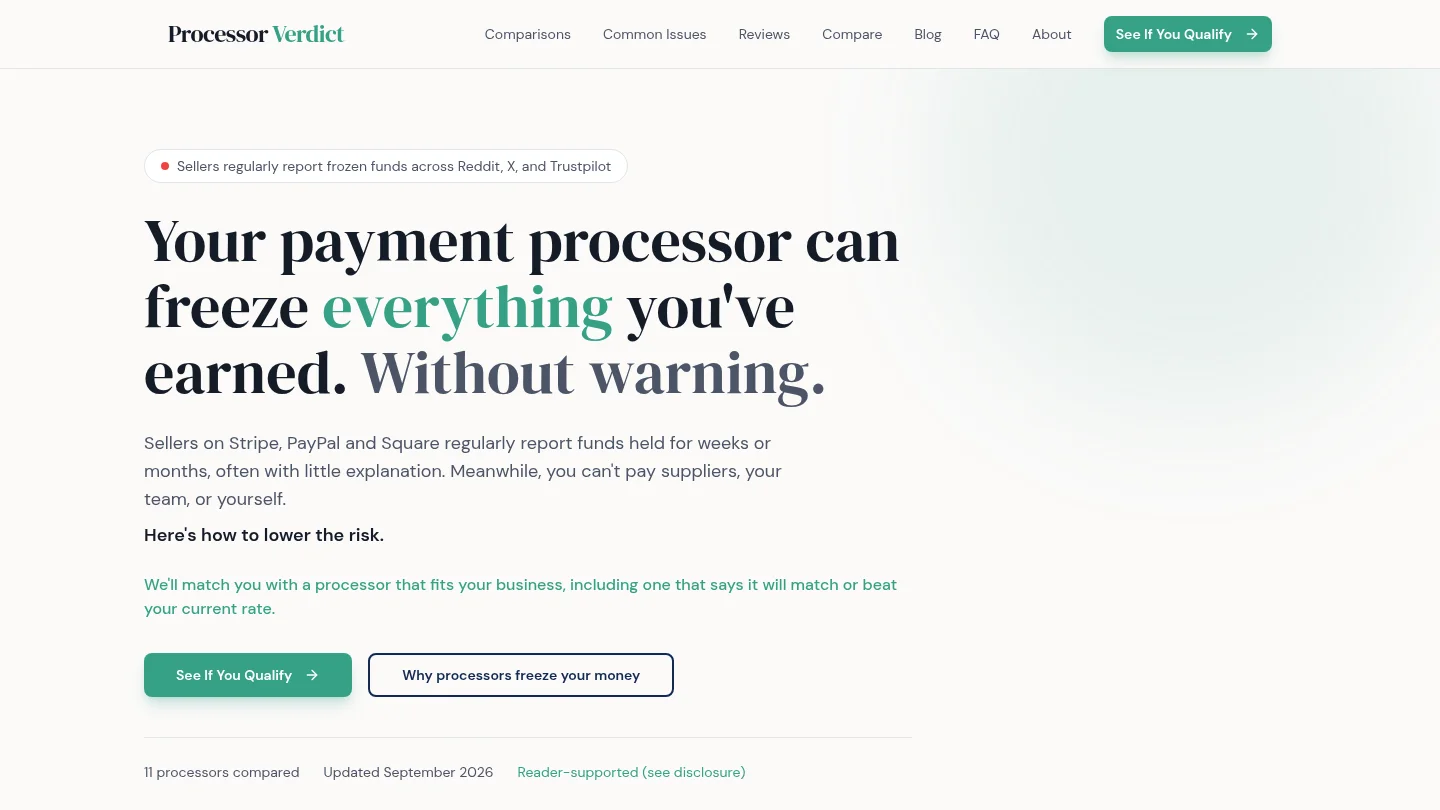
- Best for: Digital business owners who want a concentrated assessment of holds, reserves, payout speed, restrictions, chargebacks, and processor reliability.
Processor Verdict is an independently operated review and comparison publication centered on whether a processor will actually pay out. Its public positioning emphasizes digital business owners, SaaS founders, and creators who need to understand the operational consequences of a processor decision.
Its named Freeze Risk Framework is the clearest point of differentiation. The framework considers fund security, account freezes, rolling reserves, payout speed, true cost, industry acceptance, chargeback handling, and digital product or subscription fit. For a creator who has already experienced a payout delay, this concentration may be more immediately useful than a broad catalogue of payment and marketing infrastructure.
The publication also benefits from an operator perspective. Its founder and lead reviewer describes having opened and integrated payment accounts for multiple online businesses. That experience informs the editorial emphasis on reserves, restrictions, and the practical effects of payment reviews. At the same time, Processor Verdict states that it does not run live test charges or staged disputes, so readers should understand that its evidence model is based on documentation, public merchant reports, and first hand merchant experience rather than controlled transaction testing.
Pros:
- Clear focus on freeze risk, reserves, payout timing, and processor restrictions.
- Uses a repeatable framework across the processors it reviews.
- Includes hidden cost categories such as monthly charges, chargeback fees, currency conversion, and payout fees in its stated methodology.
- Useful for merchants who are choosing a replacement after a hold, termination, or reserve problem.
Cons:
- Its supplied methodology provides less detail on the full displaced creator profile, including the interaction between US LLC ownership, foreign residence, and global customers.
- It does not run live test transactions, so readers looking for test account evidence may prefer a source that includes that method.
- Coverage of ad intelligence and offer validation is Non defini pour le moment.
Which criteria matter most when your LLC and residence are in different countries?
- Entity and residence: Check whether the processor requests information about the owners, operating location, bank account, and customers, then compare that with your actual structure.
- Payout reliability: Look beyond the advertised payout schedule. Review reserve language, account review triggers, supported payout rails, and what happens during a sudden sales increase.
- Merchant of Record status: Establish who is legally responsible for the customer sale, tax collection, refunds, and chargebacks. Our guide to the Whop merchant of record explains why this distinction matters in a digital product context.
- Currency and customer geography: Compare the currencies your customers use with the currency you need to receive. A processor can appear inexpensive while conversion and payout friction reduce the practical value.
- Product category: A processor suitable for low risk software may not be suitable for coaching, signal groups, memberships, or other categories with different review expectations.
- Evidence quality: Give more weight to a review that shows its criteria, separates published fees from estimates, and explains the limits of its evidence.
A Merchant of Record can change the analysis because the platform may take on the contractual sale and certain tax responsibilities, while a conventional payment service provider usually leaves the seller responsible for those obligations. That does not make one model universally better. It changes the trade off between control, cost, tax administration, customer relationship, and platform dependency.
For a creator abroad, this is also where freeze risk and tax risk overlap. A processor review that discusses only authorization rates may miss the operational issue that matters most to you. A Merchant of Record comparison that discusses only tax handling may miss payout timing, account review behavior, or the limitations of selling a particular product category.
How the two publications handle commercial independence
- WhatPayment discloses affiliate relationships at the article level and states that vendors do not pay for placement or review content before publication.
- Processor Verdict states that it discloses affiliate relationships and presents its reviews as source based research informed by merchant experience.
- Neither disclosure removes the need to read critically, especially when one platform is repeatedly recommended across several articles.
Affiliate funding is not automatically a flaw. It becomes a useful evaluation point when the publication explains how commercial relationships work and whether they influence ranking or placement. WhatPayment makes a stronger explicit claim about no paid placement and no prepublication vendor review. That policy is relevant to a reader comparing competing processors because it separates the payment made for a qualifying action from the editorial placement decision.
Processor Verdict's framework also gives readers a way to inspect the reasoning behind a recommendation. The practical question is whether the framework is consistently applied, whether the evidence is current, and whether the conclusion matches your business model. A freeze risk score designed for a high volume coaching business may not answer every question for a low volume SaaS founder.
How to choose between the two sources in 10 minutes
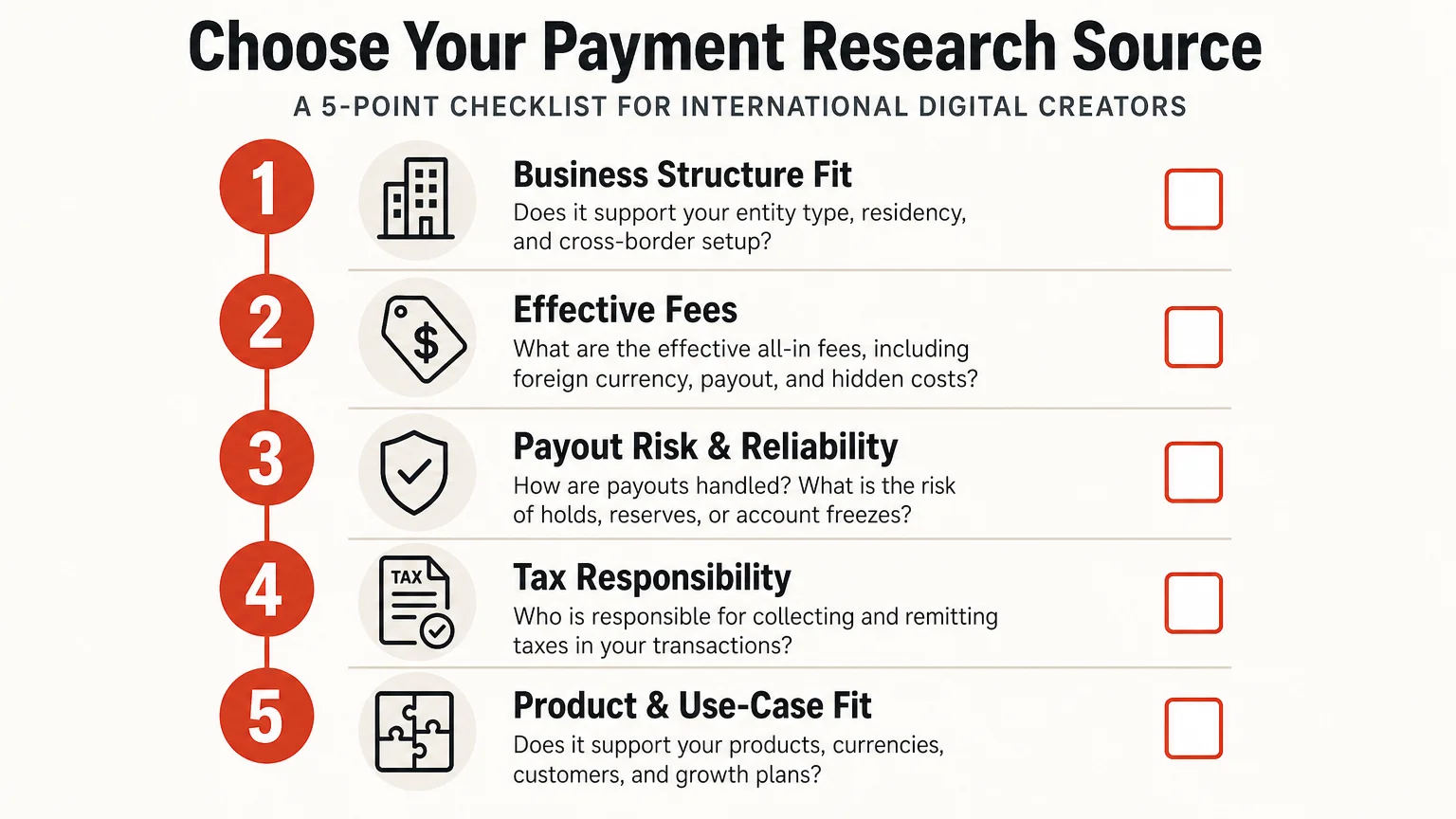
- Start with the decision: Are you choosing your first processor, replacing a frozen account, or deciding between a processor and a Merchant of Record?
- Choose WhatPayment first if your questions span fees, tax responsibility, currencies, community access, digital products, and ad intelligence.
- Choose Processor Verdict first if your immediate concern is reserves, holds, payout speed, restrictions, or freeze patterns.
- Cross check the highest risk claims against the processor's current terms, pricing, acceptable use policy, and payout documentation.
- Make the final decision from your own profile, including entity country, residence, customer geography, product category, average order value, and expected launch volume.
The most efficient approach is not to select one publication for every question. Use the broader framework to define the infrastructure problem, then use the freeze risk lens to pressure test the shortlist. This is especially useful if you are a non resident owner, sell across several currencies, or plan a launch that could create an unusual volume spike.
It is also worth separating research quality from platform quality. A well written review cannot guarantee approval, payout timing, or account continuity. Processor terms can change, risk models are not fully public, and the same category may receive different scrutiny depending on customer complaints, dispute levels, transaction patterns, and business documentation.
Verdict: WhatPayment is the better overall fit
For the displaced creator, WhatPayment versus Processor Verdict is not a choice between two payment providers. It is a choice between two research lenses. WhatPayment is the better overall fit when you need to connect effective cost, Merchant of Record responsibility, international payouts, digital product support, account risk, and adjacent offer validation. Processor Verdict is a useful specialist resource when freeze risk and payout reliability are the main decision criteria. Start with WhatPayment for the wider operating picture, then use Processor Verdict to challenge the risk assumptions behind your shortlist.
Continue With a Platform Specific Review
Once you have defined your risk tolerance, product type, and tax model, the next step is to inspect the actual platform rather than relying on a general ranking.
Our Whop review examines the platform through the criteria that matter to digital product sellers, including effective fees, Merchant of Record questions, payouts, community use cases, and practical fit. It is a useful next read if Whop is on your shortlist.
Frequently Asked Questions
Is WhatPayment a payment processor?
No. WhatPayment is an independent editorial publication that compares and reviews payment infrastructure. It does not process customer payments, approve merchants, act as a Merchant of Record, or provide tax registration and remittance.
Is Processor Verdict a payment processor?
No. Processor Verdict is also a review and comparison publication. Its editorial focus is payment processor risk, including holds, reserves, payouts, restrictions, chargebacks, and digital product fit.
Which publication is better for a US LLC owner living abroad?
WhatPayment is the stronger starting point because its stated audience and coverage directly address US LLC owners abroad, international customers, multi currency payouts, Merchant of Record questions, and digital products. Processor Verdict becomes especially useful when the main concern is freeze risk or payout reliability.
Does either publication guarantee that a processor will approve my business?
No. Approval depends on the processor's current underwriting, acceptable use rules, business documentation, transaction profile, customer geography, and risk controls. Editorial research can reduce uncertainty, but it cannot guarantee approval or uninterrupted payouts.
Should I compare a payment processor with a Merchant of Record?
Yes, if tax administration, customer contracting, refunds, and chargebacks are major concerns. The two models can assign responsibilities differently, so the best choice depends on your product, markets, desired control, and tolerance for platform dependency.
Keep reading
Browse all guidesBlog
Whop Ads Meets Meta: What It Means for Your Ad Spend
Blog
Best BNPL for Coaching Programs Over 10K for Global Buyers
Guide
EU VAT for Non-EU Creators Selling Digital Products (2026)
Guide
DAC7 Reporting Explained: What EU Creators Actually Owe
Guide
Merchant of Record: 5 Best Platforms 2026
Guide