What you'll get
Best BNPL for Coaching Programs Over 10K for Global Buyers
Compare the best bnpl for coaching programs over 10k, including limits, fees, payouts, buyer coverage, and cross-border fit.

Founder & Editor
A $10,000 coaching sale creates a different payment problem from a $500 course purchase. The buyer may need monthly financing, but you need reliable settlement, clear refund obligations, and a checkout that works for customers outside the United States. Our analysis of payment processing for high-ticket mastermind groups follows the same principle: compare the complete payment workflow, not only the financing badge.
For a US LLC owner living abroad, the question is also geographic. A buyer paying in US dollars may still be ineligible because of residency, country, credit history, transaction size, or the platform’s merchant rules. The CFPB describes BNPL as a rapidly expanding form of consumer credit and notes that product terms, fees, and reporting practices differ between providers.
Key takeaways for programs over $10,000
- Whop is the best initial option when you want one digital checkout with several financing routes and access delivery for a one-time offer.
- Stripe is more flexible when you want to select a specific financing provider, preserve your existing checkout, or build a custom payment flow.
- Affirm is one of the clearest high-ticket options, with financing available for purchases up to $30,000 through eligible integrations, subject to approval.
- Practice Better is useful for wellness and service businesses, but most documented BNPL transactions are domestic and cannot be combined with its own payment-plan feature.
- Splitit can help international buyers who already have sufficient available credit on an eligible card, but it does not create new borrowing capacity.
- Never advertise guaranteed approval, immediate unrestricted payout, or universal international availability.
How to choose the best BNPL for coaching programs over 10K
- Start with the offer structure, because one-time programs qualify differently from subscriptions and recurring memberships.
- Check the maximum transaction amount, not the provider’s general marketing range.
- Model the complete seller cost, including processing, financing, currency conversion, refunds, disputes, and payout charges.
- Confirm whether the buyer or the business must be located in a supported country.
- Document how the customer receives course, community, call, or coaching access after approval.
A financing provider usually pays the seller the purchase amount less applicable fees and then collects installments from the customer. The Federal Reserve describes this as the standard merchant model for pay-in-four products, while longer-term installment products can follow different approval and repayment rules. Federal Reserve BNPL overview provides useful context for separating short-term installments from longer financing products.
For coaching, that distinction matters. A four-payment plan may not be enough for a $12,000 mastermind, while a 24 or 36 month loan may create stronger affordability but introduce interest, additional underwriting, and stricter marketing obligations. A provider that supports a $10,000 maximum may also approve only a smaller amount for a particular buyer.
Comparison of the strongest options
| Rank | Platform or provider | Best fit | High-ticket suitability | Cross-border position | Main limitation |
|---|---|---|---|---|---|
| 1 | Practice Better Payments | Wellness, health, and service-led coaching | Supports programs, with transaction limits varying by provider | Mostly domestic BNPL, with limited exceptions | BNPL cannot be combined with Practice Better payment plans |
| 2 | Commas | High-ticket offers requiring several financing partners | Potentially strong, with quote-based partner terms | Most partner coverage is US focused | Fees and payout terms are not publicly defined here |
| 3 | ClarityPay | US buyers needing larger monthly financing | Documented ranges can reach $30,000 through supported access | US and Puerto Rico focus | Not a broad international solution |
| 4 | Splitit | International buyers with existing credit cards | Can cover some purchases above $10,000 | Broader country coverage than many domestic lenders | Requires sufficient existing card availability |
| 5 | Whop | Digital coaching, masterminds, and bundled access | Multiple financing routes, including options above $10,000 | Broad platform reach, provider-specific buyer rules | BNPL and payout terms must be confirmed for the account |
| 6 | Stripe with a financing provider | Custom checkout and processor control | Strongest with a high-ticket option such as Affirm | Depends on the provider and legal entity | More setup and separate delivery or gating work |
1. Practice Better Payments
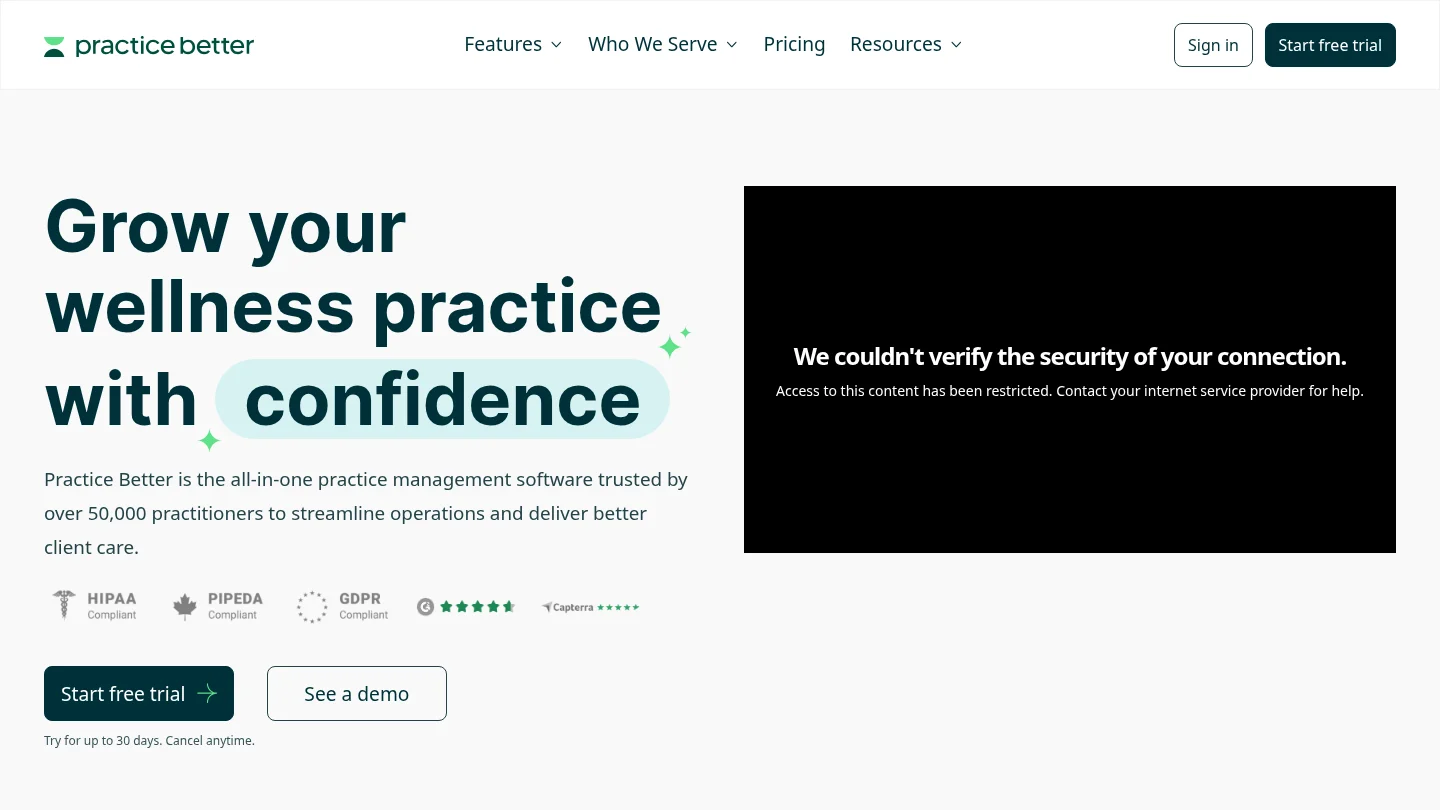
Best for: Wellness coaches, health practitioners, and service businesses that already use Practice Better for client programs.
Practice Better Payments supports Klarna, Affirm, and Afterpay or Clearpay for eligible services, packages, and programs. The documented workflow allows the client to choose a BNPL method after selecting payment in full, while the provider collects future installments. Practice Better states that funds generally arrive within 1 to 5 business days, although the exact timing depends on the payment method and account.
This option is operationally attractive for a coaching practice that needs scheduling, client records, invoices, and program delivery in one environment. It is less suitable for a globally distributed audience. Affirm requires the client’s billing address to be in the same country as the business account, and most non-domestic BNPL transactions are not supported. Klarna has broader cross-border support in specific European business locations, but that does not extend automatically to a US LLC owner abroad.
Practice Better also separates BNPL from its own payment plans. A client generally must choose either the platform’s payment plan or the external BNPL option. For a $12,000 program, that distinction should be settled before the sales process begins.
Pros:
- Strong operational fit for wellness and practitioner-led coaching.
- Supports several recognizable BNPL providers.
- Provider collection reduces routine installment administration.
- Program access and payment workflows can stay close together.
Cons:
- International buyer coverage is limited for a US-based business.
- BNPL cannot be combined with Practice Better’s own payment plans.
- Fees vary by provider and account currency and are Non defini pour le moment here.
2. Commas

Best for: High-ticket coaching and education sellers who want several financing partners evaluated together.
Commas is relevant when a single lender is unlikely to cover the full price or audience of your offer. The available topic evidence describes financing partners including ClarityPay, Payva, Klarna, PayPal, Credit Key, Climb, Zip, Sezzle, Sunbit, and Special Financing Company. That mix includes consumer, education, and B2B-oriented routes, which may help a coaching business test more than one buyer profile.
The main weakness is transparency. Platform pricing is quote-based, and each financing partner may have separate approval rules, seller fees, payout timing, refund treatment, and contractual obligations. A sales team should not state that a buyer can finance the entire program until the written terms confirm the amount and repayment structure.
Commas is also more naturally suited to a one-time purchase than a recurring coaching subscription. If your program is sold as an enrollment fee followed by separate recurring payments, only the eligible one-time component may qualify.
Pros:
- Multiple financing partners can broaden the range of possible buyer approvals.
- Relevant to high-ticket coaching and education offers.
- Potentially useful when one provider’s transaction ceiling is too low.
Cons:
- Pricing and seller economics are quote-based.
- Most partner coverage is described as US focused.
- Financing eligibility for a specific coaching offer requires direct confirmation.
3. ClarityPay
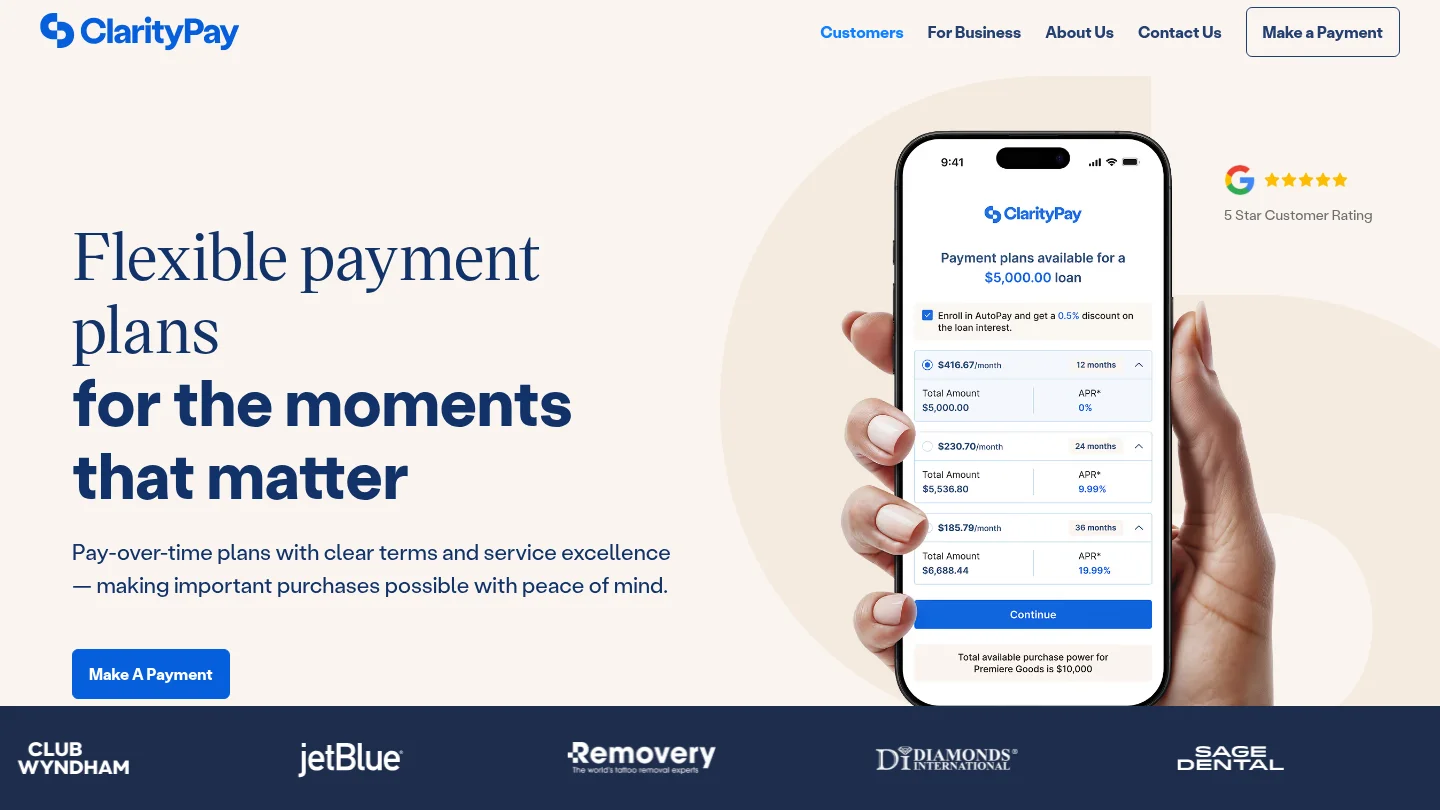
Best for: US buyers seeking a structured monthly financing plan for a larger one-time coaching purchase.
ClarityPay is one of the more relevant financing providers for the price range because supported options can reach $30,000, with terms up to 36 months in the documented Whop financing information. A separate no-interest option is described with a lower maximum and a shorter maximum term. These distinctions matter because the buyer’s payment may be interest-bearing or interest-free depending on qualification and product availability.
ClarityPay is not a complete international answer. Its documented coverage centers on the United States and Puerto Rico, so it cannot serve a customer base spread across Europe, Asia, Africa, and Latin America by itself. It works better as one route inside a multi-provider checkout than as the only financing button.
Pros:
- Transaction limits are relevant to programs above $10,000.
- Longer terms can make a premium one-time offer easier to finance.
- Can complement a broader checkout with other regional providers.
Cons:
- Geographic coverage is narrow for international coaching businesses.
- Seller fees and payout details are Non defini pour le moment without account-specific terms.
- Approval still depends on the buyer and the individual purchase.
4. Splitit
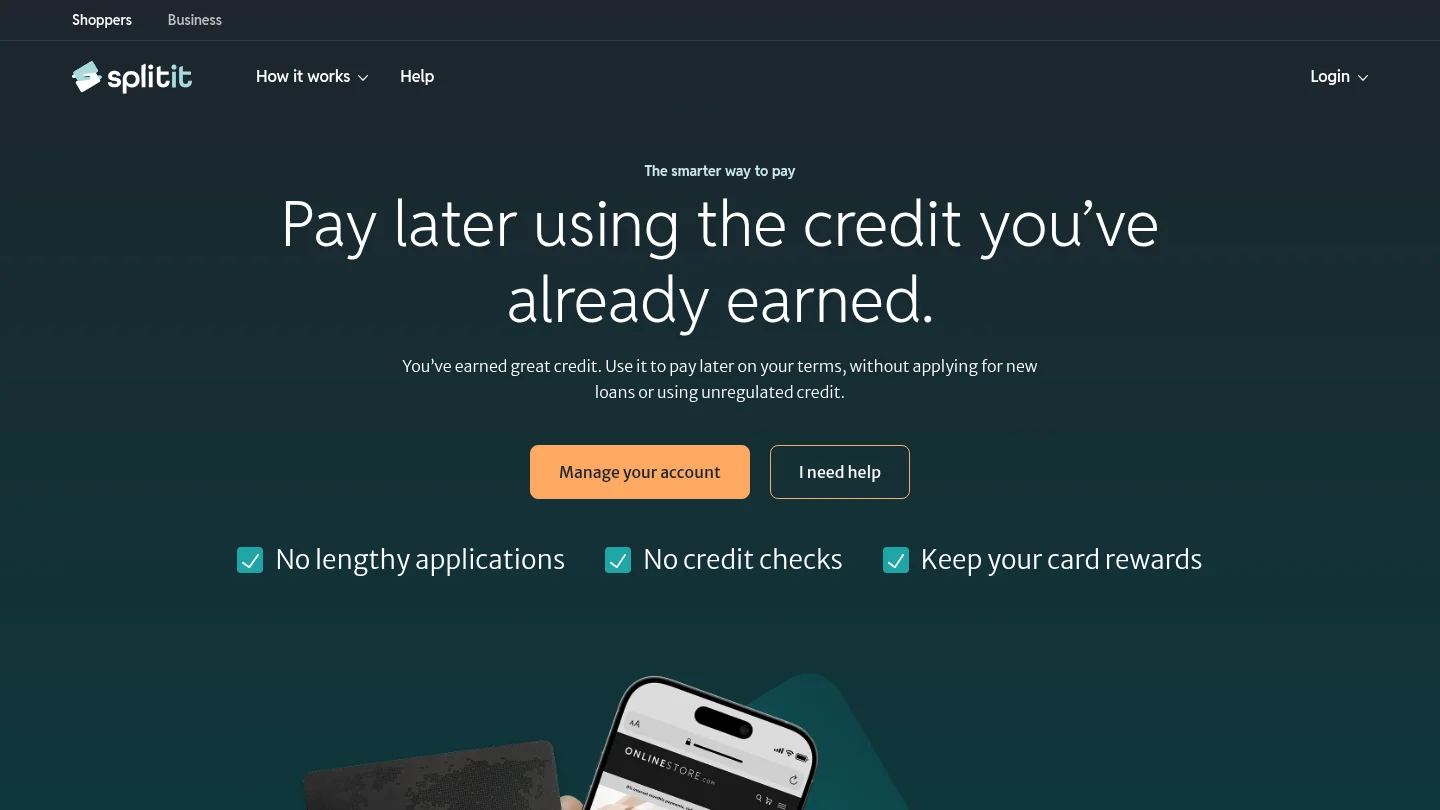
Best for: International buyers who already have an eligible credit card with enough available capacity.
Splitit differs from conventional BNPL because it uses the buyer’s existing card rather than opening a new loan account. That can reduce the friction of a new credit application and may be useful for buyers in countries where consumer financing options are limited. The trade-off is important: the buyer must already have enough available credit for the purchase authorization.
For a $10,000 coaching program, Splitit can be relevant when the buyer has the required credit capacity and wants installments without a separate credit inquiry. It is not a solution for a buyer who cannot afford the full authorization hold. It also does not remove your responsibility to explain refunds, access, delivery, and dispute procedures.
Pros:
- Can support international buyers in more countries than some domestic lenders.
- Does not require a new credit account or separate credit application.
- Can fit high-AOV digital offers when the buyer has sufficient card availability.
Cons:
- Requires an existing eligible credit card, not a debit card or insufficient credit line.
- Available term length and seller economics vary by setup.
- Financing does not create additional purchasing power for the buyer.
5. Whop
Best for: Digital coaching businesses that want checkout, course delivery, community access, and financing in one operating environment.
Whop is the strongest overall starting point when the coaching offer is a one-time digital purchase rather than a recurring subscription. Its financing ecosystem includes several providers with different transaction limits and repayment terms, which is more useful than relying on a single pay-in-four product for a $10,000 or $15,000 program. The platform can also connect payment with digital delivery and access management, reducing the number of separate systems a displaced creator must coordinate.
Whop’s core processing fee is 2.7% plus $0.30 per transaction, roughly 3% effective before other applicable charges. The BNPL-specific financing cost is Non defini pour le moment in this comparison because current documentation and provider terms can differ by financing route. That cost should be shown separately in your margin model rather than hidden inside a general processing estimate.
For a US LLC owner living abroad, Whop is attractive because the platform is designed around digital products and international online selling. It does not make every buyer eligible, however. Financing access depends on the provider, transaction size, business category, dispute history, customer location, and whether the product is structured as a one-time purchase.
Pros:
- Several financing routes can be evaluated in one digital checkout.
- Suitable for courses, masterminds, paid communities, and other digital access products.
- One-time checkout can connect payment with delivery and access workflows.
- Core processing is clearly defined at 2.7% plus $0.30.
Cons:
- Subscriptions and recurring memberships are not the same as BNPL-enabled one-time purchases.
- Provider-specific limits and financing fees must be confirmed before advertising the option.
6. Stripe with a financing provider
Best for: Coaches who already operate a custom Stripe checkout or want direct control over payment-method selection.
Stripe is a strong alternative when your business already has a website, sales funnel, CRM, and access system. It can support financing methods such as Affirm, Afterpay, Klarna, and other provider connections, but the exact availability depends on the business entity, country, customer location, product category, and integration model.
For a program priced above $10,000, the high-ticket option matters more than the familiar brand name. Affirm is the clearest example because its Stripe integration supports online and in-store purchases up to $30,000, with financing terms that can extend to 36 months for eligible customers. That does not mean every coaching offer or buyer will qualify. Approval and the available plan are determined during checkout.
Stripe usually requires more operational work than an all-in-one creator platform. You may need separate course hosting, community gating, fulfillment automation, refund workflows, and customer support procedures. That trade-off can be worthwhile if you already have those systems or need a custom branded checkout.
Pros:
- Good fit for custom checkout and existing payment infrastructure.
- Can provide access to high-ticket financing through eligible providers.
- Useful for businesses that need granular control over payment methods and reporting.
Cons:
- Financing does not automatically solve course delivery or community access.
- Merchant eligibility and provider terms vary by country and business model.
- Provider fees for a specific coaching transaction are Non defini pour le moment without an account-specific quote.
What displaced creators should verify before enabling BNPL
- Confirm that the legal seller, payout account, and customer-facing entity are consistent.
- Ask whether the provider supports buyers based on residency or only payment currency.
- Request the exact seller fee, fixed fee, refund treatment, and payout schedule in writing.
- Check whether a delayed program start date can trigger reserves or additional review.
- Explain the buyer’s total repayment amount, APR where relevant, and payment schedule.
A US LLC owner living outside the United States should not assume that a US bank account solves cross-border eligibility. Country of residence, entity location, invoice currency, customer address, and the provider’s underwriting rules can all affect the payment method shown at checkout. This is also why a Merchant of Record decision remains separate from a BNPL decision. Financing may help the buyer pay over time, but it does not automatically transfer tax, refund, or delivery responsibilities away from the seller.
Keep your access rules equally clear. If a buyer receives immediate access to a course, community, calls, or coaching materials, define what happens after a refund, dispute, or cancellation. The Federal Trade Commission advises businesses and consumers to review fees, credit reporting, missed-payment consequences, and dispute procedures before using BNPL. FTC BNPL guidance is useful when preparing customer-facing disclosures.
How to model the real cost of a $10,000 program
- Start with the program price and subtract the core processing fee.
- Add any BNPL financing fee or provider surcharge.
- Add international card, currency conversion, payout, or dispute costs where applicable.
- Estimate the cost of refunds and access already delivered.
- Compare the net cash collected with the conversion lift required to justify financing.
For example, a provider that charges a higher seller fee may still be commercially useful if it converts qualified buyers who would otherwise abandon the purchase. The correct comparison is not “lowest fee wins.” It is the net contribution after financing cost, refunds, chargebacks, payout delays, and completed delivery.
Do not treat BNPL as harmless merely because the buyer sees a smaller installment. The Federal Reserve reported that BNPL users can face late fees and overdraft or non-sufficient funds charges when automatic payments exceed available funds. That makes transparent pricing and responsible sales messaging part of the operational decision, not only a compliance detail.
Where payment infrastructure fits in the wider stack
- BNPL can reduce payment friction, but it does not validate the coaching offer.
- Ad intelligence can help evaluate competitors, creative angles, and offer positioning.
- Checkout, delivery, CRM, access control, and dispute handling still need defined ownership.
- High-volume sellers should compare processor routing, payout reliability, and account review exposure.
If your business grows beyond $100,000 per month, the decision becomes broader than financing. You may need stronger processor redundancy, clearer payout controls, and better documentation for account reviews. Our guide to payment processors for coaching businesses over $100k per month addresses that operating stage separately from the BNPL decision.
Verdict
Whop is the best first option for most one-time digital coaching programs above $10,000 when you want multiple financing routes, digital delivery, and access management in one environment. Stripe is the better alternative when you already own a custom stack or want direct control over the processor relationship. Practice Better is more focused, and it makes the most sense for wellness and practitioner-led coaching. Commas and ClarityPay deserve consideration when high-ticket approval is the priority, while Splitit is useful for international buyers with existing card capacity.
Before publishing a financing claim, verify the exact transaction limit, buyer country, seller fee, payout timing, refund rules, and access consequences. The right BNPL option is the one that improves affordability without making your margin, compliance position, or delivery workflow unclear.
Compare BNPL Options Before You Commit
High-ticket coaching financing changes more than the button shown at checkout. It affects effective fees, payout timing, buyer eligibility, tax responsibility, and the way access is delivered after payment.

We compare payment platforms for coaches, creators, and digital-product businesses using fee analysis, public documentation, use-case fit, payout behavior, and operational criteria. Explore our guide to the best BNPL options for high-ticket coaching before choosing a financing workflow.
Frequently Asked Questions
Can a buyer finance a coaching program over $10,000?
Yes, some financing products support purchases above $10,000, but the available amount depends on the provider, buyer, business category, country, and individual approval. A displayed provider does not guarantee that the full program price will be financed.
Which BNPL option is best for international coaching buyers?
There is no universal winner. Splitit may fit buyers with sufficient existing card capacity, while a multi-provider platform can offer more regional routes than a single domestic lender.
Does BNPL mean the coach gets paid immediately?
Often, the seller receives the purchase amount less applicable fees before the buyer completes all installments. The exact settlement schedule, reserves, and payout conditions depend on the platform and financing agreement.
Can I use BNPL for a coaching subscription?
Usually, BNPL access is designed for a one-time purchase rather than recurring billing. If your coaching offer includes both an enrollment fee and a subscription, confirm which component is eligible before presenting financing.
What should I disclose when offering BNPL?
Explain the full program price, available payment schedule, interest or fees where applicable, eligibility conditions, refund policy, and access consequences. Do not promise approval or describe financing as cost-free unless the applicable terms clearly support that statement.
Keep reading
Browse all guidesBlog
The Night Stripe Froze My $35,000 MRR Business
Blog
Whop Ads Meets Meta: What It Means for Your Ad Spend
Alternatives
Best Stripe Alternatives 2026: 8 Platforms for Digital Creators
Alternatives
Best Gumroad Alternatives in 2026: One Is Now Part of Stripe
Alternatives
Best Platform to Sell Digital Products: 6 Picks for 2026
Alternatives