What you'll get
Best Payment Gateways for Notion Templates, Digital Assets
Compare best payment gateways for selling notion templates and digital assets, with fees, tax duties, payouts, and delivery tradeoffs.

Founder & Editor

For a US LLC owner living abroad, choosing between the best ecommerce payment processors is not only a question of card acceptance. The right setup must also handle digital delivery, refunds, foreign customers, payout reliability, and the relationship between your US entity and your country of residence.
The main decision is whether you want to remain the legal seller through a payment processor or use a Merchant of Record that takes on stated tax and selling responsibilities. The European Commission describes the EU One Stop Shop as an electronic portal for VAT obligations on cross-border consumer sales, which illustrates why international digital commerce requires more than a checkout button. EU VAT OSS guidance should be treated as background information, not as a substitute for advice on your specific structure.
The short answer for a US LLC selling worldwide
- Easytools is the strongest option when you want checkout, delivery, and customer data connected to your own Stripe account.
- Notion Marketplace is the clearest native option if discovery inside Notion matters more than the lowest possible fee.
- Fungies is the most direct fit when you prefer a Merchant of Record to handle VAT, sales tax, GST, and digital delivery.
- Whop is attractive for products bundled with communities, memberships, or other creator offers, with fees of 2.7% plus $0.30 per transaction, roughly 3% effective in common cases.
- Payhip, Gumroad, and Lemon Squeezy can work, but current fee, payout, or tax details should be confirmed before you migrate an established catalog.
The figures below come from provider pricing or seller documentation where available. If the available evidence does not establish a current amount, the table uses Non defini pour le moment rather than treating missing information as a zero fee.
| Rank | Platform | Current fee evidence | Tax model | Template delivery and control | Best operational fit |
|---|---|---|---|---|---|
| 1 | Easytools | 5% on the free plan, paid plans from $59 per month with 1% to 2% commission, Stripe fees separate | Usually not a Merchant of Record | Checkout links, PDF instructions, direct Notion links, and customer portal | Creators who want control through their own Stripe account |
| 2 | Notion Marketplace | 8% plus $0.40 per transaction, with an additional 1% foreign exchange fee for some non US payouts | Notion is the Merchant of Record for Marketplace sales | Native listing, access locking, analytics, and template delivery | Creators prioritizing Notion discovery |
| 3 | Fungies | 5% plus $0.50 per transaction on the current official homepage | Merchant of Record model with stated VAT, sales tax, and GST handling | Digital downloads, hosted storefronts, and instant delivery | International sellers seeking outsourced compliance |
| 4 | Whop | 2.7% plus $0.30 per transaction, roughly 3% effective in common cases | Confirm current responsibility for the specific product and seller structure | Strongest fit for products connected to communities or memberships | Creators combining assets with recurring access |
| 5 | Payhip | Non defini pour le moment | Non defini pour le moment in the evidence used here | Digital storefront and download delivery | Beginners seeking a simple storefront |
| 6 | Gumroad | Non defini pour le moment for this comparison | Confirm the current Merchant of Record scope and tax terms | Marketplace discovery and digital product delivery | Creators who value simplicity and marketplace reach |
| 7 | Lemon Squeezy | Non defini pour le moment for this comparison | Merchant of Record model, subject to current eligibility and terms | Digital product and software oriented checkout | Sellers with software or license based products |
1. Easytools
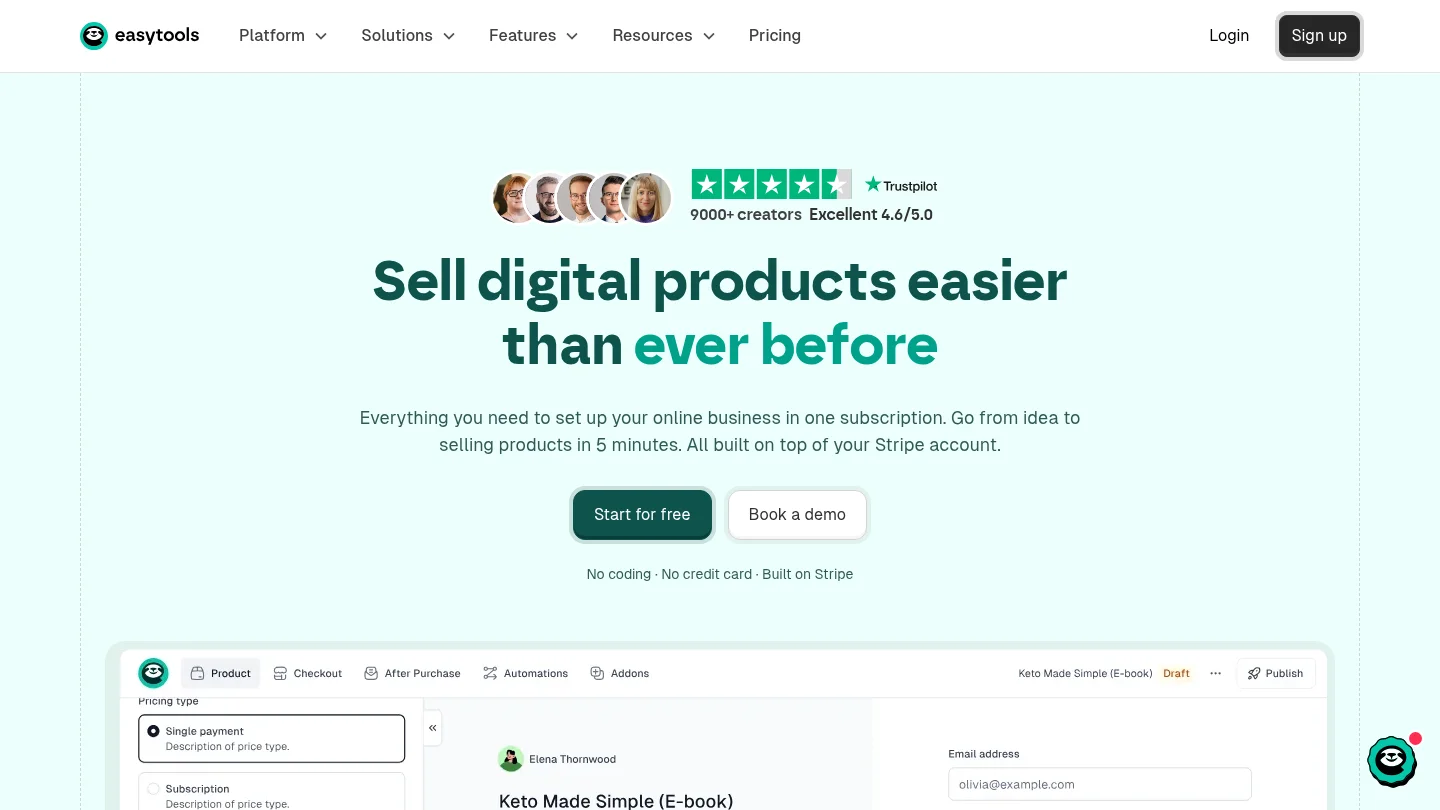
Best for: Creators who want to sell Notion templates while keeping their payment account, customer data, and payout relationship in their own Stripe setup.
Easytools is the strongest control oriented option in this comparison. Its Notion template material describes checkout links, customizable sales pages, one time payments, subscriptions, payment plans, pay what you want pricing, PDF instructions, direct template links, confirmation emails, and a customer portal. That makes it more than a payment button. It is a selling layer around a processor that can connect the purchase to delivery and access.
The tradeoff is tax responsibility. Easytools is usually not a Merchant of Record, so your company remains responsible for understanding where registration, collection, filing, and remittance apply. That may be preferable for a creator who wants to preserve direct customer ownership, but it requires more discipline than handing the full legal selling role to another platform.
Pros:
- You keep the Stripe account and the associated customer relationship rather than moving the entire commercial relationship to a marketplace.
- The free plan uses a 5% commission, while the supplied official pricing material lists paid plans from $59 per month with lower commission rates of 1% to 2%, with Stripe processing fees separate.
- Digital delivery can include a PDF with instructions, a direct Notion link, an email, and a customer portal.
Cons:
- You remain responsible for the tax and compliance decisions that come with selling internationally.
- It does not provide the same native Notion Marketplace discovery as Notion's own platform.
2. Notion Marketplace
Best for: Template creators who want their products listed where Notion users already search for templates.
Notion Marketplace is not a general purpose gateway, but it is a serious native sales channel for Notion templates. Notion's official seller documentation states that Stripe processes payments, while Notion acts as the Merchant of Record. The same documentation lists an 8% fee plus $0.40 per transaction, regional tax or VAT handling by Notion, and creator responsibility for income taxes.
The platform also gives sellers access locking, template analytics, coupon tools, and optional customer email collection. Payouts are initiated biweekly on Thursdays, require a minimum balance of $20, and funds are held for 14 days before becoming eligible for payout. Those terms matter if your business depends on predictable cash flow or if you need to fund advertising from recent sales.
Pros:
- Native discovery can reduce the need to send every buyer from social media to an external checkout.
- Notion handles regional sales tax or VAT for direct Marketplace sales under its stated Merchant of Record model.
- Access locking can reduce simple redistribution between workspaces.
Cons:
- The fee is higher than a low cost processor in many transaction scenarios.
- Funds are subject to a 14 day hold, a minimum payout balance, and possible refund or chargeback deductions.
- Creators outside the United States may face a 1% foreign exchange fee when payouts are converted from US dollars.
3. Fungies
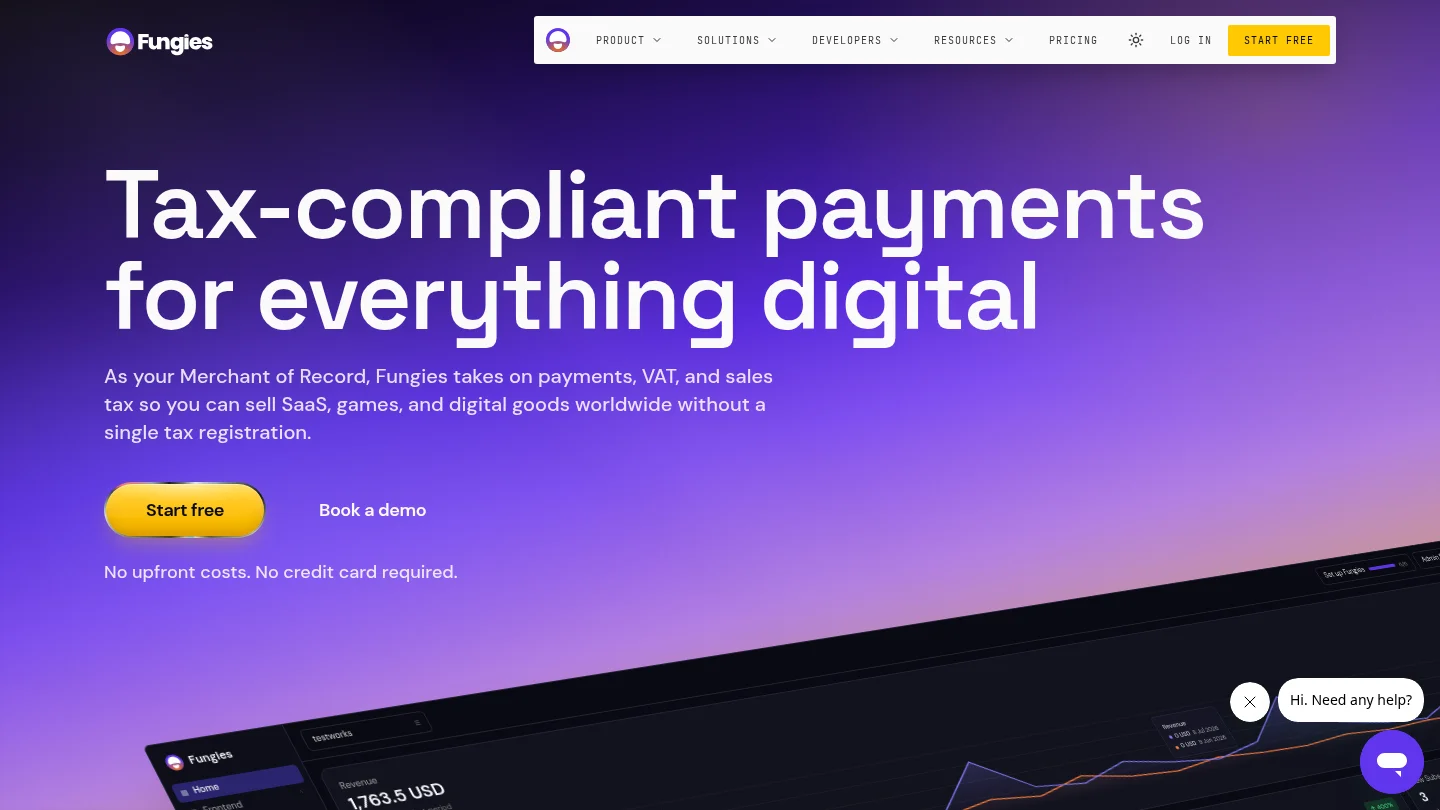
Best for: International digital sellers who prefer a Merchant of Record model and want tax handling bundled with storefront and delivery features.
Fungies is the most compliance oriented choice in the ranking. Its current official homepage presents the platform as a Merchant of Record for digital products and states that it handles VAT, US sales tax, and GST under its own registrations. It also presents a 5% plus $0.50 transaction fee, digital downloads, subscriptions, hosted storefronts, multiple payment methods, and daily payouts as the default option.
This model can be useful for a displaced creator whose customers are spread across countries and whose main priority is reducing administrative work. It also introduces platform dependency. Your revenue first moves through the Merchant of Record relationship, and the platform's acceptance, reserves, refunds, and compliance decisions become important business risks. Confirm eligibility for your exact products and residence before committing a large catalog.
Pros:
- The Merchant of Record structure can reduce the need for the seller to manage every consumer tax registration directly.
- The official homepage states a 5% plus $0.50 transaction fee with no monthly minimum in the described model.
- Digital products can be delivered immediately after payment through a hosted selling flow.
Cons:
- You accept less direct control over the legal selling relationship and the timing of funds.
- The fee is materially higher than a low rate processor when the transaction value is small.
4. Whop
Best for: Creators selling templates as part of a broader offer that includes a community, membership, course, or recurring access.
Whop is more naturally suited to creator ecosystems than to a single downloadable Notion template. It can make sense when the template is one component of a larger offer, such as a paid community with resources, recurring updates, or member only access. The current fee position for this comparison is 2.7% plus $0.30 per transaction, roughly 3% effective in common cases. Older references describing Whop as costing around 6% should not be used.
The main question for a pure template seller is delivery and ownership. Before choosing Whop, verify how a Notion link, downloadable asset, refund, customer email, and access revocation are handled for your exact product. The platform may be stronger for discovery and community monetization than for a minimal, brand controlled template store.
Pros:
- The fee position is competitive for many digital transactions, especially compared with higher percentage marketplace models.
- The platform is relevant when a template is bundled with community access or recurring content.
- Marketplace discovery can provide an additional acquisition channel.
Cons:
- Notion specific delivery and access control require confirmation for the exact seller workflow.
- It may add unnecessary community infrastructure if you only sell individual downloads.
5. Payhip
Best for: Beginners who want a simple digital storefront without building a complete ecommerce system.
Payhip is relevant to Notion template sellers because its core positioning covers digital downloads and creator storefronts. It can be a practical starting point when you want to upload a file, present a product page, and deliver a purchase without custom development.
For a US LLC owner living abroad, however, the important questions are not answered by simplicity alone. The current transaction fee, payout mechanics, Merchant of Record status, foreign exchange treatment, and country eligibility are Non defini pour le moment in the evidence used for this article. Treat that as a verification task, not as proof that the platform is expensive or inexpensive.
Pros:
- The storefront model is accessible to sellers without advanced technical skills.
- It is designed for digital products rather than physical fulfillment.
Cons:
- Current fee and tax terms need direct confirmation before an international launch.
- It offers less documented evidence here about the specific requirements of a nonresident US LLC owner.
6. Gumroad
Best for: Creators who value a familiar digital product marketplace and straightforward publishing.
Gumroad remains a recognizable option for selling downloads, templates, and other creator products. Its marketplace model can help with discovery, while its product publishing workflow is generally easier to understand than assembling a processor, storefront, delivery tool, and customer portal separately.
The difficulty is that fee and tax descriptions have changed over time, and the evidence used here does not establish a complete current fee schedule for your exact transaction profile. If you are moving an established business from a processor based setup, compare direct fees, international payment costs, payout timing, refunds, customer data access, and the current Merchant of Record terms instead of relying on older articles.
Pros:
- It is familiar to many digital creators and supports marketplace style product discovery.
- It can reduce the technical work required to publish and deliver a digital product.
Cons:
- Current fees and tax treatment should be confirmed directly before calculating margins.
- Marketplace convenience may provide less control than selling through your own processor account.
7. Lemon Squeezy
Best for: Sellers whose digital assets are connected to software, licenses, or subscription based products.
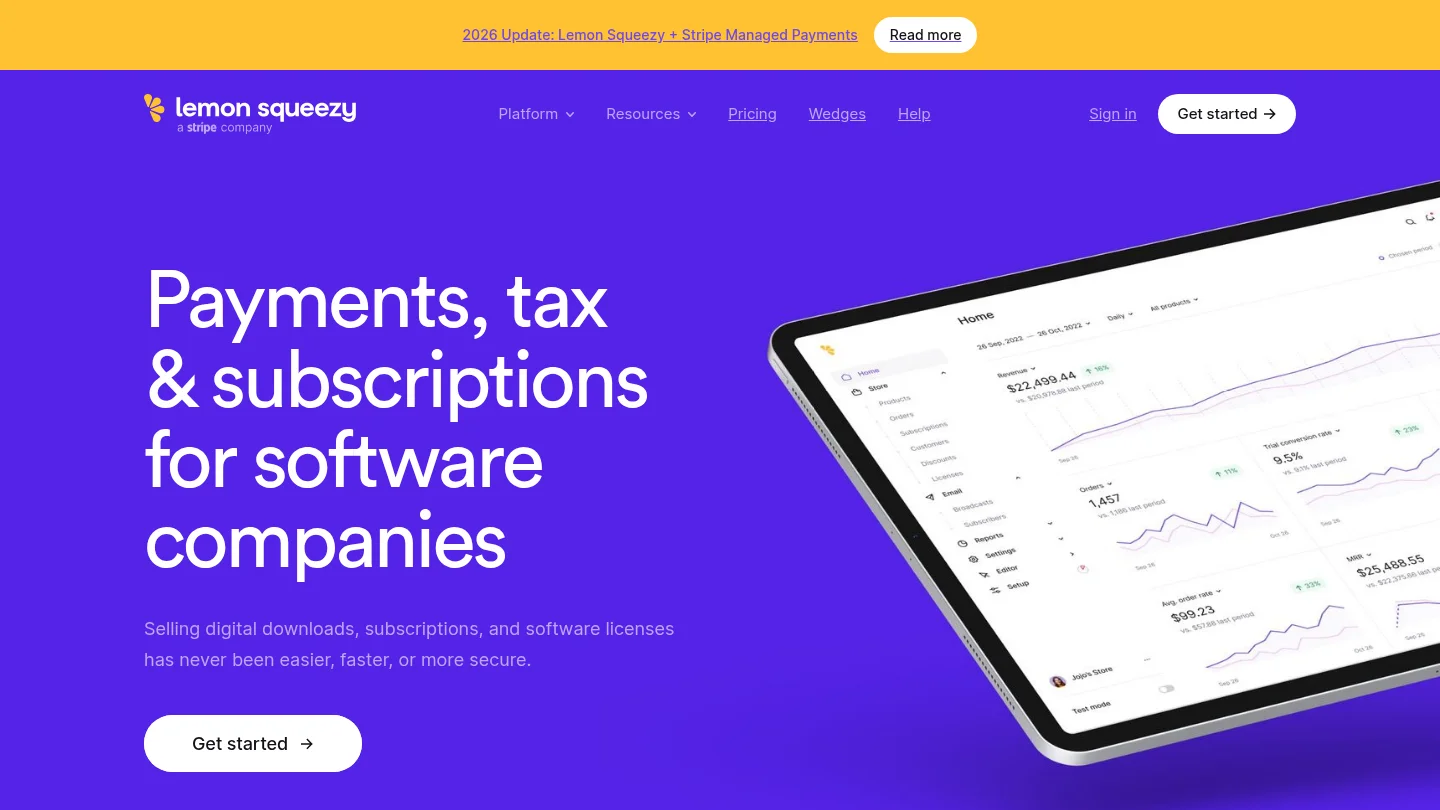
Lemon Squeezy is most naturally associated with software and digital commerce infrastructure. Its Merchant of Record positioning can be useful for a seller who wants another company to manage stated payment, tax, and compliance responsibilities. It becomes less obviously suited to a simple Notion template unless you also sell software, license keys, or recurring access.
The current fee, payout schedule, foreign exchange costs, and exact eligibility for your business profile are Non defini pour le moment in the evidence used here. Confirm those terms directly, particularly if your customers pay in several currencies or if you live outside the United States while operating through a US LLC.
Pros:
- The Merchant of Record model can simplify tax administration for eligible digital businesses.
- Its software oriented positioning may fit digital assets that include licensing or recurring access.
Cons:
- It may be more infrastructure than a standalone Notion template seller needs.
- Current costs and payout conditions require direct verification for this use case.
What matters beyond the headline transaction fee?
- Compare the total effective cost, including processor fees, platform commissions, currency conversion, payouts, subscriptions, refunds, and chargebacks.
- Separate Merchant of Record convenience from payment processor control, because the two models place tax and customer responsibilities in different hands.
- Check whether the platform delivers a Notion link securely, sends a file, provides a customer portal, or requires an external access system.
- Review payout timing, minimum balances, reserve policies, refund windows, and account review procedures before sending paid traffic.
- Confirm that your legal entity, residence, bank account, product category, and customer countries are accepted together.
A US LLC does not automatically settle every cross border question. The IRS explains that a foreign owned US disregarded entity can have specific information reporting obligations when reportable transactions exist, including Form 5472 procedures in relevant cases. IRS Form 5472 guidance is therefore useful context, but it does not determine your state, foreign country, or indirect tax obligations.
For European customers, the destination of the customer and the nature of the digital supply can affect VAT treatment. The OECD's international framework emphasizes destination based principles for cross border supplies of services and intangibles, which is one reason a Merchant of Record can be attractive even when its percentage fee is higher. OECD VAT guidelines provide useful background, but local rules and professional advice remain necessary.
Our guide to merchant of record for digital products explains the difference between outsourcing the legal sale and using a payment service provider. If Stripe is unavailable for your situation, our guide to sell digital products without Stripe is a better next step than choosing a replacement based only on a headline percentage.
Where ad intelligence fits for infopreneurs
- Ad intelligence tools can help validate whether an offer, angle, or creative appears repeatedly in the market.
- They do not prove that a payment processor will approve your company, product, residence, or customer mix.
- They do not replace margin calculations that include taxes, refunds, disputes, currency conversion, and payout delays.
- Tools such as Minea and Pipiads should be judged separately from payment infrastructure, because offer validation and payment acceptance solve different problems.
For an infopreneur, the practical sequence is to validate the offer, estimate acquisition economics, select the payment model, and then test delivery and refunds. A winning advertisement can still lead to an unprofitable product if the checkout adds a high fixed fee, the platform collects tax that was not included in the price, or payouts arrive after the advertising bill is due.
Verdict
The best payment gateways for Notion templates and digital assets depend on the control you want to keep. Choose Easytools when your priority is your own Stripe relationship, customer ownership, and a connected delivery flow. Choose Notion Marketplace when native discovery and access locking justify its fee and payout conditions. Choose Fungies when outsourced tax handling is more valuable than direct control. Whop is worth considering for community led offers, while Payhip, Gumroad, and Lemon Squeezy require a fresh review of current terms. For a US LLC owner abroad, eligibility, tax responsibility, payout reliability, and total effective cost matter more than a simple percentage.
Compare payment infrastructure before you launch
Choosing a checkout for a global digital product business requires more than comparing advertised rates. The right comparison should account for Merchant of Record status, tax responsibility, currency conversion, payouts, refunds, chargebacks, account reviews, customer access, and the difference between marketplace discovery and owned demand.

We compare payment platforms through effective all in fee analysis, public documentation, test accounts, creator feedback, use case criteria, and quarterly review. Read our best platform to sell digital products analysis before committing your catalog or advertising budget.
Frequently Asked Questions
Is Notion Marketplace a payment gateway?
Not exactly. It is a native marketplace and selling channel that uses Stripe for payment processing while Notion acts as the Merchant of Record for direct Marketplace sales.
Should a nonresident US LLC owner use a Merchant of Record?
It depends on whether reducing tax administration is more important than keeping direct control of customers, payouts, and the legal selling relationship. Confirm eligibility, tax treatment, and payout terms for your exact entity and residence before deciding.
Can I sell the same Notion template on several platforms?
Platform terms can differ, and Notion Marketplace may require a separate template and Notion Site setup when the same asset is sold through a third party. Check the current listing and access rules before duplicating a catalog across channels.
Which fee matters most for a digital product seller?
The most useful figure is the total effective cost after percentage fees, fixed fees, currency conversion, payouts, refunds, taxes, and other applicable charges. A lower headline rate can still produce a higher cost when the fixed fee is large relative to the product price.
Do ad spy tools replace payment testing?
No. Ad intelligence tools can help with offer validation and creative research, but they do not establish payment eligibility, tax responsibility, delivery reliability, or chargeback exposure.
Keep reading
Browse all guidesBlog
Best Payment Processor in 2026 for Global Digital Businesses
Blog
Spectrum Online Payment: Bill Pay or Digital Creator Processor?
Review
Payhip Review 2026: When It Beats the Giants
Review
Sellfy Review 2026: Niche, But Genuinely Defensible
Review
ThriveCart Review 2026: Is the Lifetime Deal Worth It?
Review